What Is Philosophy and Where Did It Come From?
TL;DR
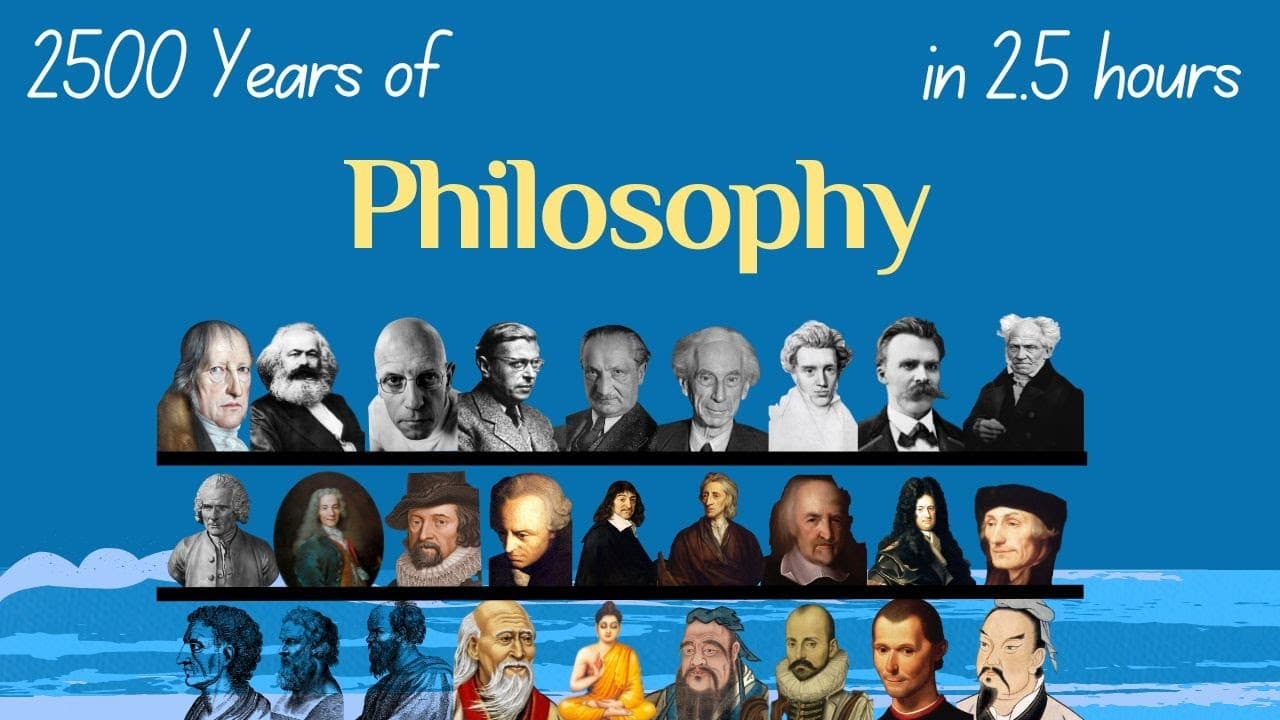
Philosophy began as humanity’s attempt to answer what exists and how we know it. The video traces 2500 years of ideas across Eastern and Western traditions, exploring major questions, terms, and thinkers. It ends with contrasts between life purposes such as knowledge and happiness and the future of philosophy.
Transcript
In this video, I will tell you the story of human philosophy encompassing an incredible 2500 years of philosophical history. By the end of this video, you will know all the basic philosophical ideas, schools and approaches, as well as some of the most influential philosophers from around the world. The video has 4 major parts and each with 2 or 3 s... Read More
Key Insights
- Philosophy is defined as the love of wisdom rooted in rational thinking.
- Humans navigate life with three tools: instincts, emotions, and reason.
- Philosophy arose from attempts to explain reality and knowledge without relying on the supernatural.
- There is a contrast between Eastern and Western philosophy, emphasizing spirituality versus rationality.
- Historical figures highlighted include Socrates, Plato, Aristotle, Buddha, Lao Tzu, and Confucius.
- The content is structured into four parts with sections like chapters in books.
- Philosophy seeks to answer questions about the purpose of life and civilization.
- Two major pillars of philosophy are what is out there and how we know it.
Install to Summarize YouTube Videos and Get Transcripts
Explore YouTube Video Summarizer or Get YouTube Transcript Extractor
Questions & Answers
Q: How did philosophy originate according to the video
Philosophy originated as humans sought rational explanations for the world around them, moving away from reliance on gods and supernatural stories. The video explains that early thinkers replaced myth with reason to ask what is real and how we know it, laying the groundwork for a systematic discipline that would grow across cultures and eras.
Q: What are the three basic human tools discussed in the video
The video identifies three core tools humans possess to navigate life: instincts, emotions, and reason. Instinct drives basic needs like food, sex, and companionship; emotions provide motivation and adaptation to changing environments; reason enables rational, long term planning and scientific progress, shaping civilization and knowledge.
Q: What is the difference between Eastern and Western philosophy as described
Eastern philosophy, the video notes, often emphasizes spirituality and changing oneself, while Western philosophy emphasizes rationality and changing the world. The contrast highlights different traditions, methods, and aims, showing how diverse approaches contribute to a broader understanding of knowledge, ethics, and the nature of reality.
Q: Which major philosophers are highlighted in the video
The video highlights major figures such as Socrates, Plato, Aristotle, Buddha, Lao Tzu, and Confucius, among others. It uses these thinkers to illustrate the development of ideas across cultures, including questions about reality, knowledge, ethics, politics, and the purposes of life and civilization.
Q: What are the four parts of the video’s structure
The video is organized into four parts, each with two or three sections like chapters in books. This structure guides the viewer through foundational questions about origin, the nature of philosophy, terms, comparisons between East and West, and a discussion of life’s purposes and the drivers of human civilization.
Q: What are the two pillars of philosophy mentioned
The two pillars are what is really out there and how we know it. The video emphasizes that philosophy asks about reality and knowledge, seeking explanations that do not rely on the supernatural, and it traces how these concerns have been treated by different traditions and thinkers across time.
Q: What role does the video assign to fear of death
The video describes death as a central existential concern that has driven religious ideas, myths, and later philosophical inquiry. Early thinkers sought to console humanity by proposing afterlife concepts, while philosophers later pursued rational explanations for mortality, existence, and the nature of life without defaulting to supernatural assurances.
Q: How does the video describe the purpose of philosophy today
The video presents philosophy as a continuous inquiry into fundamental questions about reality, knowledge, and human life, while integrating insights from both Eastern and Western traditions. It argues that philosophy remains relevant for understanding our civilization, guiding rational inquiry, and addressing deep questions about what it means to live well.
Summary & Key Takeaways
-
Philosophy is the love of wisdom, the oldest human science, and arises from rational inquiry rather than relying on gods. It is framed by the questions of reality and knowledge, and the text outlines how this discipline evolved across cultures and eras.
-
Philosophy is presented as a four part journey with multiple sections, echoing chapters in books, and organized to compare origins, terms, and schools from ancient to modern times.
-
The video emphasizes human beings as rational animals endowed with three core tools—instinct, emotions, and reason—and shows how these shape the development of philosophical thought and its role in explaining life and civilization.
Read in Other Languages (beta)
Share This Summary 📚
Summarize YouTube Videos and Get Video Transcripts with 1-Click
Try YouTube Summary with ChatGPT & Claude or YouTube Transcript Generator
Explore More Summaries from Fiction Beast 📚



Summarize YouTube Videos and Get Video Transcripts with 1-Click
Try YouTube Summary with ChatGPT & Claude or YouTube Transcript Generator