How to become an AI Engineer with RAG and agents
TL;DR
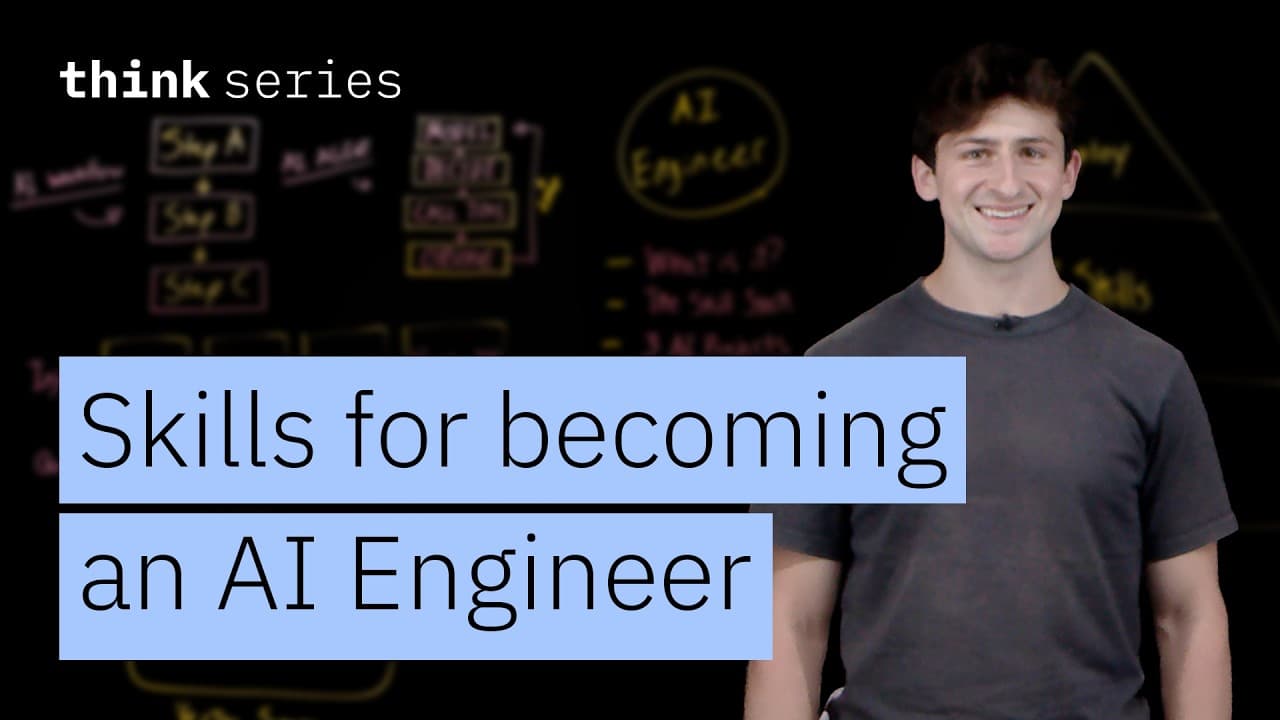
Becoming an AI engineer centers on three skill tiers: foundations, AI-specific techniques, and deployment. Foundations include Python, Git, Linux, and APIs; AI-specific skills cover embeddings, vector search, and retrieval augmented generation; deployment focuses on containerization, observability, and monitoring. Build practical projects and demonstrate them with real tools to land jobs.
Transcript
If you want to become an AI engineer, well, you might not need a computer science degree, but what you do need are the right skills and to understand the fundamentals. And today, I'm going to break down what an AI Engineer actually is, the skill stack that you need to learn, and three projects that'll help demonstrate your skills to potential emplo... Read More
Key Insights
- Foundations are essential and include Python fluency, Git proficiency, Linux familiarity, and API understanding, since most AI tools rely on these building blocks and enable effective collaboration and integration.
- Embeddings and vector search enable grounding information for LLMs, allowing retrieval augmented generation to bring factual context into model responses rather than relying on training data alone.
- AI agents are capable of dynamic decision making, calling tools, observing results, and looping to improve outcomes, which distinguishes practical AI engineering from static QA.
- Tier two emphasizes turning data into meaningful context through vector representations and similarity search, enabling relevant results to be retrieved for different topics.
- RAG pipelines involve chunking documents, embedding, storing vectors, retrieving relevant pieces, and feeding that information back into the model for grounded answers.
- Tier three focuses on deployment practices such as containerization and Kubernetes, which are necessary to run AI systems in various environments beyond the laptop.
- Observability and monitoring are critical for transparency, reliability, and cost control, ensuring AI applications operate safely in production.
- Applications of these skills commonly include knowledge systems with RAG, agents that query and visualize data, and deploying scalable AI solutions for real users
Install to Summarize YouTube Videos and Get Transcripts
Explore YouTube Video Summarizer or Get YouTube Transcript Extractor
Questions & Answers
Q: How do I start building as an AI engineer without a CS degree
Start with the foundational skills that the field demands: learn Python well enough to read and write code, become proficient with Git for version control, and gain comfort with Linux and command line utilities. Develop a solid understanding of APIs to connect models and tools. Build small projects to demonstrate these basics and progressively add AI specific components like embeddings and simple agents. This approach shows capability to design and implement end to end solutions rather than just theoretical knowledge.
Q: What is the difference between an AI engineer and a ML researcher
An AI engineer builds practical systems using existing foundation models, wiring them into data pipelines, adding tools and memory, and deploying usable products. A machine learning researcher focuses on creating new models and architectures from scratch and typically conducts deep mathematical research. For most industry roles, emphasis is on engineering work that turns models into reliable applications rather than theoretical model development.
Q: What are the core foundation skills for tier one
Tier one foundations include Python fluency to read and modify code, Git for version control, Linux familiarity for deployment environments, and API understanding to connect software components. Together these skills enable you to read model code, manage project workflows, operate in production environments, and integrate external services through API calls reliably.
Q: Why are embeddings and vector search important in AI engineering
Embeddings convert text into numerical vectors that capture semantic meaning, enabling effective similarity queries rather than keyword matching. Vector search is used to retrieve relevant information quickly, which is essential for grounding outputs in Retrieval Augmented Generation. This helps ensure responses reference accurate, contextually relevant data such as documents, policies, or data sources in an enterprise setting.
Q: What is Retrieval Augmented Generation and how does it work
Retrieval Augmented Generation combines a language model with a retrieval step. Documents are chunked, embedded into vectors, stored in a database, and retrieved based on query similarity. The retrieved content is then fed into the model along with the question to produce grounded, contextually accurate answers rather than relying solely on the model’s training data.
Q: What makes AI agents different from simple workflows
AI agents can dynamically decide what to do next rather than following a fixed chain of steps. They can call tools, observe results, and loop through decisions based on feedback. This capability enables more flexible, capable systems that can adapt to varying inputs and tasks, making them highly valuable for production AI applications.
Q: What deployment skills are essential for AI systems
Essential deployment skills include containerization to package AI agents and models for different environments, Kubernetes for orchestration, and observability to trace decisions and diagnose issues. Monitoring and security considerations are also important to manage costs, ensure reliability, and protect data in production AI applications.
Q: What real world projects help demonstrate AI engineering skills
Projects that combine RAG with grounded data, and agents that can query databases or visualize data, are highly relevant. Build end to end solutions that take in data, retrieve relevant information, reason with it, and provide actionable outputs. Demonstrating deployment readiness with containerized apps and observability dashboards is also critical for showing operability in real world scenarios.
Summary & Key Takeaways
-
You need a strong foundation before diving into AI engineering, with core skills in Python, Git, Linux, and APIs to connect software components and models.
-
The second tier focuses on embedding based data grounding, vector similarity search, and retrieval augmented generation to keep model outputs accurate and contextual.
-
The final tier covers shipping production systems, including containerization with Kubernetes, observability to trace decisions, and security and cost considerations for real-world deployments.
Read in Other Languages (beta)
Share This Summary 📚
Summarize YouTube Videos and Get Video Transcripts with 1-Click
Try YouTube Summary with ChatGPT & Claude or YouTube Transcript Generator
Explore More Summaries from IBM Technology 📚
Summarize YouTube Videos and Get Video Transcripts with 1-Click
Try YouTube Summary with ChatGPT & Claude or YouTube Transcript Generator