What Is the ARC Prize and How Does It Advance AGI Research?
TL;DR
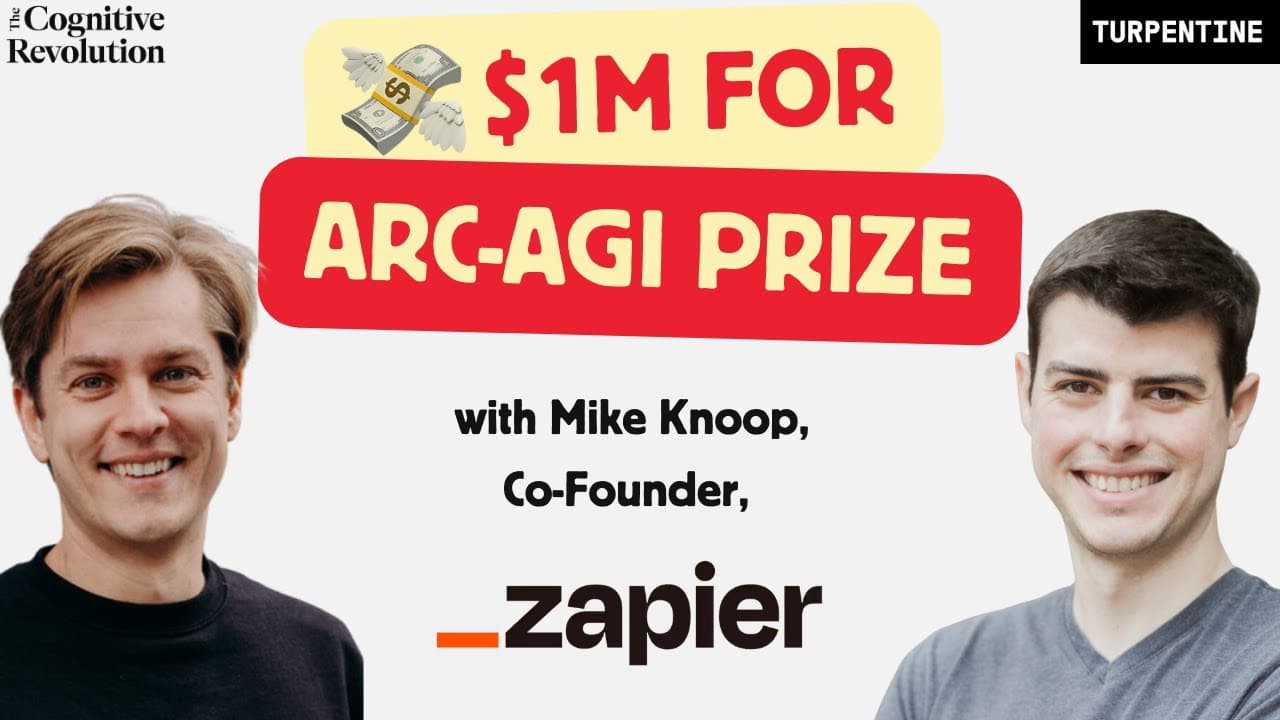
The ARC Prize is a $1 million competition designed to promote the development of efficient AI architectures capable of solving the ARC benchmark, a test of general intelligence. The challenge involves solving novel two-dimensional grid puzzles under strict compute constraints, aiming for a $500,000 grand prize for achieving 85% accuracy on 100 private puzzles. This competition highlights ongoing difficulties in AI's ability to generalize across novel tasks and the importance of efficient skill acquisition.
Transcript
hello and welcome to the cognitive Revolution where we interview Visionary researchers entrepreneurs and Builders working on the frontier of artificial intelligence each week we'll explore their revolutionary ideas and together we'll build a picture of how AI technology will transform work life and Society in the coming years I'm Nathan lens joined... Read More
Key Insights
- The ARC Prize is a $1 million competition designed to encourage the development of more efficient AI architectures that can solve the ARC benchmark, a test of general intelligence.
- The ARC benchmark involves solving novel two-dimensional grid puzzles that require inferring transformation rules, emphasizing the need for AI systems to efficiently acquire and apply new skills.
- The competition's rules include a $500,000 grand prize for achieving 85% accuracy on 100 private puzzles using limited compute resources, emphasizing efficiency in AI problem-solving.
- The ARC benchmark was created to assess general intelligence and has remained unsolved for over five years, highlighting the challenge of developing AI systems that can generalize across novel tasks.
- Current AI systems, including large language models, struggle with the intuitive problem-solving required by the ARC benchmark, suggesting a gap in AI's ability to replicate human-like reasoning.
- The discussion explores the possibility of hybrid AI systems that combine language models with algorithmic search and reasoning modules to improve practical utility and reliability.
- There is concern that breakthroughs in efficiency-focused AI architectures could pose safety risks if they lack an understanding of human values, echoing AI safety debates.
- The conversation highlights the importance of open science and collaboration in advancing AI research, contrasting with the current trend of commercial secrecy around cutting-edge AI models.
- More videos with Mike Knoop:
Install to Summarize YouTube Videos and Get Transcripts
Explore YouTube Video Summarizer or Get YouTube Transcript Extractor
Questions & Answers
Q: What is the ARC Prize?
The ARC Prize is a $1 million public competition designed to motivate research into more efficient and generalizable AI architectures. The contest aims to solve the ARC benchmark, a test of general intelligence, by encouraging the development of AI systems that can efficiently acquire and apply new skills to novel tasks. The grand prize of $500,000 is awarded for achieving 85% accuracy on 100 private puzzles under strict compute and time constraints.
Q: What is the ARC benchmark?
The ARC benchmark, created by François Chollet in 2019, is a test of general intelligence that involves solving novel two-dimensional grid puzzles. These puzzles require inferring transformation rules and applying them to solve a final input grid. The benchmark emphasizes the need for AI systems to efficiently acquire and apply new skills, as each task is novel and requires intuitive problem-solving abilities similar to those of humans.
Q: Why is the ARC benchmark significant?
The ARC benchmark is significant because it remains unsolved after more than five years, highlighting the challenge of developing AI systems that can generalize across novel tasks. It serves as a measure of general intelligence, focusing on the efficiency of skill acquisition and application. The benchmark's endurance suggests that current AI technologies, including large language models, struggle with the intuitive problem-solving required to achieve human-like reasoning.
Q: What are the rules of the ARC Prize competition?
The ARC Prize competition requires participants to achieve 85% accuracy on 100 private puzzles using limited compute resources, specifically a P100 GPU with 12 hours of runtime. Participants can use pre-trained models and licensed software but cannot use internet access, which excludes API calls to today's leading frontier models. The competition emphasizes efficiency in AI problem-solving and requires open-sourcing the solution to claim the prize.
Q: What challenges do current AI systems face with the ARC benchmark?
Current AI systems, including large language models, face challenges with the ARC benchmark due to its requirement for intuitive problem-solving and generalization across novel tasks. These systems struggle to replicate the human-like reasoning needed to infer transformation rules from limited examples. The benchmark highlights a gap in AI's ability to efficiently acquire and apply new skills, which is essential for achieving general intelligence.
Q: How might hybrid AI systems address the challenges of the ARC benchmark?
Hybrid AI systems that combine language models with algorithmic search and reasoning modules could address the challenges of the ARC benchmark by improving practical utility and reliability. Such systems would leverage the strengths of language models in understanding and generating human-like text while incorporating algorithmic components to enhance problem-solving capabilities. This approach could lead to more effective and efficient AI architectures capable of generalizing across novel tasks.
Q: What are the potential safety risks of efficiency-focused AI architectures?
Efficiency-focused AI architectures could pose safety risks if they lack an understanding of human values. Such systems might solve problems effectively but fail to recognize when to stop, leading to unintended consequences. This concern echoes AI safety debates, where theorists have anticipated small but highly capable systems that might not align with human values, potentially resulting in scenarios like the paperclip maximizer thought experiment.
Q: Why is open science important in advancing AI research?
Open science is crucial in advancing AI research because it fosters collaboration, transparency, and the sharing of knowledge and resources. The current trend of commercial secrecy around cutting-edge AI models limits the dissemination of information and hinders collective progress. Open science enables researchers to build on each other's work, accelerating innovation and the development of new ideas. The ARC Prize aims to contribute to open progress by requiring participants to open-source their solutions.
Summary & Key Takeaways
-
The ARC Prize is a $1 million competition to motivate research into more efficient AI architectures capable of solving the ARC benchmark, a test of general intelligence. The benchmark involves novel two-dimensional grid puzzles requiring the inference of transformation rules, emphasizing the need for AI systems to efficiently acquire and apply new skills.
-
The competition's rules include a $500,000 grand prize for achieving 85% accuracy on 100 private puzzles using limited compute resources, emphasizing efficiency in AI problem-solving. The ARC benchmark, created by François Chollet in 2019, has remained unsolved for over five years, highlighting the challenge of developing AI systems that can generalize across novel tasks.
-
The discussion explores the possibility of hybrid AI systems that combine language models with algorithmic search and reasoning modules to improve practical utility and reliability. Concerns are raised about the potential safety risks of efficiency-focused AI architectures lacking an understanding of human values, echoing AI safety debates.
Read in Other Languages (beta)
Share This Summary 📚
Summarize YouTube Videos and Get Video Transcripts with 1-Click
Try YouTube Summary with ChatGPT & Claude or YouTube Transcript Generator
Explore More Summaries from Cognitive Revolution "How AI Changes Everything" 📚




Summarize YouTube Videos and Get Video Transcripts with 1-Click
Try YouTube Summary with ChatGPT & Claude or YouTube Transcript Generator