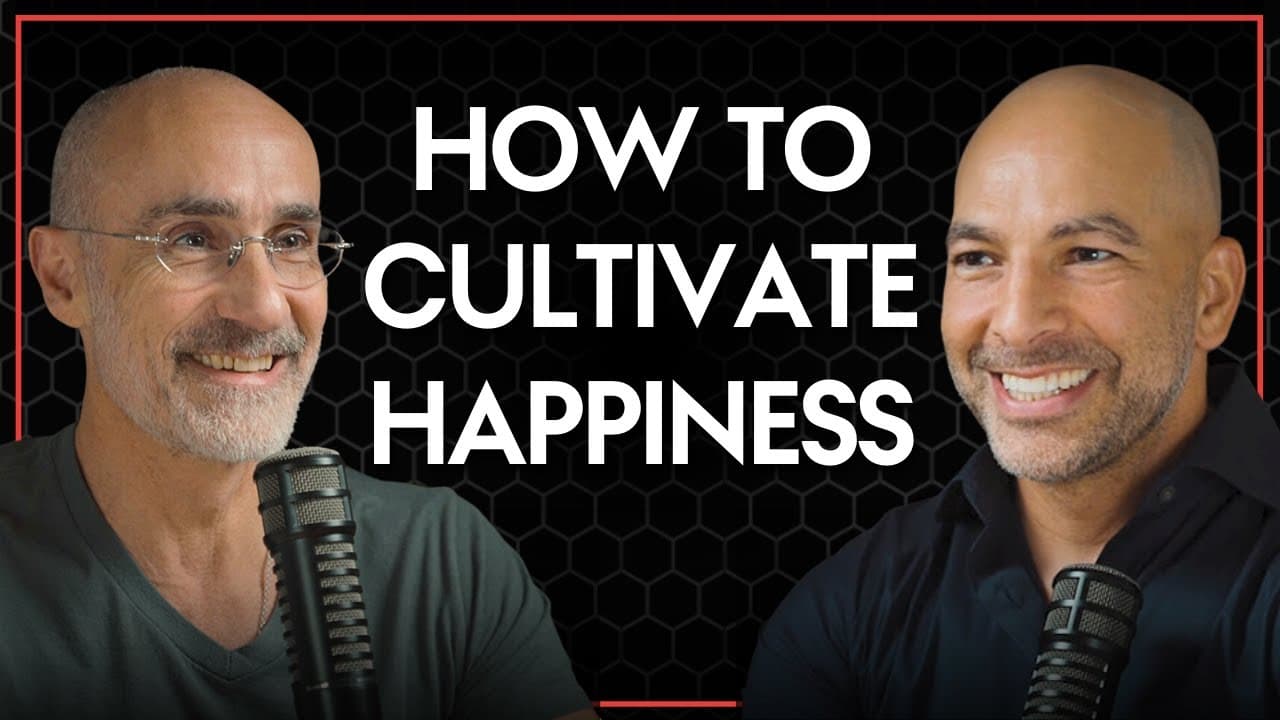
Arthur Brooks on Why Happiness Is Not a Feeling
TL;DR
Feelings are evidence of happiness, not happiness itself, the way the smell of turkey is not the Thanksgiving dinner. Emotions are signals produced by the brain's limbic system, so treating them as your overall wellbeing means chasing ghosts. The secret is running your life like a startup where you are the CEO who does what is right, not what feels good.
Transcript
this is the Salient theme take charge man take charge don't don't leave your health up to what feels good right now take charge of it I mean you're the boss you're this is the startup is you you're the entrepreneur you're the the guy in charge of the Enterprise you're the CEO treated as such you know the CEO doesn't do what feels good all the time ... Read More
Key Insights
- Happiness is not a feeling. Feelings are evidence of happiness the way the smell of a turkey is evidence of Thanksgiving dinner, not the dinner itself, and mistaking one for the other leaves you chasing ghosts.
- Emotions are information produced by the limbic system, a part of the brain shaped over a 40 million year evolutionary process. They are signals about your environment, not the underlying phenomenon of happiness.
- Happiness and unhappiness are not opposite ends of one spectrum. Modern neuroscience shows you can experience happy and unhappy feelings in parallel rather than one simply being the absence of the other.
- The average person spends about 40% of their time with predominantly positive feelings and roughly 16 to 17% with predominantly negative feelings, sitting mostly in a neutral idle of positivity.
- There are six fundamental emotions that are the building blocks of emotional life: four negative (sadness, anger, fear, disgust) and two positive. Evolution favors negative emotions because they demand attention to keep you alive.
- Fear and anger involve the amygdala and threat response. Spotting a car about to hit you triggers stress hormones through the hypothalamus, pituitary, and adrenal glands in about 74 milliseconds, before the prefrontal cortex catches up.
- Disgust operates through the insular cortex to warn against pathogens, but demagogic leaders and media reprogram it so people view political opponents like cockroaches, historically enabling barbaric acts against fellow citizens.
- Social rejection and physical pain share brain machinery. Affective pain from being excluded activates the same dorsal anterior cingulate cortex as the emotional component of stubbing your toe, which is why grief is unremediated sadness.
Install to Summarize YouTube Videos and Get Transcripts
Explore YouTube Video Summarizer or Get YouTube Transcript Extractor
Questions & Answers
Q: What is the difference between happiness and happy feelings?
According to Arthur Brooks, happiness and happy feelings are not the same. Feelings are evidence of happiness, not happiness itself, the way the smell of a turkey is evidence of Thanksgiving dinner but is not the dinner. Feelings are limbic system activity, signals and information produced by the brain. If you mistake these feelings for the underlying phenomenon of happiness, you end up chasing it all over the place, chasing ghosts, letting how you slept or what you ate determine your state.
Q: Can happiness and unhappiness exist at the same time?
Yes. Ancient philosophers assumed happiness and unhappiness sat on a single spectrum, with unhappiness being the mere absence of happiness. Brooks explains that the explosion of neuroscience shows this is wrong. Because of how emotions are produced, you can be happy and unhappy, or have happy and unhappy feelings, in parallel. The average person spends about 40% of their time with predominantly positive feelings and 16 to 17% with predominantly negative feelings, so both systems operate together rather than canceling each other out.
Q: What are the six fundamental emotions?
Brooks identifies six basic emotions that are the building blocks of all emotional life, produced by the limbic system of the brain. Four are negative: sadness, anger, fear, and disgust. Two are positive. All four negative emotions have a strong evolutionary basis. Fear and anger relate to threat and involve the amygdala, disgust involves the insular cortex and guards against pathogens, and sadness involves the dorsal anterior cingulate cortex and registers social separation. These fundamental emotions combine to create the full range of human emotional experience.
Q: Why does evolution favor negative emotions over positive ones?
Evolution favors negative emotions because they get your attention and are supposed to. Brooks explains that positive emotions are nice to have, but negative emotions demand attention because ignoring them could cost you your life. This is why the average person experiences intense negative feelings around 16 to 17% of the time. Threat-based emotions like fear and anger trigger rapid survival responses, ensuring you react to danger, avoid pathogens, and stay connected to your tribe rather than being left to die alone.
Q: How does the brain respond when a car is about to hit you?
Brooks describes the threat response in detail. When a car is about to run you over, the image crosses your visual cortex and is recorded in the occipital lobe as an enormous predator. This signals the amygdala to send a message through the hypothalamus to the pituitary gland, which signals the adrenal glands above your kidneys to release stress hormones. This all happens in 74 milliseconds, so you are already sweating, your heart is pumping, and you have jumped out of the way before your prefrontal cortex catches up about three seconds later.
Q: What is grief and why does it last so long?
Grief is unremediated sadness. Sadness is felt largely in the dorsal anterior cingulate cortex, part of the limbic system, and it registers mental pain when you are socially excluded or separated from a loved one. This evolved so you would not be separated from your tribe. In grief, your brain keeps signaling that you must be reunited with the person, but you cannot be because they are permanently gone through death or divorce. It takes a long time for the dorsal anterior cingulate cortex to stop registering that pain.
Q: Why does social rejection feel like physical pain?
Social rejection and physical pain share brain machinery. Brooks explains that when you stub your toe there are two processes: sensory pain felt in the nerve endings, and affective pain, the I hate this component. The affective component of physical pain involves the dorsal anterior cingulate cortex, the same region activated when you are emotionally excluded. fMRI studies show that when people are rejected by others, the same part of the brain illuminates. This is why a child left alone at the cafeteria table feels genuine pain similar to physical hurt.
Q: How can you treat your life like a startup to be happier?
Brooks says the secret of happiness is treating your life like a startup where you are the CEO, the entrepreneur in charge of the enterprise. A good CEO does not do what feels good all the time; the CEO does what is right notwithstanding his or her feelings. He compares this to a philosophy of health and longevity, calling it happy span rather than health span. You will not achieve the happiness you seek by doing what feels good in the moment, but you can learn, grow, and make progress throughout the journey.
Summary & Key Takeaways
-
Arthur Brooks, a Harvard social scientist and Atlantic columnist, returns to Peter Attia's The Drive to discuss his book Build the Life You Want. He argues happiness is not a feeling but that feelings are merely evidence of it, comparing the mistake to confusing turkey's smell with Thanksgiving dinner.
-
Emotions are limbic system signals from a 40 million year evolution. There are six basic emotions, four negative and two positive. Negative emotions dominate because evolution rewards attention to threat. The average person feels predominantly positive 40% of the time and negative 16 to 17%.
-
Fear and anger run through the amygdala in 74 milliseconds, disgust through the insular cortex, and sadness through the dorsal anterior cingulate cortex, which also registers social rejection. Brooks says the secret of happiness is treating your life like a startup and acting as the CEO who does what is right, not what feels good.
Read in Other Languages (beta)
Share This Summary 📚
Summarize YouTube Videos and Get Video Transcripts with 1-Click
Try YouTube Summary with ChatGPT & Claude or YouTube Transcript Generator
Explore More Summaries from Peter Attia MD 📚


Summarize YouTube Videos and Get Video Transcripts with 1-Click
Try YouTube Summary with ChatGPT & Claude or YouTube Transcript Generator