Why Did Aristotle Reject Plato's Philosophy?
TL;DR
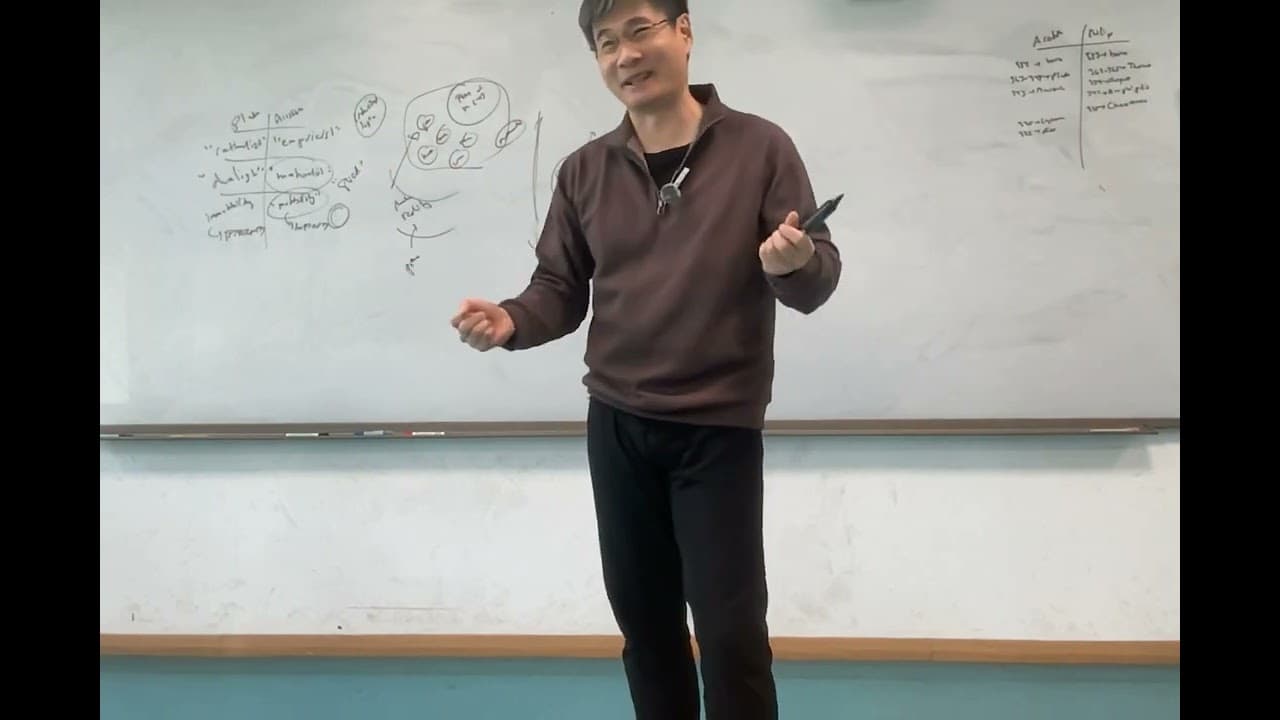
Aristotle’s worldview conflicts with Plato’s because Aristotle emphasizes observation, material reality, change, and movement toward purpose, while Plato emphasizes pure reason, eternal forms, and the soul. The lecture uses three paradoxes about Aristotle’s surviving writings, extraordinary intellectual range, and opposition to his teacher to introduce the controversial argument that Aristotle functioned as an editor, systematizer, sympathizer, or censor rather than an original philosopher.
Transcript
okay so today we we will finish the Greeks um by discussing Aristotle and a lot of what I will say today um will be controversial okay so um feel free to challenge me feel free to ask for clarification feel free to um ask any questions okay so um here's my argument Aristotle is a paradox he is one of the mysterious figures in world history he's one... Read More
Key Insights
- Aristotle is presented as paradoxical because he is considered one of history’s greatest philosophers, yet the lecture states that no surviving text can be identified as something he personally wrote. His reputation therefore cannot be demonstrated in the same direct way as a writer whose original texts survive.
- About 200 works are attributed to Aristotle, according to the lecture, and their subjects include politics, poetics, ethics, rhetoric, physics, metaphysics, and biology. The unusually broad range of these works forms the second paradox surrounding his identity and intellectual legacy.
- Aristotle’s relationship with Plato creates a third paradox because he studied under Plato for 20 years but developed a radically conflicting account of reality. Rather than merely extending his teacher’s system, Aristotle is portrayed as challenging or negating its central assumptions.
- Plato’s philosophy treats the Form of the Good as eternal, perfect, and immutable. Other ideal forms, including justice, beauty, reason, and the ideal horse, derive from this higher reality, while objects in ordinary experience are described as copies or imitations within a shadow realm.
- Pure reason is Plato’s route toward truth in the lecture’s simplified account. A physically drawn circle can never be perfect because it always has an imperfect edge, but the mind can imagine a perfect circle by approaching the realm of ideal forms through mathematics and thought.
- Aristotle’s universe is defined by motion initiated by a prime mover. Things act well when they move toward their purpose, or telos, and badly when they move away from it. A soldier who fights and tries to win fulfills the purpose assigned to that role.
- Empiricism distinguishes Aristotle from Plato’s rationalism in the lecture’s comparison. Aristotle’s approach seeks truth through observation and induction, while Plato’s approach seeks it through pure thought, philosophy, and mathematics rather than treating sensory experience as the highest source of knowledge.
- The lecturer’s controversial thesis is that Aristotle may be better understood as a censor, sympathizer, editor, or systematizer than as an original philosopher or writer. The lecture proposes this interpretation as a possible resolution to the three paradoxes, not as an established conclusion.
- More videos from this channel:
- More from this channel: Predictive History
Install to Summarize YouTube Videos and Get Transcripts
Explore YouTube Video Summarizer or Get YouTube Transcript Extractor
Questions & Answers
Q: Why is Aristotle described as a paradoxical figure?
Aristotle is described as paradoxical for three reasons. He is ranked among the greatest philosophers, yet the lecture says no surviving text can be identified as something he personally wrote. About 200 works covering an extraordinary range of subjects are attributed to him. He also studied under Plato for 20 years while developing a worldview that directly conflicts with Plato’s central ideas.
Q: How does Aristotle’s worldview differ from Plato’s?
Plato emphasizes an eternal and immutable realm of ideal forms, with ordinary reality treated as a world of changing copies and imitations. Aristotle instead emphasizes a universe in motion, material existence, observation, and movement toward purpose. The lecture summarizes the contrast through three pairings: rationalism versus empiricism, dualism versus materialism, and eternity versus continuing change or infinity.
Q: What is Plato’s Form of the Good?
The Form of the Good is presented as Plato’s divine, eternal, perfect, and immutable reality. It gives rise to other perfections or ideal forms, including justice, beauty, and reason. Particular things in the experienced world are imperfect copies of their ideal forms. Moving intellectually toward the Form of the Good is considered good, while moving away from it is considered bad.
Q: Why does Plato consider mathematics a path to truth?
Mathematics allows the mind to approach ideal forms through pure thought. The lecture uses a circle as its example: no physical drawing can produce a perfectly smooth circle because an edge or imperfection will remain at a sufficiently small scale. A perfect circle can nevertheless be imagined, so mathematical reasoning provides access to an ideal that physical objects cannot fully embody.
Q: What does Aristotle mean by purpose or telos?
Telos is the purpose toward which a thing or person moves. In the lecture’s simplified account, movement toward that purpose is good, while movement away from it is bad. A soldier’s purpose is described as fighting and winning wars. Fighting and doing one’s best therefore fulfill that role, while running away moves against its assigned purpose.
Q: Why is Aristotle associated with empiricism?
Aristotle is associated with empiricism because the lecture describes his method as seeking truth through observation and induction. Induction moves from repeated observations toward a broader conclusion. This approach contrasts with Plato’s rationalism, which treats pure thought, mathematics, and philosophy as ways to reach truth beyond the imperfect and transient objects encountered in ordinary experience.
Q: How did Plato and Aristotle shape Western philosophy?
The conflict between Plato and Aristotle is presented as a fundamental debate that informed Western philosophy for thousands of years. Later philosophers repeatedly moved between a Platonic emphasis on rational ideals and an Aristotelian emphasis on empirical reality. The lecture gives Descartes as an example from the rationalist camp and David Hume as an example from the empiricist camp.
Q: What controversial argument does the lecture make about Aristotle?
The lecturer argues that Aristotle may not have been an original philosopher, thinker, or writer. Instead, he may have functioned as a censor, sympathizer, editor, or systematizer who selected ideas according to what was politically convenient. The lecturer presents this as a controversial interpretation intended to explain the absence of original writings, the extraordinary range of attributed works, and the conflict with Plato.
Summary & Key Takeaways
-
Aristotle is presented as a mysterious and paradoxical historical figure. No text is identified as an original work personally written by him, yet about 200 works are attributed to him. These works span politics, poetics, ethics, rhetoric, physics, metaphysics, and biology, giving his attributed scholarship an extraordinary range.
-
Plato’s worldview places the eternal and immutable Form of the Good above the changing world, which consists of imperfect copies or imitations. Pure thought, philosophy, and mathematics provide access to truth. The visible world is treated as transient, while ideal forms such as justice, beauty, and the perfect circle are enduring realities.
-
Aristotle’s worldview begins with a prime mover that sets everything in motion. Goodness involves moving toward a thing’s purpose, or telos. The lecture contrasts Aristotle’s empiricism, materialism, and emphasis on continuing change with Plato’s rationalism, dualism, and eternity, presenting their conflict as foundational to later Western philosophical debate.
Read in Other Languages (beta)
Share This Summary 📚
Summarize YouTube Videos and Get Video Transcripts with 1-Click
Try YouTube Summary with ChatGPT & Claude or YouTube Transcript Generator
Explore More Summaries from Predictive History 📚



Summarize YouTube Videos and Get Video Transcripts with 1-Click
Try YouTube Summary with ChatGPT & Claude or YouTube Transcript Generator