Why Did the Islamic Golden Age Begin and End?
TL;DR
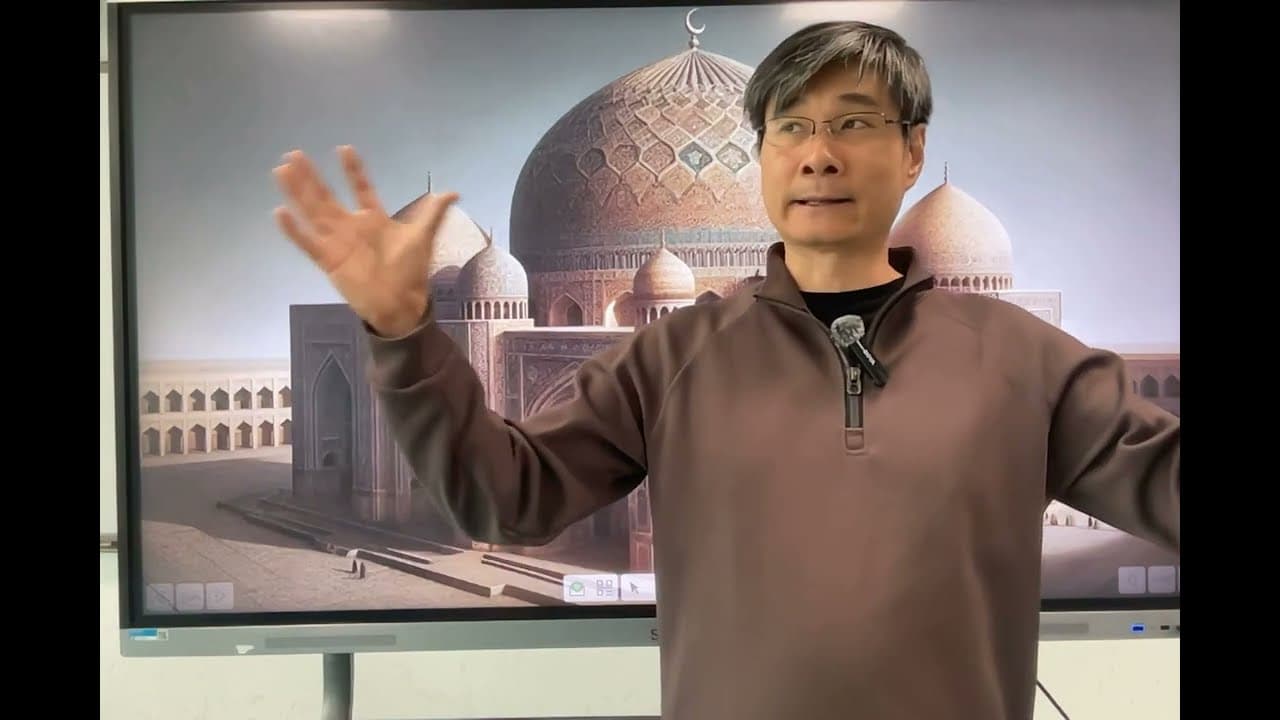
The lecture links the Islamic Golden Age’s rise to the Abbasid Caliphate’s development of Baghdad, denser global trade networks, and the Maritime Silk Road, and identifies the Mongol conquest as its endpoint. Baghdad’s House of Wisdom became a global center of learning and literacy, while Bukhara also flourished artistically. Read on to see how religion, conquest, commerce, and scholarship shaped this period.
Transcript
okay good morning so today we do Islam um some quick facts some questions that we will look at today about uh theic golden age uh the first major question is while Europe was in its Dark Ages uh Islam was embarked on its golden age so the first question is how did this happen why was there where why was there there this Divergence second question w... Read More
Key Insights
- Islam is the world's second largest religion after Christianity, and it is divided into two major sects: the Shia, based primarily in Iran, and the Sunni, who are found nearly everywhere else across Africa, the Middle East, Central Asia and India.
- The core Shia and Sunni divide rests on succession. The Shia believe only a direct descendant of Muhammad's grandson Ali can lead the religion, while the Sunni do not. Within a religion of this size there are many other sects, but this is the defining difference.
- The word Muslim means to submit yourself to God, to believe in God and to commit to him wholeheartedly. Muhammad is considered the final prophet of God, with Jesus regarded in this tradition as the penultimate prophet.
- The Quran originates in visions Muhammad received in a cave at around age forty, when the Archangel Gabriel appeared to him. Muhammad, a merchant by trade, understood his mission as being a messenger of God revealing truth to the pagan society of the Arabian world.
- The Constitution of Medina, written after Muhammad's flight from Mecca, promised religious freedom to everyone. It settled conflict between the pagan, Muslim and Jewish factions of the city and established Islam from the outset as an open, tolerant and inclusive religion.
- Islam has five pillars, making it simple and clear compared with Christianity and Judaism: belief that Allah is the only God, prayer at least five times daily facing Mecca, giving money to the poor, fasting during holy days, and the Hajj pilgrimage to Mecca.
- Arab expansion out of the Arabian desert destroyed the Sassanian Persian Empire and stripped the Byzantines of at least half their territory, including their richest provinces, Syria and Egypt. Constantinople itself survived two major sieges thanks to its fortress walls and Greek Fire.
- Globalization is not a recent phenomenon. The Abbasid trade routes connected the entire world over the caliphate's history, reaching the Tang and Song dynasties, and the Abbasids created the Maritime Silk Road in addition to the long-established overland Silk Road.
- The Al-Aqsa Mosque sits on the Temple Mount, where the Romans burned the Jews' second temple. The lecture treats this as a genuine puzzle, since building on the holiest Jewish site fits poorly with a tradition that presented itself as tolerant and inclusive.
Install to Summarize YouTube Videos and Get Transcripts
Explore YouTube Video Summarizer or Get YouTube Transcript Extractor
Questions & Answers
Q: Why did the Islamic Golden Age begin and end?
The Golden Age began under the Abbasid Caliphate, which succeeded the Umayyads and made Baghdad a cultural center. The Abbasids enriched and accelerated existing trade networks, created the Maritime Silk Road alongside the overland route, and supported learning at Baghdad’s House of Wisdom. The lecture identifies the Mongol conquest as the period’s endpoint.
Q: What was the Islamic Golden Age, and where was it centered?
The lecture presents the Islamic Golden Age as the height of civilization under the Abbasid Caliphate. Its principal center was Baghdad, whose House of Wisdom became a global center of learning and literacy. Bukhara in Uzbekistan was another center of artistic creativity.
Q: How did Abbasid trade contribute to the Islamic Golden Age?
The Abbasids made existing trade networks richer, denser, and faster. Their routes connected distant regions, including the Tang and Song dynasties, while the Maritime Silk Road supplemented the older overland route. These connections helped make Baghdad a center of the world described in the lecture.
Q: What was Baghdad’s role during the Islamic Golden Age?
Baghdad was the Abbasid capital and the primary cultural center of the Golden Age. Its House of Wisdom served as a global center of learning and literacy before the Mongol conquest. The lecture also describes Baghdad as a distinctive round city near the Tigris and Euphrates.
Q: How quickly did Islam spread beyond Arabia?
Arab forces expanded from the Arabian desert across most of the Middle East in less than 100 years. They destroyed the Sassanian Persian Empire and took at least half of the Byzantine Empire, including Syria and Egypt. Constantinople resisted two major sieges because of its walls and Greek Fire.
Q: What is the main difference between Sunni and Shia Muslims?
The defining difference described in the lecture concerns religious succession. The Shia believe that only a direct descendant of Muhammad’s grandson Ali can lead the religion, whereas the Sunni do not. The lecture places the Shia primarily in Iran and the Sunni across much of the wider Muslim world.
Q: How did Islam begin, according to the lecture?
Muhammad was a merchant who, at around age 40, received visions in a cave from the Archangel Gabriel. He memorized the revelations that became the basis of the Quran and understood himself as God’s messenger to Arabian pagan society. Resistance in Mecca eventually forced him to leave for Medina.
Q: What was the Constitution of Medina?
After the Hijra from Mecca, Muhammad became the leader of Medina’s warring pagan, Muslim, and Jewish factions. He wrote the Constitution of Medina, which promised religious freedom to everyone. The lecture presents it as evidence of Islam’s early open, tolerant, and inclusive character.
Summary & Key Takeaways
-
Islam is the world's second largest religion, split into the Sunni majority and the Shia, who are based primarily in Iran. The one major doctrinal difference is that the Shia hold that only a direct descendant of Muhammad's grandson Ali can lead the religion. Islam extends across Africa, the Middle East, Central Asia and India, and the most populous Muslim country is Indonesia.
-
Muhammad, a merchant, had a vision in a cave at around age forty in which the Archangel Gabriel revealed to him what became the Quran. Meeting resistance in Mecca, he left for Medina in the Hijra, where he led warring pagan, Muslim and Jewish factions and wrote the Constitution of Medina, which promised religious freedom to everyone.
-
From the Arabian desert, the poorest place in the region, the Arabs conquered the Sassanian Persian Empire and took at least half of the Byzantine Empire, including its richest parts, Syria and Egypt. Constantinople held out through two major sieges because of its walls and Greek Fire. The whole expansion took less than a hundred years.
-
The Abbasid Caliphate, successor to the Umayyads, made Baghdad the cultural center of the Golden Age. Bukhara in Uzbekistan was another site of artistic creativity. Abbasid trade routes connected the entire world, including heavy trade with the Tang and Song dynasties, and the Abbasids created the Maritime Silk Road on top of the long-existing overland one.
-
The lecture frames three unsolved mysteries: why no early records survive from the movement's first hundred years despite literate Jewish participants and the Constitution of Medina; why the Muslims attacked two major empires at once; why Muhammad named no successor; and why the Al-Aqsa Mosque was built on the Jewish Temple Mount.
Read in Other Languages (beta)
Share This Summary 📚
Summarize YouTube Videos and Get Video Transcripts with 1-Click
Try YouTube Summary with ChatGPT & Claude or YouTube Transcript Generator
Explore More Summaries from Predictive History 📚




Summarize YouTube Videos and Get Video Transcripts with 1-Click
Try YouTube Summary with ChatGPT & Claude or YouTube Transcript Generator