How to Improve Your IELTS Writing Task 2 Score
TL;DR
Answer every part of the IELTS Writing Task 2 prompt directly, then support each position with ideas that are easy to explain and illustrate. A focused four-paragraph structure, a concise introduction that paraphrases the prompt and answers both questions, and a balance between quality and quantity can produce a clear 260–300-word essay within the 40-minute limit.
Transcript
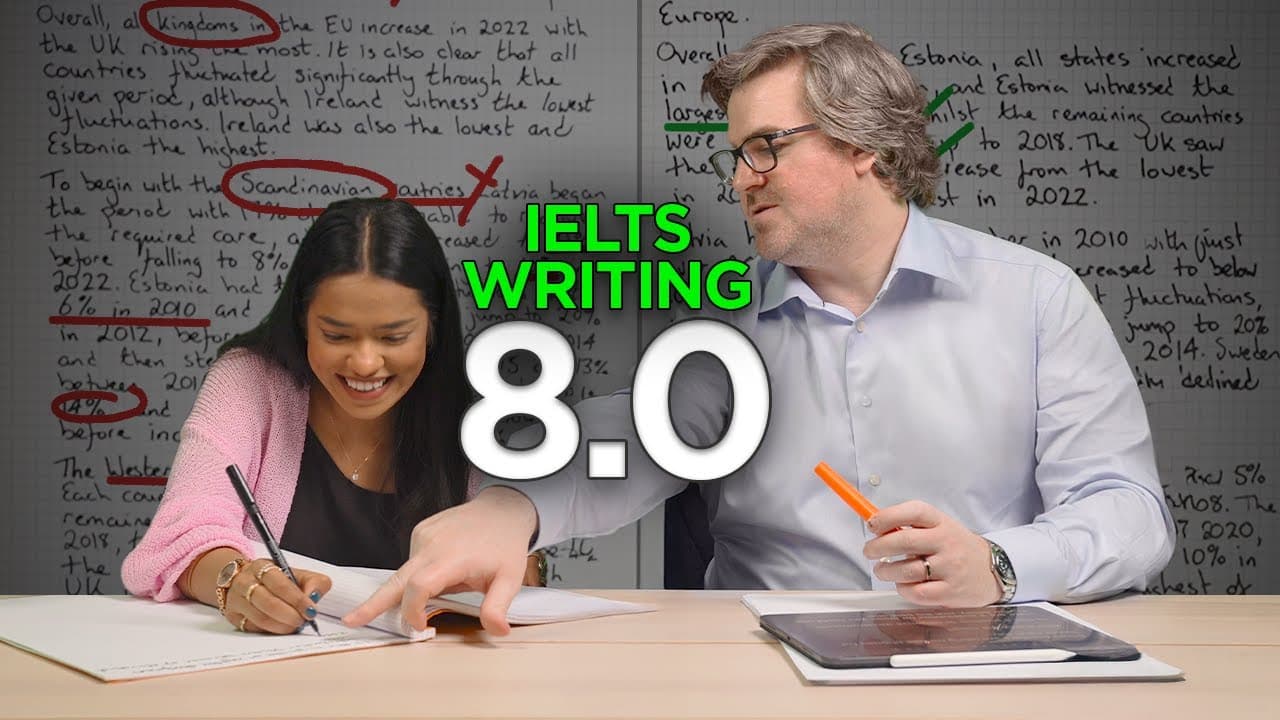
meet Isa Isa wants to move abroad but she's stuck at 6.5 in I writing task 2 and we're going to help her today improve to a band 8 or maybe even nine so I'm going to transform her writing the good news is I'm going to do it step by step and you guys can participate too this is a fully interactive lesson and you'll be able to participate by choosing... Read More
Key Insights
- The writer’s primary responsibility is to answer the exact question asked. A statement about parental irresponsibility or child development is insufficient when the prompt specifically asks why parents permit phone use and whether that situation represents a positive or negative development.
- A strong essay idea is one that directly addresses the prompt and can be explained with a relevant example. The claim that educational apps make phone use positive is acceptable because it answers the evaluation question and can be developed, even if some readers disagree.
- The examiner does not need to agree with the writer’s opinion. IELTS writing assessment focuses on whether the position is reasonable, relevant, clearly expressed, and adequately supported, so trying to predict or satisfy the examiner’s personal beliefs can distract from the actual task.
- Claims that are difficult to prove should be avoided when the writer lacks the necessary expertise. For example, asserting that phones cause permanent eye damage would require a convincing explanation of how screens affect eyes and an appropriate example, making the position harder to support.
- An effective structure must match the specific prompt rather than come from a memorized template. A generally sound essay framework can still fail if it includes irrelevant material, such as solutions to a problem when the question asks only about causes and positive or negative development.
- A focused four-paragraph structure can balance quality, quantity, and time. The recommended organization uses an introduction, one main body paragraph for the first question, another main body paragraph for the second question, and a conclusion, producing approximately 260–300 words in 40 minutes.
- The writer’s position should appear before the conclusion. Discussing both positive and negative sides and revealing the final opinion only at the end can create a surprise conclusion, while answering the questions clearly in the introduction and main body makes the reasoning easier to follow.
- A suitable introduction paraphrases the prompt and briefly answers every question it contains. Hooks are unnecessary for this academic task, opposing views require more detail than the introduction should contain, and the paraphrase helps demonstrate that the writer has understood the original question.
Install to Summarize YouTube Videos and Get Transcripts
Explore YouTube Video Summarizer or Get YouTube Transcript Extractor
Questions & Answers
Q: How do you answer every part of an IELTS Writing Task 2 prompt?
Identify each separate question before planning the essay, then assign a clear answer to each one. In the toddler phone-use example, the writer must explain why parents allow the behavior and decide whether it is a positive or negative development. Statements about irresponsibility or child development do not satisfy the task unless they directly answer those two requested points.
Q: How should you choose ideas for IELTS Writing Task 2?
Choose ideas that directly answer the prompt and are easy to explain and illustrate. An idea does not need universal agreement or the examiner’s personal approval. It must be reasonable and supportable. The educational-app position works because it answers whether phone use can be positive and gives the writer a clear basis for further explanation and examples.
Q: Does the IELTS examiner need to agree with your opinion?
The examiner does not need to share the writer’s opinion. A position can still be suitable when many people would disagree with it, provided it is reasonable, relevant to the question, and developed clearly. The task tests whether the writer answers the prompt, explains the reasoning, and provides an example, rather than whether the examiner personally accepts the conclusion.
Q: Why should difficult scientific claims be avoided in an IELTS essay?
A difficult scientific claim can be hard to explain and support within the essay. The claim that mobile phones cause permanent eye damage, for example, would require knowledge about how screens interact with eyes and a convincing example. Unless the writer has enough expertise to develop that reasoning, a simpler, directly supportable idea is more practical and credible.
Q: What structure works for a two-part IELTS Writing Task 2 question?
Use four paragraphs: an introduction, a main body paragraph answering the first question, a main body paragraph answering the second question, and a conclusion. For the phone-use prompt, one body paragraph explains why parents let toddlers use phones, while the other evaluates whether that development is positive or negative. This keeps both answers visible and organized.
Q: Why should IELTS essay templates be adapted to the prompt?
A memorized structure only helps when its contents match the actual task. A template that discusses solutions is unsuitable if the prompt asks for causes and an evaluation of positive or negative development. Writers need both a solid structure and relevant ideas. Filling a familiar framework with material that the question never requested can leave the task unanswered.
Q: How long should the recommended IELTS Task 2 essay be?
The lesson recommends balancing quality and quantity by writing approximately 260–300 words within the 40-minute test period. A much longer structure that covers positive and negative arguments before finally stating an opinion may consume too much time and reduce quality. A focused four-paragraph response makes the target length easier to manage while still answering both questions.
Q: What should an IELTS Writing Task 2 introduction include?
The introduction should paraphrase the prompt and briefly answer every question it asks. Paraphrasing demonstrates understanding, while the short answers immediately establish relevant ideas and the writer’s position. An academic essay does not need a hook, and detailed discussion of opposing views belongs in the main body rather than in the introduction. The opening should remain clear and direct.
Summary & Key Takeaways
-
Strong IELTS Writing Task 2 responses begin with accurate interpretation of the prompt. For a question asking why parents let toddlers use phones and whether this is positive or negative, the essay must address both parts. An opinion is acceptable even if the examiner disagrees, provided it is reasonable, relevant, and supportable.
-
A practical structure contains an introduction, two main body paragraphs, and a conclusion. One body paragraph answers why the situation occurs, while the other evaluates whether it is positive or negative. This organization makes the writer’s reasoning visible, avoids a surprise conclusion, and supports completion within the available 40 minutes.
-
The introduction should paraphrase the prompt and briefly answer both questions. It does not need an attention-grabbing hook, and detailed discussion belongs in the main body. A successful introduction demonstrates understanding, presents relevant ideas immediately, and should make the essay’s subject and position understandable even without the original prompt.
Read in Other Languages (beta)
Share This Summary 📚
Summarize YouTube Videos and Get Video Transcripts with 1-Click
Try YouTube Summary with ChatGPT & Claude or YouTube Transcript Generator
Explore More Summaries from IELTS Advantage 📚

Summarize YouTube Videos and Get Video Transcripts with 1-Click
Try YouTube Summary with ChatGPT & Claude or YouTube Transcript Generator