How Does the Hungarian Language Work and Evolve?
TL;DR
Hungarian is a Uralic, agglutinative language whose suffixes express meanings such as number, possession, location, and grammatical case. Its distinctive structure includes vowel harmony, definite and indefinite verb conjugations, pronoun dropping, and meaning-changing verb prefixes, while its history reflects migration, language contact, political change, and deliberate vocabulary reform.
Transcript
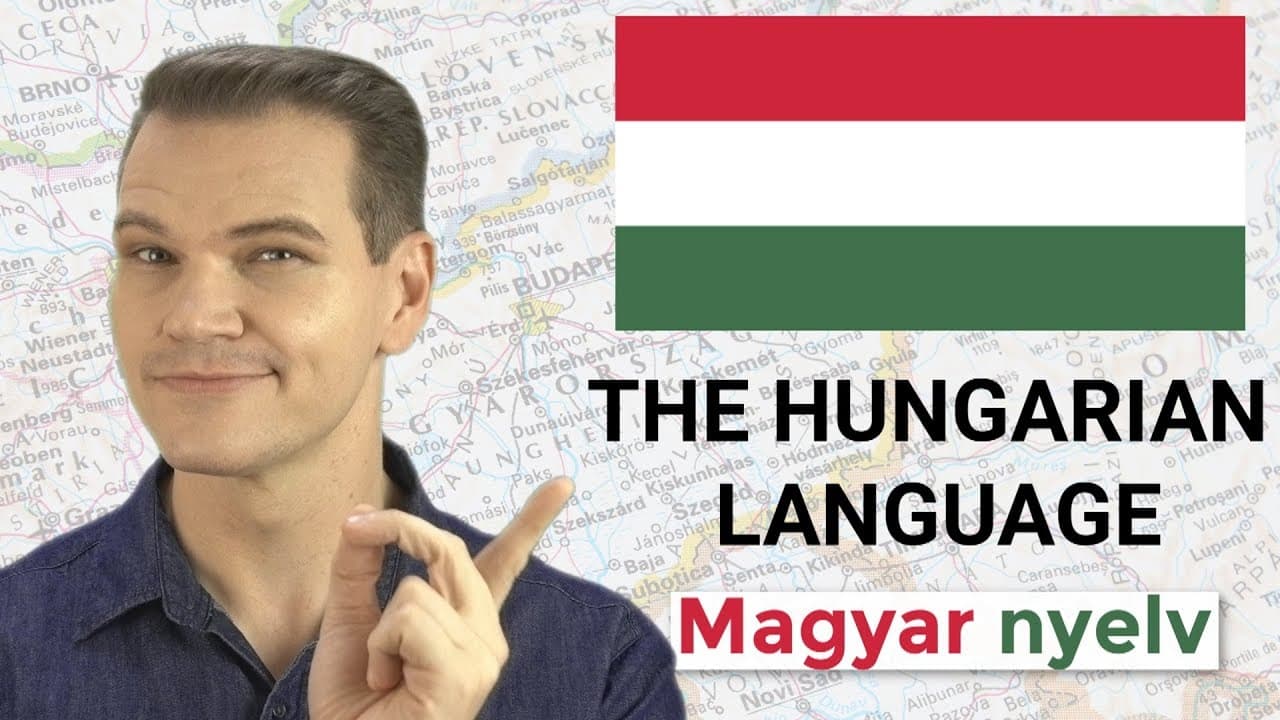
(upbeat music) Hello everyone. Welcome to the LangFocus channel and my name is Paul. Today's topic is the Hungarian language Or, "magyar nyelv," as it's called in Hungarian. Hungarian is not just another European language. There's nothing else quite like it. For starters, it's not an Indo-European language. So when you look at a map, and see that E... Read More
Key Insights
- Hungarian is a member of the Ugric branch of the Uralic language family, not the Indo-European family. Its closest ancient relationships are therefore connected to languages that developed around the Ural Mountains rather than to the neighboring languages of Central Europe.
- Hungarian speakers are concentrated in the Carpathian Basin, including around 10 million speakers in Hungary and communities in several neighboring countries. Northwestern and central Romania contain the largest minority described, with around 1.2 million speakers, or about 6 percent of Romania's population.
- The Magyars reached the Carpathian Basin in the 9th century after gradually migrating westward. Their long contact with Turkic peoples included participation in the Onogur tribal alliance and the Khazar Khaganate, contributing substantial Turkic influence to Hungarian vocabulary and writing.
- The name Hungarian most likely derives from Onogur, a Turkic tribal alliance whose name meant ten tribes. Related historical forms included Ungari in Latin, Oungroi in Greek, and Qguri in Proto-Slavic, even though Hungarians call their language magyar nyelv.
- Hungarian writing shifted toward the Latin alphabet after the Christian kingdom was established under Stephen I around the year 1000. The Old Hungarian script continued in vernacular use among Székely Magyars until at least the 17th century and later experienced a limited cultural revival.
- Hungarian language reform in the 18th and 19th centuries standardized the language and expanded its usefulness for literature and science. Reformers revived older vocabulary, created words from existing roots and affixes, and elevated selected dialect words into national usage.
- Hungarian is an agglutinative language, meaning that a word can contain a linear sequence of meaningful parts. Suffixes added to a noun may indicate plurality, possession, location, or case, allowing forms such as városomban to express the meaning in my city.
- Hungarian verbs distinguish definite and indefinite conjugations according to the object. Írok egy könyvet means I write a book, while írom a könyvet means I write the book. Hungarian also permits subject pronouns to be omitted because the verb form identifies the subject.
Install to Summarize YouTube Videos and Get Transcripts
Explore YouTube Video Summarizer or Get YouTube Transcript Extractor
Questions & Answers
Q: What language family does Hungarian belong to?
Hungarian belongs to the Ugric branch of the Uralic language family. The Uralic family originated near the Ural Mountains and includes Samoyedic and Finno-Ugric groupings. Proto-Ugric remained unified for more than a millennium before Hungarian diverged from it around 800 BCE, although those ancient relationships are not immediately obvious in modern Hungarian.
Q: How did Hungarian reach the Carpathian Basin?
The Magyars became nomadic around 2,000 years ago in response to changes in climate and landscape, then gradually migrated westward from the vicinity of the Ural Mountains. After extensive interaction with Turkic political groups, they crossed the Carpathian Mountains under Árpád in 896 and began settling in the Carpathian Basin. A Christian kingdom was established by the year 1000.
Q: Why are Hungarian speakers found outside Hungary?
Hungarian-speaking communities occupy several parts of the Carpathian Basin in Romania, Serbia, Croatia, Slovenia, Austria, Slovakia, and Ukraine. These areas had belonged to the Kingdom of Hungary until 1920, when the Treaty of Trianon redrew Hungary's borders and assigned many territories to neighboring countries. Consequently, millions of Hungarian speakers remained outside the new borders of Hungary.
Q: How did Turkic languages influence Hungarian?
Turkic influence developed through prolonged contact while the Magyars lived near the Ural Mountains and migrated west. They participated in the Turkic Onogur alliance and later became part of the Khazar Khaganate. One cited lexicon contains around 500 Old Turkic loanwords, and the Old Hungarian script developed from the Orkhon script used by the Khazars.
Q: What does agglutination mean in Hungarian grammar?
Agglutination means that Hungarian words are constructed by adding a linear sequence of meaningful suffixes to a root. Város means city, városok means cities, városom means my city, and városomban means in my city. Each added element contributes information such as plurality, possession, location, or grammatical case while preserving a recognizable root.
Q: How does vowel harmony affect Hungarian suffixes?
Vowel harmony determines which vowels appear inside Hungarian suffixes. The suffix form depends on the vowel in the word's final syllable and on the particular suffix being attached. Forms derived from város use vowels that harmonize with o, while forms derived from zseb use e, producing contrasts such as városomban and zsebemben for comparable grammatical meanings.
Q: Why does Hungarian have definite and indefinite verb conjugations?
Hungarian changes the conjugation of a transitive verb according to whether its object is definite or indefinite. Írok valamit means I write something, and írok egy könyvet means I write a book, both using the indefinite conjugation. Írom a könyvet means I write the book and uses the definite conjugation because the object is identified by the definite article.
Q: How does Hungarian express future actions and alter verb meanings?
Hungarian has almost no separate future-tense forms. Future meaning can instead be expressed with a verb's infinitive followed by a present-tense form of fogni, as in írni fogok egy könyvet, meaning I will write a book. Prefixes also modify verbs: ül means to sit, leül means to sit down, and felül can mean to sit up.
Summary & Key Takeaways
-
Hungarian belongs to the Ugric branch of the Uralic family rather than the Indo-European family surrounding it in the Carpathian Basin. The Magyars gradually migrated west from the Ural region, interacted extensively with Turkic peoples, and entered the Carpathian Basin under Árpád in 896 before establishing a Christian kingdom.
-
Hungarian accumulated vocabulary from Old Turkic, Slavic, German, Iranic, Latin, and Turkish sources. It was written in both the Old Hungarian and Latin scripts, while Latin remained Hungary's official language for centuries. Reforms in the 18th and 19th centuries standardized Hungarian and expanded its literary and scientific vocabulary.
-
Hungarian builds words by attaching sequences of suffixes to roots. Vowel harmony changes suffix vowels according to a word's final syllable, while verbs distinguish definite from indefinite objects. Subjects may be omitted, future meaning usually uses an infinitive with fogni, and prefixes can adjust or completely transform a verb's meaning.
Read in Other Languages (beta)
Share This Summary 📚
Summarize YouTube Videos and Get Video Transcripts with 1-Click
Try YouTube Summary with ChatGPT & Claude or YouTube Transcript Generator
Explore More Summaries from Langfocus 📚

Summarize YouTube Videos and Get Video Transcripts with 1-Click
Try YouTube Summary with ChatGPT & Claude or YouTube Transcript Generator