What is OpenAI’s 722-math-paper breakthrough?
TL;DR
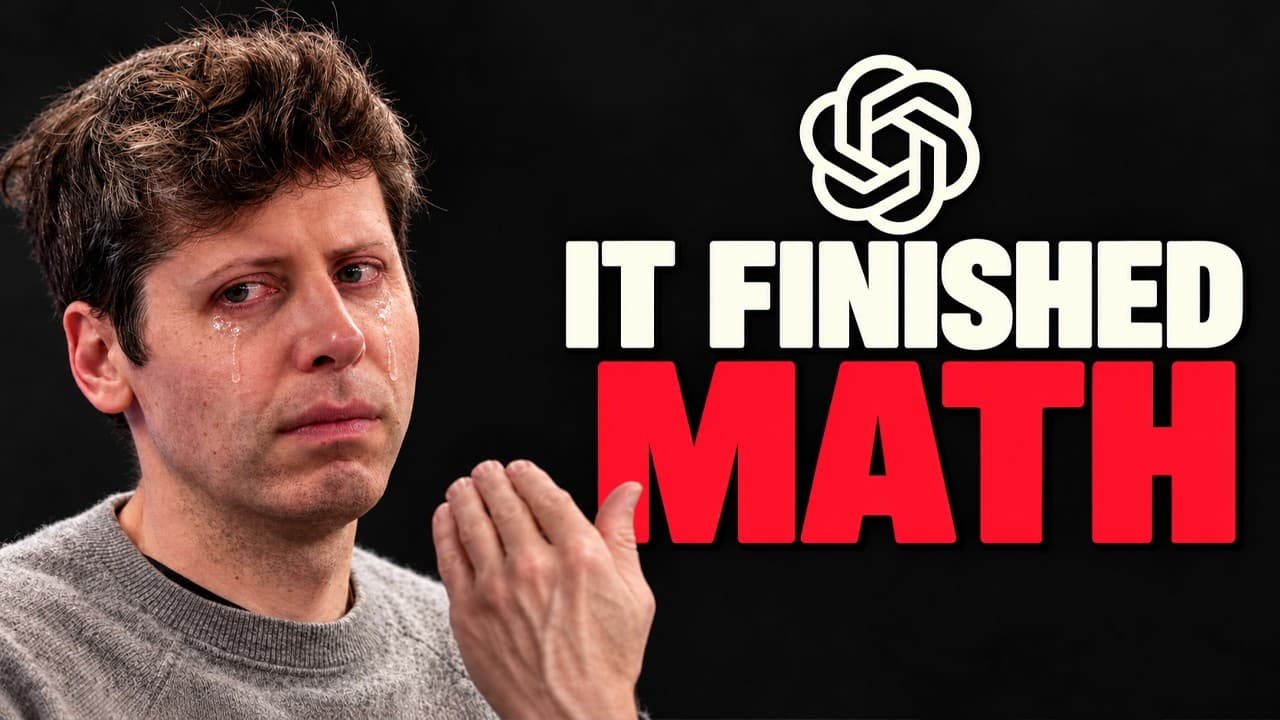
OpenAI released a large set of math papers, including results on the Riemann hypothesis and other Millennium Prize problems, generated by a model that trained on solving unsolved math tasks. The move sparked debate among mathematicians about AI-driven discovery and the need for transparent verification and public access. The work was published in a public repository and accompanied by discussions of proof checking and community guidelines.
Transcript
An AI just took on hundreds of math problems humans have been stuck on for decades, and the people who should be celebrating are furious. OpenAI dropped 722 math papers onto GitHub in one go, all written by a model nobody outside the company can use. One of them takes the biggest swing in 160 years at the Riemann hypothesis, probably the most famou... Read More
Key Insights
- OpenAI published 722 math papers in a public repository called OpenAI/math.
- The work includes 372 families of results and Lean-verified proofs for many papers.
- The Riemann hypothesis results claim a fence around critical points and rule out Siegel zeros under certain conditions.
- A second major claim concerns the unique games theorem and proving it using AI, challenging prior assumptions.
- The model tackled Millennium Prize problems and related conjectures, including Hodge and Kakeya in multiple dimensions.
- There is debate among mathematicians about the speed and ethics of AI-driven discovery and publication.
- Guidelines from the Institute for Advanced Study were discussed to ensure responsible sharing and reproducibility.
- OpenAI argues for better disclosure standards and public model access to advance science.
Install to Summarize YouTube Videos and Get Transcripts
Explore YouTube Video Summarizer or Get YouTube Transcript Extractor
Questions & Answers
Q: What is the scope of OpenAI’s math paper release and how is it organized?
OpenAI released 722 math papers into a public repository called OpenAI/math. The papers are grouped into 372 families, with 235 of those families also including proofs in Lean, a formal language that allows computer-checked verification of each step. Old versions are kept public, and every paper is ready to cite, supporting reproducibility and traceability.
Q: Which major problems does the release address and what is claimed?
The release addresses problems such as the Riemann hypothesis, the Hodge conjecture, the Kakeya problem, and Hilbert’s 10th problem, among others. OpenAI claims the model achieved breakthroughs on these Millennium Prize problems and related conjectures, providing computer-checked proofs for some results and showing significant progress in others.
Q: What controversy surrounds OpenAI’s approach to releasing these results?
Mathematicians are upset about rapid, large-scale releases of powerful AI-driven results without the usual peer review and time for verification. They worry about trust, potential mistakes, and the impact on traditional mathematical research. Some call for responsible sharing, public model access, and better documentation of how problems were chosen and solved.
Q: How does Lean contribute to these papers?
Lean provides a formal proof framework that lets computer-verified checks confirm each step of a proof. For 235 families, Lean proofs accompany the results, offering a higher level of reliability and reproducibility than traditional proofs, while the rest may still be under human review or awaiting formalization.
Q: What are the implications for unsolved problems and AI in mathematics?
If AI can solve Millennium Prize problems and provide verifiable proofs, it could accelerate discovery beyond textbook problems and push mathematics toward new methods of collaboration with machines. This raises questions about the role of human mathematicians and how to balance speed, accuracy, and transparency in future research.
Q: What does the controversy say about openness versus control in AI research?
The discussions reflect a tension between openness and controlled delivery of AI-driven scientific results. While openness can accelerate validation and collaboration, it also risks spreading imperfect or unvetted findings. The math community is calling for guidelines, provenance, and public access to underlying prompts and results in a reproducible way.
Q: What did the OpenAI and academic communities propose to manage this shift?
Proposals include publishing papers with explanation of methods, prompts, reasoning summaries, and costs; using platforms like Hexagon and Palamar for machine-checked proofs; and adopting the Leiden Declaration for broader mathematical community governance. These measures aim to ensure accountability, reproducibility, and responsible use of AI in math.
Q: How did the math community respond to the Navier–Stokes and other breakthroughs?
The Navier–Stokes breakthroughs sparked accusations of unfair competition and concerns about speed and access. Mathematicians emphasized the need for transparent teams, public modeling details, and fair attribution, contrasting the rapid AI-driven strides with the slower, traditional pace of human-led research.
Summary & Key Takeaways
-
OpenAI released 722 math papers in a public repository, grouped into 372 families, with 235 having Lean proofs for validation.
-
The papers include major results touching the Riemann hypothesis, Hodge conjecture, and other Millennium Prize problems, as well as theoretical limits like the unique games theorem.
-
Mathematicians react with concern and calls for community oversight, public proofs, and transparent disclosure as AI accelerates discovery and challenges traditional research paradigms.
Read in Other Languages (beta)
Share This Summary 📚
Summarize YouTube Videos and Get Video Transcripts with 1-Click
Try YouTube Summary with ChatGPT & Claude or YouTube Transcript Generator
Explore More Summaries from AI Revolution 📚




Summarize YouTube Videos and Get Video Transcripts with 1-Click
Try YouTube Summary with ChatGPT & Claude or YouTube Transcript Generator