How Do Don't-Care Terms Simplify K-Maps?
TL;DR
Don't-care terms may be assigned either 0 or 1 when simplifying a K-map, depending on which choice produces the simpler implementation. For F(A,B,C) with minterms 2, 3, 4, and 5 and don't-cares 6 and 7, ignoring the don't-cares gives A XOR B, while treating them as 1 gives A OR B. Both match every required output.
Transcript
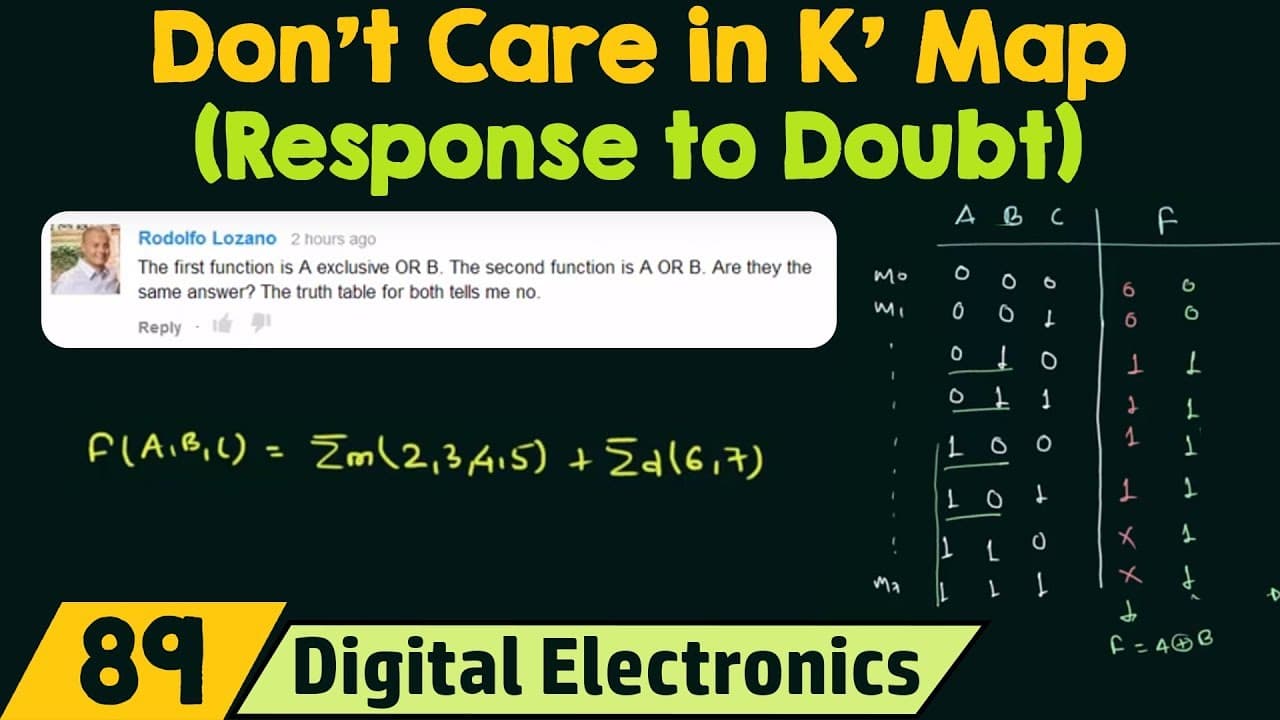
welcome to this presentation in which I will try to clear the doubt of one of our viewers related to the don't care in kmap so the function which I took was F having the Min terms 2 3 45 and the don't care 67 I in first case solved the kmap without using the don't cares as you can see here and uh I found out that the function is equal to a xor B th... Read More
Key Insights
- A don't-care term is an output entry that can be treated as either 0 or 1 during K-map simplification. The chosen value should support a simpler grouping and does not need to match a required output for that input combination.
- The example function is F(A,B,C) with minterms 2, 3, 4, and 5 and don't-care terms 6 and 7. Since it has three variables, its truth table contains eight possible input combinations, labeled m0 through m7.
- The required outputs are 1 at m2, m3, m4, and m5, while m0 and m1 are 0. The outputs at m6 and m7 are unspecified, so they can be selected according to the needs of the simplification.
- Ignoring the don't-care terms produces F = A XOR B. At the required output rows, the function is true when exactly one of A and B is 1, which matches the odd-ones behavior described for XOR.
- Assigning 1 to both don't-care entries produces F = A OR B. With this assignment, the output is 1 whenever B is 1 or A is 1 across the combinations considered in the completed truth table.
- A XOR B and A OR B are not identical Boolean functions across their full truth tables. Their apparent equivalence in this example exists only because the input rows where they differ correspond to the specified don't-care terms.
- Both simplified expressions satisfy the original function because each produces the required values at every specified minterm and zero-output row. A don't-care specification permits different outputs at m6 and m7, so equality at those rows is unnecessary.
- The OR implementation uses a single two-input OR gate, while the XOR form can be written as A complement B OR B complement A. The presentation states that the larger implementation increases the number of gates, decreases speed, and increases power dissipation.
Install to Summarize YouTube Videos and Get Transcripts
Explore YouTube Video Summarizer or Get YouTube Transcript Extractor
Questions & Answers
Q: What does a don't-care term mean in a K-map?
A don't-care term represents an input combination whose output is not required to be a specific value. During K-map simplification, it may be treated as either 0 or 1. The useful choice is the one that supports simpler grouping. In the example, terms 6 and 7 are don't-cares, so assigning them 1 enables the simpler expression A OR B.
Q: How are the outputs assigned for the example function?
The function F(A,B,C) has minterms 2, 3, 4, and 5, so its output is 1 at m2, m3, m4, and m5. The remaining specified outputs, m0 and m1, are 0. Terms m6 and m7 are don't-cares. Since A, B, and C are three variables, the complete truth table contains eight possible input combinations.
Q: Why does ignoring the don't-cares produce A XOR B?
When the don't-care entries are not used as 1, the required true rows are m2, m3, m4, and m5. Across those rows, the output is true when A and B contain an odd number of ones, meaning one is 0 and the other is 1. This behavior matches A XOR B, independently of the value assigned to C.
Q: Why does assigning the don't-cares to 1 produce A OR B?
Assigning 1 to don't-care terms m6 and m7 makes the output true for the additional rows where A and B are both 1. Combined with minterms m2, m3, m4, and m5, the completed output is true whenever A is 1 or B is 1. Therefore, the K-map simplifies to the expression F = A OR B.
Q: Are A XOR B and A OR B the same Boolean function?
A XOR B and A OR B are not the same across their complete truth tables. XOR is false when A and B are both 1, while OR is true for that combination. In the given function, however, the corresponding rows are m6 and m7, which are don't-cares. Their different outputs there do not violate any specified requirement.
Q: How can two different expressions both solve the same K-map?
Two expressions can both solve the K-map when they agree on every required output and differ only at don't-care entries. A XOR B and A OR B both produce 1 at minterms 2, 3, 4, and 5 and 0 at the required zero rows. Their disagreement occurs at terms 6 and 7, where either output is permitted.
Q: Which expression gives the simpler implementation in this example?
A OR B gives the simpler implementation described in the presentation because it requires a single two-input OR gate. Without using the don't-care terms, A XOR B can be expressed as A complement B OR B complement A, which involves more logic. The presentation associates the additional gates with reduced speed and increased power dissipation.
Q: How should a result involving don't-cares be checked?
A result involving don't-cares should be checked against the particular function specified in the question, not by asking whether the simplified expressions have identical complete truth tables. Verify the required 1 outputs, the required 0 outputs, and then identify whether any disagreements occur only at don't-care rows. If they do, both expressions can satisfy the specification.
Summary & Key Takeaways
-
The example uses the three-variable function F(A,B,C), with minterms 2, 3, 4, and 5 and don't-care terms 6 and 7. Because three variables produce eight possible input combinations, the truth table includes entries from m0 through m7, with the final two outputs left unspecified as don't-cares.
-
When the don't-care entries are not used, the required output is 1 where A and B contain an odd number of ones. This pattern produces F = A XOR B. The variable C does not affect the simplified result because both values of C occur for each required combination of A and B.
-
When don't-care entries 6 and 7 are assigned 1, every input combination where A or B equals 1 has output 1. The simplified function becomes F = A OR B. Although XOR and OR have different complete truth tables, both satisfy the specified minterms because their differences occur at the don't-care entries.
Read in Other Languages (beta)
Share This Summary 📚
Summarize YouTube Videos and Get Video Transcripts with 1-Click
Try YouTube Summary with ChatGPT & Claude or YouTube Transcript Generator
Explore More Summaries from Neso Academy 📚





Summarize YouTube Videos and Get Video Transcripts with 1-Click
Try YouTube Summary with ChatGPT & Claude or YouTube Transcript Generator