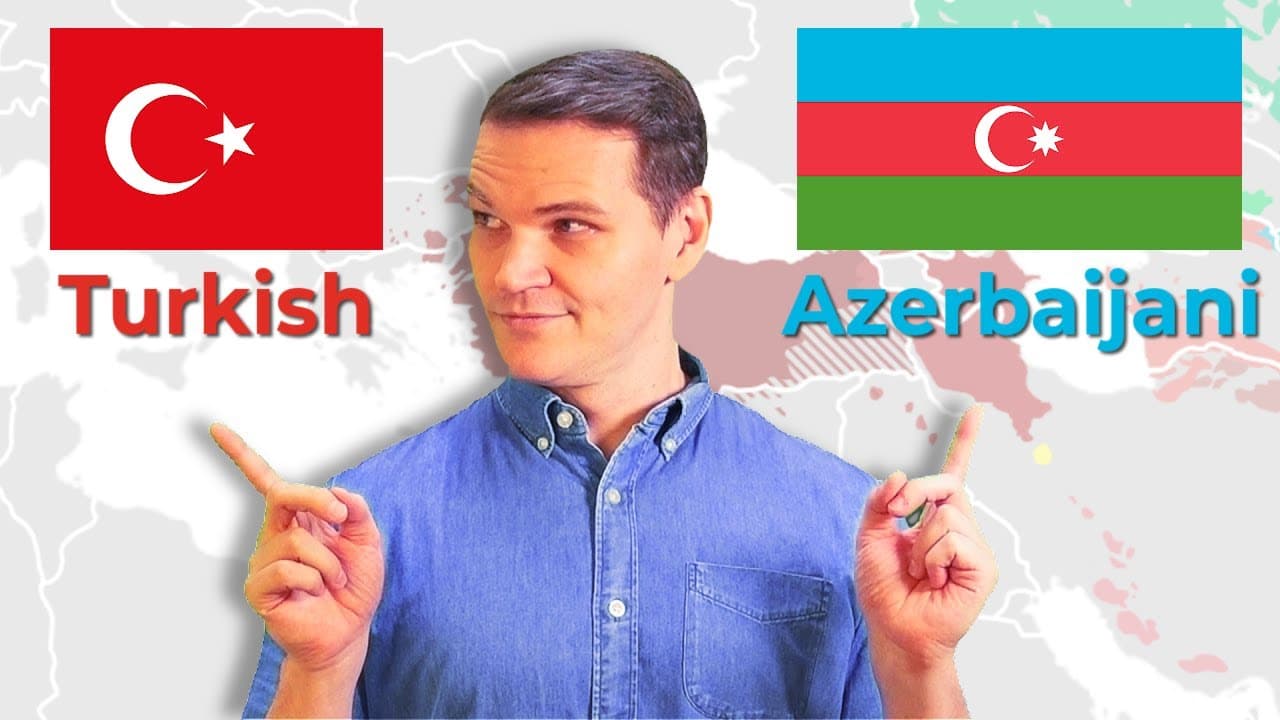
Turkish vs Azerbaijani (How SIMILAR are they?)
TL;DR
Turkish and Azerbaijani are 65-90% mutually intelligible.
Transcript
the turkic language family is a huge family of languages with over 170 million native speakers stretching all the way from europe to northeast asia there are many different languages in this family including turkish azerbaijani or azeri turkmen kazakh tatar and wigar among others interestingly i've spoken with people from turkey who tell me that tu... Read More
Key Insights
- Turkic languages are spoken by over 170 million people from Europe to Northeast Asia, with Turkish and Azerbaijani being closely related.
- Mutual intelligibility between Turkish and Azerbaijani is high, ranging from 65% to 90%, depending on exposure and regional dialects.
- Azerbaijani speakers often understand Turkish better due to exposure to Turkish media, while Turkish speakers require more time to understand Azerbaijani.
- Both languages belong to the Oghuz branch of the Turkic family, sharing historical roots and similar grammar structures.
- Turkish underwent language reforms in the 1920s, removing many Persian and Arabic loanwords, unlike Azerbaijani, which retains more of these words.
- The two languages differ in vocabulary, pronunciation, and orthography, with numerous false friends and cognates having different meanings.
- The grammar of both languages is agglutinative, but there are isolated differences such as the use of suffixes and question formation.
- Azerbaijani has been influenced by Russian due to historical Soviet control, leading to Russian loanwords in the language.
Install to Summarize YouTube Videos and Get Transcripts
Explore YouTube Video Summarizer or Get YouTube Transcript Extractor
Questions & Answers
Q: What is the mutual intelligibility level between Turkish and Azerbaijani?
The mutual intelligibility level between Turkish and Azerbaijani ranges from 65% to 90%. Azerbaijani speakers generally understand Turkish better due to exposure to Turkish media, while Turkish speakers need several weeks of exposure to comprehend Azerbaijani well. This level of understanding can vary based on regional dialects and individual exposure.
Q: How did historical events influence the similarities between Turkish and Azerbaijani?
Historical events such as the Seljuk Empire's conquests in the 11th century contributed to the spread of Oghuz Turkic languages, including Turkish and Azerbaijani. These languages diverged over time due to different rulers and influences. The Ottoman Empire's influence led to shared literary forms, but post-Ottoman reforms in Turkey removed many Persian and Arabic words, creating differences.
Q: What are some key differences in vocabulary between Turkish and Azerbaijani?
Turkish and Azerbaijani have differences in vocabulary, with Turkish undergoing reforms to remove Persian and Arabic loanwords, while Azerbaijani retains more of these words. Both languages have false friends and cognates with different meanings, such as words for 'summer' and 'spring' or 'muffin' and 'bread,' requiring speakers to be cautious of these differences.
Q: How do Turkish and Azerbaijani differ in their use of scripts?
Turkish adopted the Latin script after language reforms in the 1920s, while Azerbaijani has used various scripts due to historical influences. South Azerbaijani, spoken in Iran, still uses the Perso-Arabic script. North Azerbaijani, after Soviet influence, was written in Cyrillic until it switched to the Latin script post-independence in 1991.
Q: What role do Russian loanwords play in Azerbaijani?
Russian loanwords in Azerbaijani are a result of the historical control by the Russian Empire and the Soviet Union. These loanwords are found in various domains, such as administration and military, and include examples like the word for 'pencil,' which was borrowed from Russian. This influence adds another layer of complexity to the language.
Q: How do Turkish and Azerbaijani handle question formation differently?
In Turkish, question-forming suffixes are attached to the verb, while in Azerbaijani, these suffixes are placed at the end of the sentence. However, in daily Azerbaijani speech, questions are often indicated by intonation rather than suffixes, showcasing a pragmatic difference in spoken language.
Q: What is the impact of Turkish language reforms on its vocabulary?
The Turkish language reforms of the 1920s aimed to purify the language by removing many Persian and Arabic loanwords, replacing them with words of Turkic origin. This has led to a more distinct vocabulary compared to Azerbaijani, which did not undergo similar reforms and retains more Persian and Arabic influences.
Q: How do Turkish and Azerbaijani handle the use of personal pronouns differently?
While most personal pronouns are similar in Turkish and Azerbaijani, the pronoun for 'I' differs, with 'ben' in Turkish and 'men' in Azerbaijani. This difference is an example of the minor variations in vocabulary and pronunciation that exist between the two languages, despite their overall grammatical similarity.
Summary & Key Takeaways
-
Turkish and Azerbaijani are closely related Turkic languages with high mutual intelligibility, influenced by historical and geographical factors. Turkish speakers often require exposure to understand Azerbaijani, while Azerbaijani speakers are more familiar with Turkish due to media consumption.
-
The two languages share a common grammatical structure but differ in vocabulary and pronunciation. Turkish underwent significant language reforms in the 1920s, removing many Persian and Arabic influences, leading to differences in the lexical items used in both languages.
-
Azerbaijani retains more Persian and Arabic loanwords and has also been influenced by Russian, especially during the Soviet era. The languages have numerous false friends and cognates with different meanings, requiring speakers to become familiar with these differences for effective communication.
Read in Other Languages (beta)
Share This Summary 📚
Summarize YouTube Videos and Get Video Transcripts with 1-Click
Try YouTube Summary with ChatGPT & Claude or YouTube Transcript Generator
Explore More Summaries from Langfocus 📚


Summarize YouTube Videos and Get Video Transcripts with 1-Click
Try YouTube Summary with ChatGPT & Claude or YouTube Transcript Generator