What Are the Essential Components of a Graph?
TL;DR
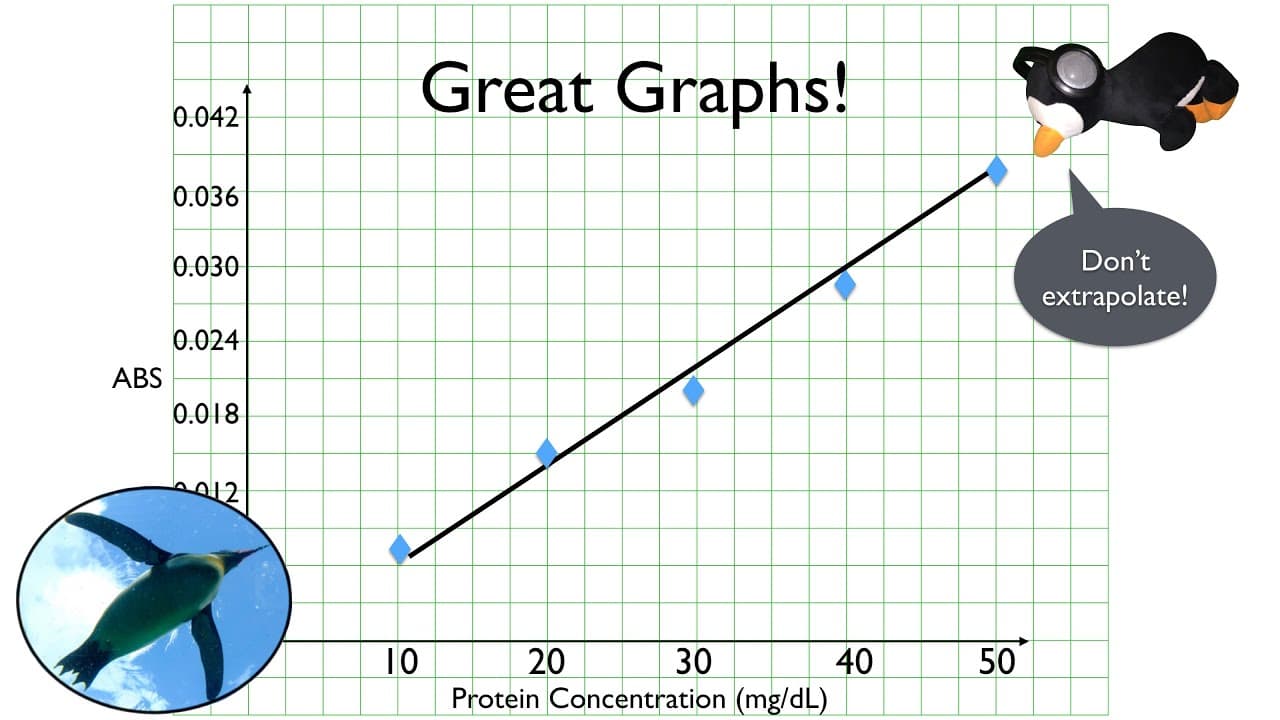
The essential components of a graph include a descriptive title, legends for multiple datasets, and properly labeled axes with units. To create a graph, choose the appropriate type, determine the range, plot data points, and consider drawing a line of best fit if necessary. Understanding these elements is crucial for accurately representing and interpreting data in biology and natural sciences.
Transcript
Hello, and welcome to the Penguin Prof Channel. This video is a part of my Laboratory Success Series. And we are going to be looking at great graphs. Before we get into it, I'm going to ask for your support. You want to feed the penguin by clicking those buttons below. You know it feels good. Another way you can feed the penguin is by supporting... Read More
Key Insights
- 🛟 Different types of graphs serve different purposes in biology and natural sciences.
- 📈 Essential components of a graph include a title, legend, axis titles, and units of measure.
- 👋 Creating a graph by hand involves determining the range, plotting data points, and drawing a line of best fit if necessary.
- 🏆 Outliers should be evaluated based on statistical tests and the context of the data.
- 🍳 Breaking the axis can enhance the visualization of data with extreme values.
- 👶 Percent change can be calculated as (new value - original value) / |original value| * 100.
- 🔬 Graphing skills are valuable in biology and natural sciences laboratory work.
Install to Summarize YouTube Videos and Get Transcripts
Explore YouTube Video Summarizer or Get YouTube Transcript Extractor
Questions & Answers
Q: What are some common types of graphs used in biology and natural sciences?
Some common types of graphs used in biology and natural sciences include pie graphs, bar graphs, scatter plots, line graphs, and frequency histograms. Each graph type serves a specific purpose in visualizing and analyzing data.
Q: What are the essential components of a graph?
The essential components of a graph include a descriptive title, a legend (if multiple data sets are present), axis titles with units of measure, and data points or lines. These components should be clear and informative, allowing the reader to understand the data being presented.
Q: How do you create a graph by hand?
To create a graph by hand, you start by collecting the data and determining the best type of graph to use. Then, you determine the range of the data and choose appropriate increments for the axis. After plotting the data points, you can draw a line of best fit if necessary. Finally, you can measure the slope of the line by selecting two points and calculating the rise over the run.
Q: How should outliers be handled in a graph?
The handling of outliers depends on the context and purpose of the data. In an educational setting, it is recommended to consult with the professor or instructor about whether to retain or exclude outliers. In research, statistical tests like Q tests can help determine the validity of outliers and whether they should be kept or discarded.
Q: When should you break the axis in a graph?
Breaking the axis is useful when the dataset contains values that are significantly different from others, making it difficult to visualize the majority of the data. By breaking the axis, you can ensure the details of the majority data are visible while still displaying the outliers or extreme values.
Summary & Key Takeaways
-
Introduction to different types of graphs, including pie graphs, bar graphs, scatter plots, line graphs, and frequency histograms.
-
Explanation of the essential components of a graph, such as titles, legends, and axis.
-
Step-by-step instructions for creating a graph by hand, including determining the range, plotting data points, drawing a line of best fit, and measuring the slope of a line.
-
Tips for handling outliers, breaking the axis, and calculating percent change in a graph.
Read in Other Languages (beta)
Share This Summary 📚
Summarize YouTube Videos and Get Video Transcripts with 1-Click
Try YouTube Summary with ChatGPT & Claude or YouTube Transcript Generator
Explore More Summaries from ThePenguinProf 📚



Summarize YouTube Videos and Get Video Transcripts with 1-Click
Try YouTube Summary with ChatGPT & Claude or YouTube Transcript Generator