How to Develop a Winning Product Strategy
TL;DR
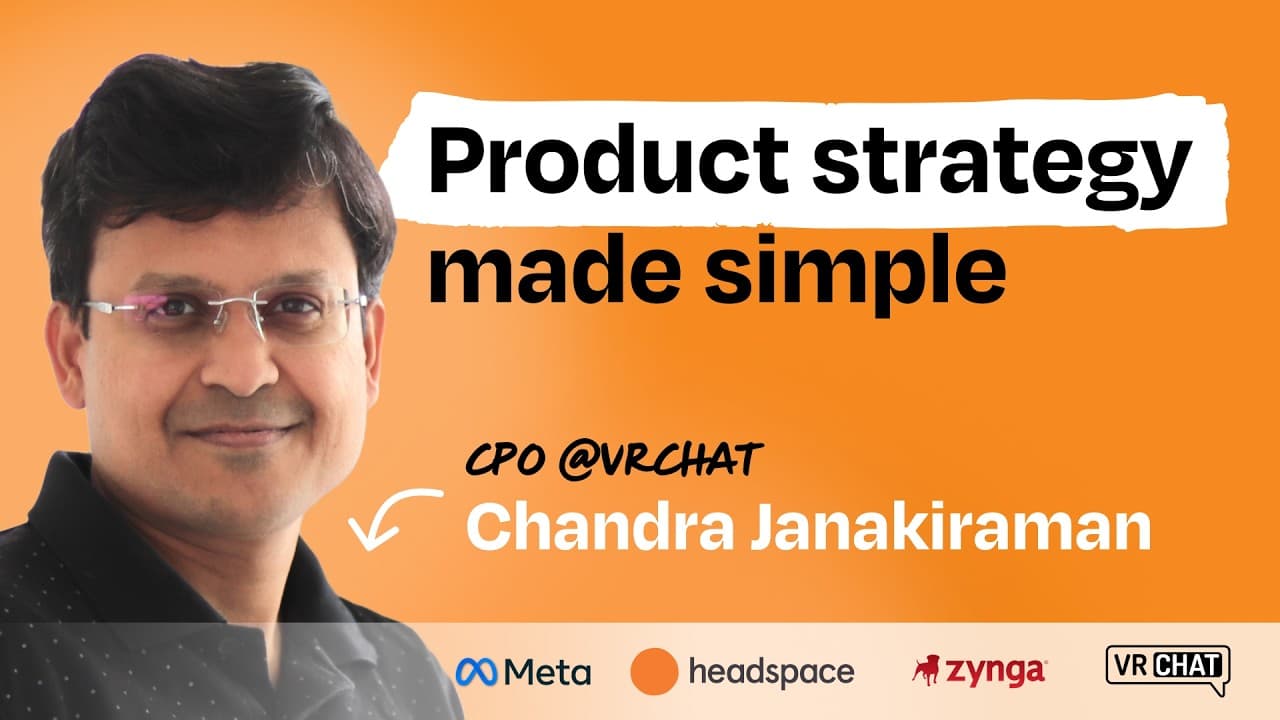
To develop a winning product strategy, follow a structured process that includes preparation, strategy sprints, and design sprints. This approach helps in identifying strategic pillars and aligning team efforts towards maximum impact. The process emphasizes collaboration, input gathering, and iterative testing to ensure the strategy is effective and adaptable.
Transcript
I started noticing that there was a certain mystique and aura about product strategy. There was this perception that some people were intrinsically really good at strategy and others were not. It was almost as if there was a strategy gene you needed to be born with to be good at it. Say someone's sitting down, okay, I'm going to start develop... Read More
Key Insights
- Product strategy sits between mission/vision and the plan, forcing choice to deploy resources for maximum impact.
- The strategy process involves five phases: preparation, strategy sprint, design sprint, document writing, and rollout.
- Preparation phase includes forming a strategy working group and gathering insights from data, user research, and leadership interviews.
- Strategy sprint is the heart of the process, focusing on identifying and prioritizing strategic pillars based on impact and feasibility.
- Design sprint generates illustrative concepts to bring strategic pillars to life, not detailed features.
- Document writing consolidates insights and strategy into a cohesive story, separate from the roadmap.
- Rollout involves aligning key stakeholders and team members, ensuring the strategy is understood and actionable.
- Big-S strategy focuses on aspirational goals and future trends, complementing the problem-focused small-S strategy.
Install to Summarize YouTube Videos and Get Transcripts
Explore YouTube Video Summarizer or Get YouTube Transcript Extractor
Questions & Answers
Q: How to develop a product strategy?
To develop a product strategy, follow a structured process that includes preparation, strategy sprints, and design sprints. Start by forming a strategy working group and gathering insights from data, user research, and leadership interviews. During the strategy sprint, identify and prioritize strategic pillars based on impact and feasibility. The design sprint helps generate concepts that illustrate these pillars. Finally, consolidate the strategy into a document and align stakeholders through a rollout process.
Q: What is the difference between small-S and big-S strategy?
Small-S strategy focuses on solving current problems and is typically present-forward, operating on a two-year horizon. It emphasizes identifying strategic pillars to deploy resources effectively. Big-S strategy, on the other hand, is aspirational and future-backward, considering long-term trends and goals over a three to ten-year horizon. It involves envisioning different futures and testing concepts to inform the strategic direction.
Q: What are strategic pillars in product strategy?
Strategic pillars are the key focus areas identified during the strategy development process that guide where resources should be deployed for maximum impact. They are derived from analyzing problems and opportunities, and are prioritized based on criteria such as expected impact, certainty of impact, clarity of levers, and differentiation. These pillars form the foundation of a product strategy, helping align team efforts.
Q: How does AI impact product strategy development?
AI tools can significantly enhance product strategy development by assisting in research, such as competitive analysis and trend identification. They can generate mock strategies, providing a comprehensive view of potential focus areas, although human judgment is still needed to prioritize and refine these insights. In the future, AI may automate more complex strategy workflows, offering real-time optimization and iteration.
Q: What is the role of a strategy working group?
A strategy working group is a small team, typically comprising representatives from engineering, product, design, and data, that collaborates to create the product strategy. The group is responsible for gathering insights, identifying strategic pillars, and ensuring alignment within the team. The PM usually drives the process, but the strategy is a collective effort, incorporating diverse perspectives and expertise.
Q: Why is alignment important in strategy development?
Alignment is crucial in strategy development to ensure that all team members and stakeholders understand and support the strategic direction. It facilitates effective collaboration, minimizes resistance, and enhances the likelihood of successful execution. The strategy development process incorporates alignment through leadership interviews, collaborative workshops, and stakeholder rollouts, ensuring buy-in and cohesion.
Q: How long does the strategy development process take?
The strategy development process typically takes eight to twelve weeks for small-S strategy, which focuses on current problems and solutions. This timeframe allows for thorough preparation, strategy sprints, and design sprints, leading to a well-defined strategy document. Big-S strategy, which is more aspirational and future-focused, can take up to six months, as it involves exploring long-term trends and envisioning potential futures.
Q: What are common pitfalls in strategy development?
Common pitfalls in strategy development include insufficient preparation, lack of alignment among stakeholders, and failure to prioritize effectively. Strategies can also falter if they are too broad or lack focus, or if there is inadequate testing and iteration. Ensuring a structured process, clear communication, and ongoing evaluation can help mitigate these risks and lead to a successful product strategy.
Summary & Key Takeaways
-
Product strategy is crucial in aligning a team’s efforts with the company's mission and vision, sitting between these and the actionable plan. It involves making strategic choices to deploy resources effectively, ensuring maximum impact.
-
The strategy development process is divided into five phases: preparation, strategy sprint, design sprint, document writing, and rollout. Each phase has specific goals, from gathering insights to aligning stakeholders.
-
Big-S strategy emphasizes long-term aspirations and trends, while small-S strategy focuses on current problems and solutions. Both approaches are essential for a comprehensive product strategy, with AI tools increasingly aiding in their development.
Read in Other Languages (beta)
Share This Summary 📚
Summarize YouTube Videos and Get Video Transcripts with 1-Click
Try YouTube Summary with ChatGPT & Claude or YouTube Transcript Generator
Explore More Summaries from Lenny's Podcast 📚




Summarize YouTube Videos and Get Video Transcripts with 1-Click
Try YouTube Summary with ChatGPT & Claude or YouTube Transcript Generator