How to Build Career Value When AI Knows More
TL;DR
Career value in an AI economy comes increasingly from judgment, taste, agency, rapid adaptation, sustained intent, and the ability to handle interruptions, rather than from accumulating knowledge alone. As AI makes information and polished credentials easier to produce, workers should focus on choosing worthwhile goals, recognizing machine errors, adapting faster than skills become obsolete, and demonstrating unmistakably human competence.
Transcript
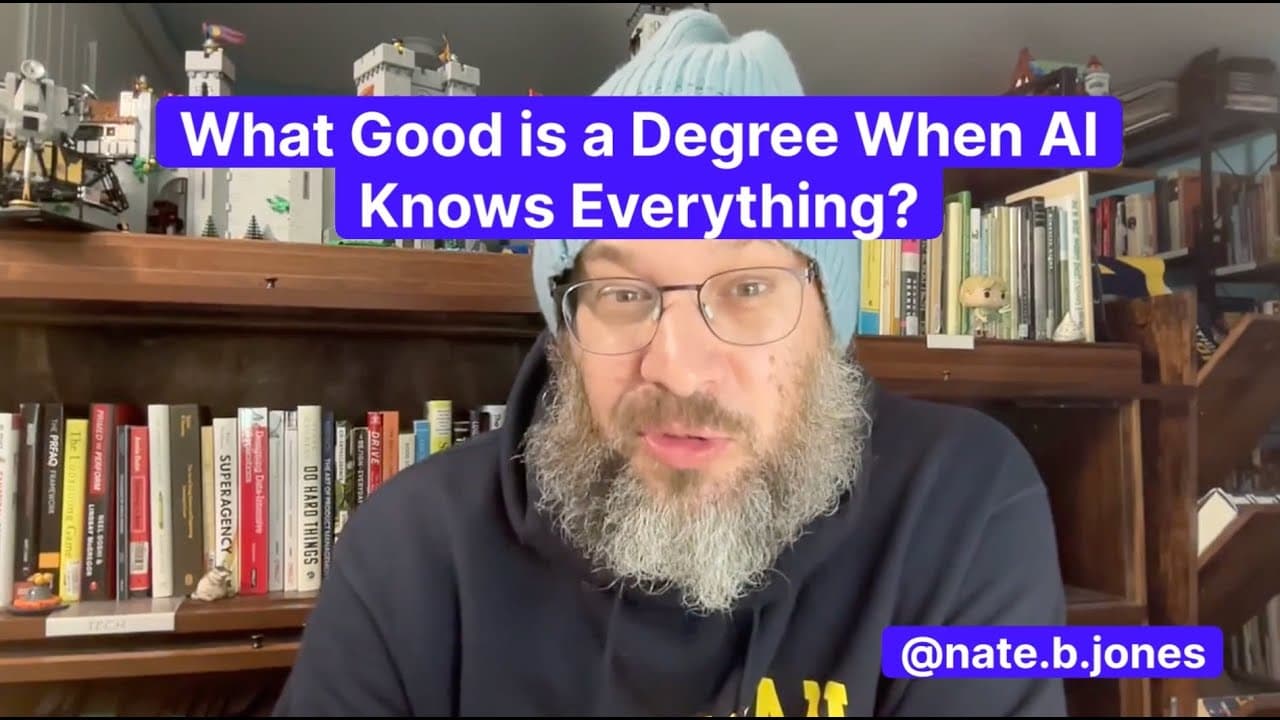
We need to talk about the knowledge economy. It's fundamentally broken and I want to take it apart and talk about each of the pieces. We're going to talk about college. We're going to talk about job seeking. We're going to talk about how knowledge accumulates in the economy and underneath it all AI. So stick with me. Number one, let's learn about t... Read More
Key Insights
- Knowledge hyperinflation is a condition in which information and capabilities expand too quickly for any person to absorb them comprehensively. Human knowledge reportedly took about a century to double before 1900, about 25 years after World War II, and roughly 12 or 13 months by the early 2000s.
- Traditional credentials are losing meaning because education is often treated as a route to grades, networks, and employment rather than learning for its own sake. When students can use ChatGPT to complete academic work, a degree or high grade may provide weaker evidence of genuine knowledge and capability.
- Résumés are becoming unreliable signals because generative systems can simulate polished application documents. Monster's bankruptcy is presented as evidence that internet-era job discovery and résumé-based hiring no longer solve the central problem of determining whether an applicant can actually perform well.
- Taste is the ability to select worthwhile problems, solutions, and outputs from the many options AI can generate. Its value includes knowing what to build, understanding what should not be built, and choosing an appropriate course when machine-assisted execution makes production abundant.
- Extreme agency is the capacity to operate with minimal direction while taking substantial ownership. If AI increasingly handles execution, people create value by setting goals, defining priorities, correcting course, and building systems that turn broadly stated intentions into coherent and useful results.
- Learning velocity is the speed at which a person adapts, rather than the volume of knowledge already accumulated. As technical skills lose relevance more quickly, advantage shifts toward people who can learn faster than knowledge changes and repeatedly adjust to new tools, requirements, and conditions.
- Intent horizon is the ability to maintain coherent goals over long periods. Current LLMs are described as instantiated without previous memory, making sustained strategic continuity a weak point even when they can work on tactical tasks for several hours.
- Interruptibility is a human capacity to absorb interruptions, switch contexts, and understand changed circumstances. LLM interactions generally work best when conversations remain consistent, so people may retain an advantage in environments where priorities shift and tasks require fluid movement between different contexts.
Install to Summarize YouTube Videos and Get Transcripts
Explore YouTube Video Summarizer or Get YouTube Transcript Extractor
Questions & Answers
Q: What is a knowledge hyperinflation economy?
A knowledge hyperinflation economy is one in which information and capabilities grow so rapidly that individuals cannot keep up through conventional study or accumulation. Human knowledge reportedly took about a century to double before 1900, about 25 years after World War II, and around 12 or 13 months by the early 2000s. AI-driven software releases every 3 or 4 months suggest an even faster environment.
Q: Why are college degrees becoming weaker career signals?
College degrees become weaker signals when completing the educational ritual no longer reliably demonstrates learning, judgment, or practical competence. Students may rationally focus on grades, networks, and access to jobs, while using ChatGPT to help them get through coursework. This does not make learning worthless, but it means employers cannot assume that a credential alone proves what an applicant knows or can do.
Q: Why can AI make résumés less useful to employers?
AI can produce polished résumé language that simulates knowledge and competence, making it harder for employers to distinguish authentic capability from generated presentation. Résumés persist largely because they are the traditional application format, not because they reliably prove performance. Employers are therefore experimenting with in-person evaluation, whiteboard exercises, and work completed where AI assistance is clearly limited, at least for now.
Q: What is taste in an AI-driven workplace?
Taste is the judgment required to decide what should be built, which problem deserves attention, and which machine-generated option is appropriate. AI may supply a million possible outputs, but abundance does not determine which one matters. A person with taste can choose useful directions, reject unsuitable ideas, understand what should not be built, and connect execution to a meaningful purpose.
Q: Why will extreme agency matter as AI improves?
Extreme agency matters because stronger AI execution increases the importance of human direction. A highly agentic person can work with minimal supervision, accept ownership, establish priorities, define goals, correct mistakes, and build systems around the work. If machines become increasingly capable of carrying out specified tasks, people remain valuable by determining which tasks serve the goal and how changing conditions should alter the plan.
Q: How can workers develop value when technical skills change quickly?
Workers can build value by increasing learning velocity, which means improving how rapidly they understand and adapt to unfamiliar tools, skills, and conditions. The goal is not to accumulate enough knowledge to remain permanently current, since the useful life of a technical skill is being compressed. The more durable advantage is learning faster than knowledge changes and repeatedly adjusting before existing expertise becomes obsolete.
Q: What is an intent horizon, and why is it important?
An intent horizon is the capacity to preserve coherent goals and direction over a long period. It matters because extending an AI system from 3 hours of work to 7 hours mainly improves tactical endurance, not durable strategic continuity. Current LLMs are described as instantiated without previous memory, so people can contribute by maintaining long-term objectives, accumulated context, and consistent purpose across separate tasks and decisions.
Q: What human abilities could remain valuable beside AI?
Five proposed abilities are taste, extreme agency, learning velocity, long intent horizons, and interruptibility. Together, they let people choose worthwhile goals, act without constant direction, adapt faster than skills become obsolete, maintain coherent objectives, and switch contexts when circumstances change. These strengths support a judgment economy in which value comes from recognizing machine errors and rigidity, not from trying to possess more knowledge than AI.
Summary & Key Takeaways
-
Human knowledge once doubled far more slowly, but AI now helps software and information change within months. The resulting knowledge hyperinflation makes comprehensive mastery unrealistic and weakens established signals such as degrees, grades, and résumés. People increasingly need ways to demonstrate competence that cannot be reproduced merely by generating polished text.
-
Education and hiring remain organized around knowledge accumulation and credential-based proof, even as AI can help students complete assignments and applicants simulate strong résumés. Colleges, employers, and workers therefore face a shared problem: grades and application documents reveal less about genuine capability, judgment, motivation, or the ability to perform meaningful work.
-
The proposed alternative is a judgment economy centered on five human strengths: taste, extreme agency, learning velocity, long intent horizons, and interruptibility. These abilities help people select worthwhile problems, define goals, adapt as skills change, maintain coherent direction, switch contexts, and recognize when AI is rigid, mistaken, or moving toward harmful outcomes.
Read in Other Languages (beta)
Share This Summary 📚
Summarize YouTube Videos and Get Video Transcripts with 1-Click
Try YouTube Summary with ChatGPT & Claude or YouTube Transcript Generator
Explore More Summaries from AI News & Strategy Daily | Nate B Jones 📚






Summarize YouTube Videos and Get Video Transcripts with 1-Click
Try YouTube Summary with ChatGPT & Claude or YouTube Transcript Generator