How Do Supervised and Unsupervised Learning Differ?
TL;DR
Supervised learning uses labeled examples to predict classes or continuous values, while unsupervised learning analyzes unlabeled data to discover patterns, relationships, and simpler representations. Choose supervised learning when accurate predictions are the goal, unsupervised learning when labels are unavailable or hidden structures matter, and semi-supervised learning when a small labeled subset can complement a much larger unlabeled dataset.
Transcript
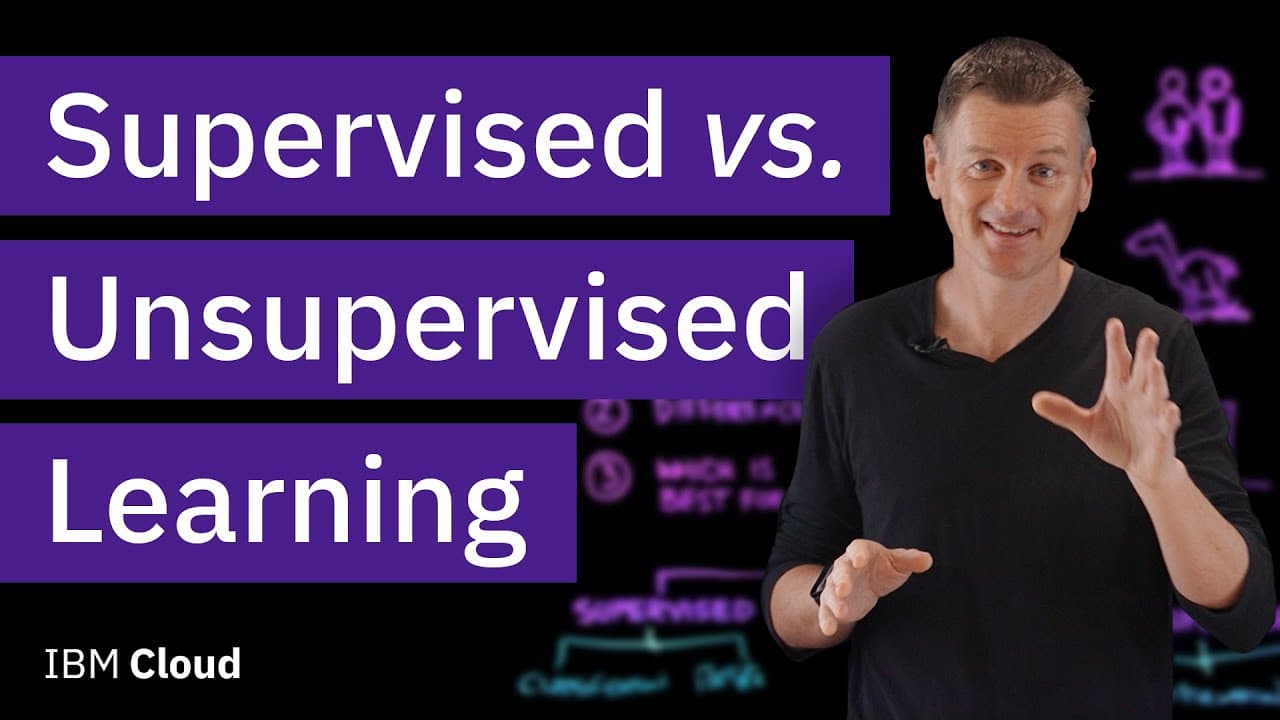
Supervised and unsupervised learning are two core components in building machine learning models. So what's the difference? Well, just to cut to the chase: supervised learning, that uses labeled input and output data, while an unsupervised learning model doesn't. But what does that really mean? Well, let's better define both learning models, go de... Read More
Key Insights
- Supervised learning is a machine learning approach that trains on labeled datasets, meaning the correct output is known for every training example. The model measures its accuracy against those answers, adjusts through repeated predictions, and attempts to generalize what it learns to examples it has never encountered.
- Classification is a supervised learning task that produces a discrete class label, such as spam or not spam. The transcript identifies linear classifiers, support vector machines, decision trees, and random forests as common classification algorithms that learn from labeled inputs and outputs.
- Regression is a supervised learning task that produces a continuous value, such as a price or probability. The transcript presents linear regression and logistic regression as common regression algorithms, distinguishing this task from classification by the form of its output rather than by its training process.
- Unsupervised learning is an approach that receives no labels and discovers inherent structures or hidden patterns without human intervention. Instead of learning correct answers, it analyzes similarities and relationships within the available data, making it useful when real-world datasets have not been labeled.
- Clustering is an unsupervised learning task that groups similar examples together. Customer segmentation is one application, where a business can organize customers according to shared characteristics such as age, location, or spending habits without assigning the groups in advance.
- Association is an unsupervised task that identifies relationships between variables in a dataset. Market basket analysis uses association rules to determine which items are often purchased together, supporting observations of the form that customers who bought one item also bought another.
- Dimensionality reduction is an unsupervised task that decreases the number of variables while preserving as much information as possible. It is often used during data preprocessing, including cases where autoencoders remove noise from visual images to improve picture quality.
- Semi-supervised learning is a middle-ground approach that trains with both labeled and unlabeled data. It is particularly useful for high-volume datasets where relevant features are difficult to extract, including medical imaging collections in which specialists can label only a small subset.
Install to Summarize YouTube Videos and Get Transcripts
Explore YouTube Video Summarizer or Get YouTube Transcript Extractor
Questions & Answers
Q: What is the difference between supervised and unsupervised learning?
Supervised learning trains on labeled input and output data, so every training example includes the correct answer. The algorithm repeatedly makes predictions, compares them with those answers, and adjusts itself to generalize to unseen cases. Unsupervised learning receives no labels. It works independently to find similarities, relationships, and hidden structures within the data rather than learning from predefined correct outputs.
Q: How does supervised learning use labeled training data?
Supervised learning uses a dataset in which the correct output is known for each example. The algorithm makes predictions on the training data, compares those predictions with the supplied answers, and adjusts through repeated iterations. Because it has labeled inputs and outputs, the model can measure its accuracy over time and learn patterns intended to generalize to examples it has not previously seen.
Q: What tasks can supervised learning perform?
Supervised learning performs two main task categories described in the transcript: classification and regression. Classification returns a discrete label, such as spam or not spam, and can use linear classifiers, support vector machines, decision trees, or random forests. Regression returns a continuous value, such as a price or probability, with linear regression and logistic regression given as common examples.
Q: What are the main uses of unsupervised learning?
Unsupervised learning is used for clustering, association, and dimensionality reduction. Clustering groups similar examples, such as customers with shared ages, locations, or spending habits. Association finds relationships between variables, including items often bought together. Dimensionality reduction decreases the number of variables while retaining as much information as possible, such as when autoencoders remove noise from visual images during preprocessing.
Q: Can unsupervised learning make predictions?
Unsupervised learning does not make predictions according to the transcript. Its role is to identify inherent structures and group related data. Applied to commute records, for example, it could cluster journeys with similar weather conditions and times of day, but it would not predict each journey's duration. A supervised model could make that prediction after learning from labeled examples that include the correct commute times.
Q: When should supervised learning be chosen?
Supervised learning should be chosen when the goal is to predict a class or continuous value and appropriately labeled training data is available. It is more commonly used because its results tend to be more accurate and efficient. The tradeoff is the need for up-front human intervention to label examples, which can become difficult when working with very large datasets.
Q: When is unsupervised learning more useful?
Unsupervised learning is more useful when data lacks labels or when the objective is to uncover hidden patterns that a supervised model might not find. It can handle large volumes of data in real time and automatically organize examples by their similarities. Its disadvantages are reduced transparency into how the data was clustered and a higher risk of inaccurate results compared with supervised learning.
Q: How does semi-supervised learning combine both approaches?
Semi-supervised learning trains with a mixture of labeled and unlabeled examples. It is useful when a dataset is very large or relevant features are difficult to extract, but labeling every example is impractical. In a collection containing millions of images, for instance, only a few thousand might be labeled. Those labels can help improve accuracy across the larger unlabeled collection.
Q: Why is semi-supervised learning useful for medical images?
Semi-supervised learning is useful for medical images because a relatively small labeled subset can improve accuracy without requiring specialists to label the entire collection. A radiologist could examine and label some CT scans for tumors or diseases. The machine could then use those examples alongside the unlabeled scans to predict more accurately which patients might need additional medical attention.
Summary & Key Takeaways
-
Supervised learning trains on examples containing known inputs and correct outputs. By comparing its predictions with those answers, the algorithm adjusts and learns to generalize to unseen examples. Its two main task categories are classification, which produces discrete labels, and regression, which produces continuous values such as prices or probabilities.
-
Unsupervised learning receives no labels and independently searches for structure within data. Its main tasks are clustering similar examples, discovering associations between variables, and reducing dimensionality while preserving information. Applications include customer segmentation, market basket analysis, grouping images by their contents, and removing noise from visual images during preprocessing.
-
The appropriate approach depends on the available data and intended result. Supervised models generally offer accurate, trustworthy predictions but require human labeling. Unsupervised models can process large volumes of unlabeled data and reveal hidden patterns, although their groupings may lack transparency. Semi-supervised learning combines labeled and unlabeled examples as a practical middle ground.
Read in Other Languages (beta)
Share This Summary 📚
Summarize YouTube Videos and Get Video Transcripts with 1-Click
Try YouTube Summary with ChatGPT & Claude or YouTube Transcript Generator
Explore More Summaries from IBM Technology 📚


Summarize YouTube Videos and Get Video Transcripts with 1-Click
Try YouTube Summary with ChatGPT & Claude or YouTube Transcript Generator