What Is Prompt Engineering and Why Is It Important?
TL;DR
Prompt engineering is the practice of designing inputs for AI models to improve their performance and achieve desired outcomes. Despite advancements in AI, it remains crucial due to the importance of context, few-shot examples, and techniques like contrastive chain of thought, which help refine responses. Moreover, prompt hacking exposes vulnerabilities in AI systems, highlighting the ongoing need for skilled prompting in a rapidly evolving landscape.
Transcript
and there are all these different strategies all over the internet but it was really hard to know where to start what to use what things worked best what things worked together and the solution to that ended up being a comprehensive guide that sort of like a Wiki page pulled in all of the different sources from across the internet about prompting a... Read More
Key Insights
- Learnprompting.org transitioned from an open-source guide to a business offering enterprise-targeted courses, maintaining its original free resources.
- Prompt engineering remains relevant despite advances in AI, with context inclusion, few-shot prompting, and chain of thought as core techniques.
- Advanced prompting techniques like contrastive chain of thought can significantly boost AI performance by constraining reasoning spaces.
- Current AI models like GPT-4 Turbo offer great performance, though usability for researchers is sometimes lessened due to verbosity.
- Image-based prompting with GPT-4 V shows potential in tasks like matching images to business profiles, though best practices are still emerging.
- Productivity improvements with AI, especially in coding, can reach up to 3x, with techniques like coding by analogy enhancing efficiency.
- Prompt hacking exposes systematic vulnerabilities in AI, showing that current defenses are often inadequate against sophisticated attacks.
- The future of prompt engineering may shift towards agent design, requiring new skills in building job-specific and secure AI agents.
Install to Summarize YouTube Videos and Get Transcripts
Explore YouTube Video Summarizer or Get YouTube Transcript Extractor
Questions & Answers
Q: What is the core offering of Learnprompting.org?
Learnprompting.org offers a comprehensive guide to prompt engineering, initially as an open-source resource. It has since expanded to include enterprise-targeted courses aimed at professional prompt engineering, while maintaining its original free resources. The platform helps users become more efficient in interacting with AI.
Q: Why is prompt engineering still relevant today?
Prompt engineering remains relevant due to the need for effective communication with AI models. Core techniques like context inclusion, few-shot prompting, and chain of thought are essential for maximizing AI performance. Despite advances, these techniques help users navigate complex tasks and extract value from AI systems.
Q: How does contrastive chain of thought enhance AI performance?
Contrastive chain of thought enhances AI performance by constraining the reasoning space of language models. It involves showing models examples of incorrect reasoning chains and instructing them not to follow those paths, thereby improving accuracy and reliability in problem-solving tasks.
Q: What are the challenges in using GPT-4 Turbo for research?
While GPT-4 Turbo offers great performance, its verbosity can be a challenge for researchers who require concise outputs. The model's tendency to be more verbose affects usability in research contexts, where precise and efficient communication is often necessary for analysis and experimentation.
Q: How does image-based prompting with GPT-4 V work?
Image-based prompting with GPT-4 V involves using images as context to guide AI responses. For example, providing a screenshot of a business website can help the AI select appropriate images that match the business's style and branding, enhancing tasks like image selection and content creation.
Q: What productivity improvements can AI bring to coding?
AI can significantly enhance coding productivity, with improvements reaching up to 3x. Techniques like coding by analogy, where AI adapts existing code patterns to new contexts, streamline the development process. AI assists in debugging, code generation, and implementing complex patterns efficiently.
Q: What did the prompt hacking competition reveal about AI vulnerabilities?
The prompt hacking competition revealed that AI systems are vulnerable to sophisticated attacks that can bypass developer instructions. Techniques like model hijacking and context manipulation demonstrate that current prompt-based defenses are often inadequate, highlighting the need for robust security measures.
Q: How might the role of prompt engineering evolve with the rise of AI agents?
The role of prompt engineering may evolve towards agent design, focusing on building secure, job-specific AI agents. These agents will require advanced skills in tool use, reasoning over multiple steps, and ensuring security against prompt injection attacks, marking a shift from traditional prompt engineering.
Summary & Key Takeaways
-
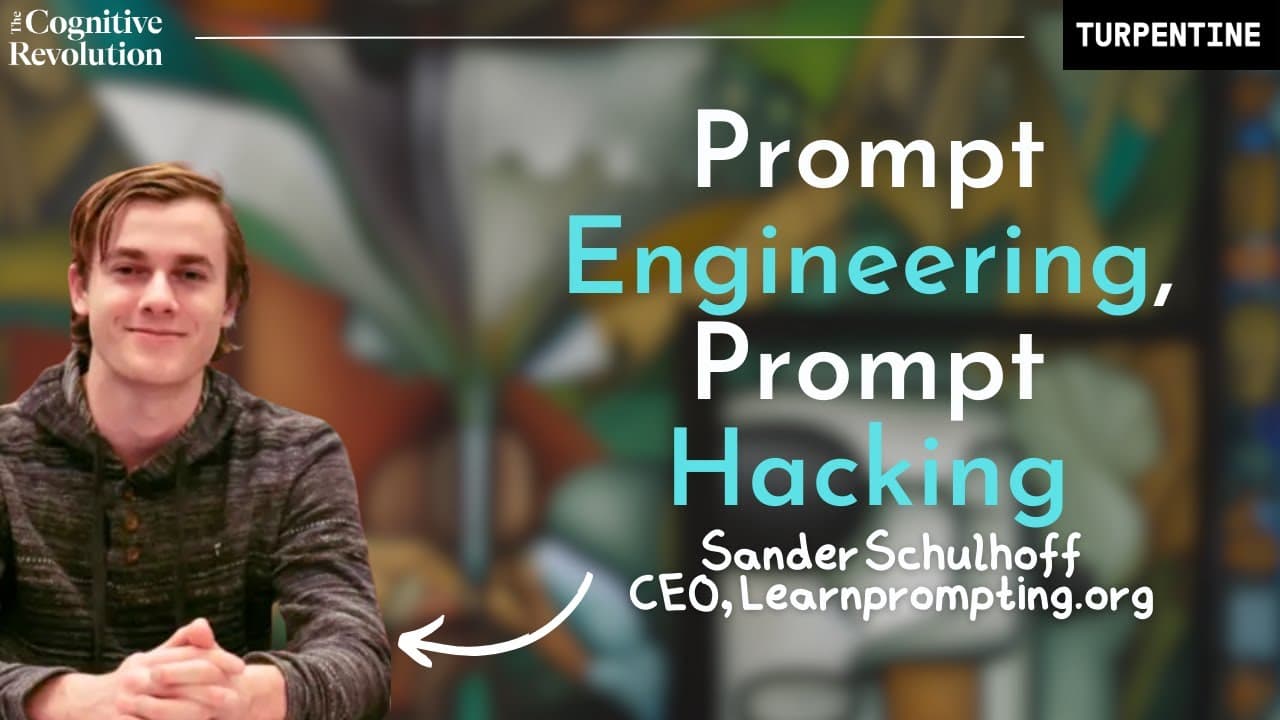
Sander Schulhoff, CEO of Learnprompting.org, discusses the evolution of prompt engineering and its continued relevance despite advancements in AI models. Learnprompting.org started as an open-source guide and has now expanded to include enterprise-targeted courses.
-
Key prompting techniques include context inclusion, few-shot prompting, and chain of thought. Advanced methods like contrastive chain of thought can further enhance AI performance. Despite improvements in AI, prompt engineering remains a vital skill.
-
Prompt hacking, as explored in Schulhoff's competition, highlights vulnerabilities in AI systems. The future may see a shift towards agent design, with a focus on building secure, job-specific AI agents capable of complex reasoning and tool use.
Read in Other Languages (beta)
Share This Summary 📚
Summarize YouTube Videos and Get Video Transcripts with 1-Click
Try YouTube Summary with ChatGPT & Claude or YouTube Transcript Generator
Explore More Summaries from Cognitive Revolution "How AI Changes Everything" 📚





Summarize YouTube Videos and Get Video Transcripts with 1-Click
Try YouTube Summary with ChatGPT & Claude or YouTube Transcript Generator