How can Mumbai reduce flood losses and deaths?
TL;DR
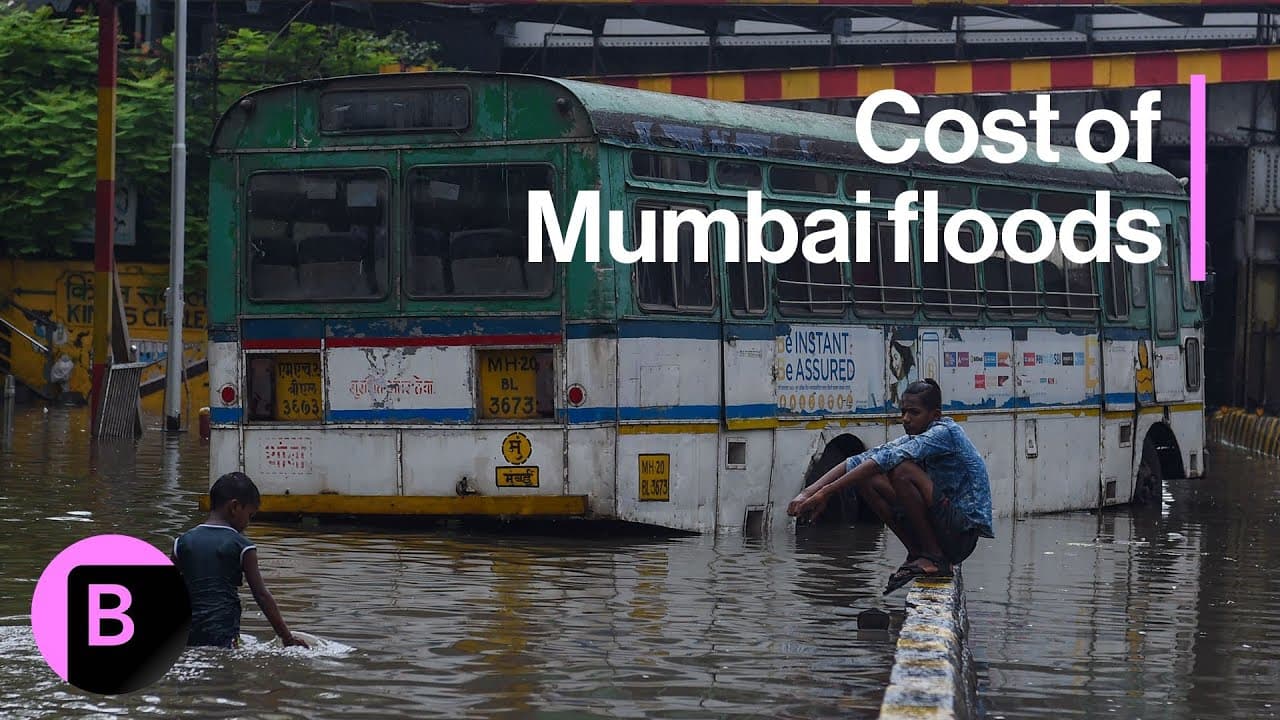
A new study links Mumbai floods to about 2700 deaths annually and roughly $1.2 billion in losses each year, caused by drowning, electrocution and disease. It attributes the problem to rapid urbanization, poor planning, and an aging drainage system, calling for infrastructure upgrades and municipal empowerment to improve resilience.
Transcript
Mumbai, India's financial capital, is pouring billions into new highways, train lines and airports. Yet every year, the city is still brought to its knees by relentless rains and floods. A new study reveals that severe flooding in Mumbai claimed more than 2700 lives annually over a decade, while causing economic losses of $1.2 billion each year. De... Read More
Key Insights
- Mumbai floods cause about 2700 deaths annually and $1.2 billion in losses, driven by drownings, electrocution and disease.
- Urbanization and rapid city growth are cited as major contributors to flood vulnerability and insufficient drainage system upgrades.
- Aging and outdated drainage systems fail to handle extreme rainfall, underscoring the need for continuous infrastructure upgrades.
- Political empowerment of cities is identified as a core bottleneck, with power concentrated at the center and states, limiting local flood management.
- Officials have introduced some measures like early warning and vulnerability mapping, but these have not yet solved the problem.
- Waste management issues and clogged drains worsen flooding, particularly impacting informal settlements and slum dwellers.
- Extremely rainfall events are becoming more intense and frequent, requiring downscaled climate models to plan future infrastructure needs.
- Comparisons with other cities suggest that continuous upgrade and city-level adaptation are essential rather than relying on national fixes.
- More videos from this channel:
- More from this channel: Bloomberg Television
Install to Summarize YouTube Videos and Get Transcripts
Explore YouTube Video Summarizer or Get YouTube Transcript Extractor
Questions & Answers
Q: A real search query question about the video (e.g. 'How to...', 'What is...', 'Why does...', 'When should...'). Question 1
What does the study say about the typical causes of Mumbai flood deaths and the economic losses during the monsoon season, and what does it imply for urban planning in megacities across India? The study attributes deaths to drowning, electrocution and disease, with diarrhea and tuberculosis worsening during floods, and estimates about 2700 deaths annually plus $1.2 billion in losses. It implies that rapid urbanization, poor urban planning, and an aging drainage system are key drivers, and that empowering cities with more governance authority could help drive targeted upgrades and resilience measures.
Q: Question 2
How does the transcript describe the role of political structure in handling city flood risks, and what changes does it suggest for better outcomes? It points to devolution of power and the centralization of authority as a core problem, noting that cities often lack empowerment to determine their futures because they are cash cows for higher levels of government. The suggested change is to strengthen city-level governance and funding mechanisms to enable proactive flood mitigation and infrastructure planning.
Q: Question 3
What mitigation approaches are mentioned in the discussion, and which are identified as insufficient on their own? The discussion mentions early warning systems and vulnerability mapping as infrastructure upgrades, but notes that these measures alone have not solved the flood problem due to changing rainfall intensity and urban drainage limitations. It emphasizes ongoing upgrades, climate modeling, and public participation as necessary complements.
Q: Question 4
How does climate change factor into Mumbai’s flood risk according to the dialogue, and what planning tools are proposed to address it? The dialogue states that rainfall intensity and duration have changed, increasing flood risk, and that future risk should be informed by downscaled climate models to tailor drainage and land-use planning. It suggests upgrading infrastructure in line with projected rainfall scenarios to maintain resilience.
Q: Question 5
What is said about informal settlements and slum dwellers in relation to flooding, and what policy directions does it imply? The conversation notes that informal settlements arise from rapid urbanization and lack of adequate housing and sanitation, making residents highly vulnerable to floods. Policy directions include creating better infrastructure, expanding metropolitan areas around the city, and improving waste management to prevent drains from clogging.
Q: Question 6
What are the observed limitations of Mumbai’s drainage upgrades since major flood events, and what is proposed to overcome them? The dialogue acknowledges that infrastructure upgrades have occurred but flood events remain a problem, suggesting the need for continuous upgrades, better downscaled climate modeling, and more robust urban planning that accounts for changing rainfall patterns and urban growth.
Q: Question 7
Why does the study claim that focusing solely on national or central actions is insufficient for flood resilience in Mumbai, and what is the recommended approach? It argues that cities require empowered, responsive governance rather than top-down directives, as central authorities benefit from local revenue while local administrations face governance gaps. The recommended approach is strengthening city-level capacity, financing, and governance to drive targeted adaptation.
Q: Question 8
What practical actions could cities take to protect vulnerable populations during floods, according to the interview, and how do they tie to the described study findings? The interview suggests improving waste management to prevent drain clogging, upgrading drainage to handle higher rainfall, and using climate-informed planning to anticipate future events. These actions align with the study’s emphasis on infrastructure upgrades, urban planning, and local governance empowerment to reduce flood risk and disease.
Summary & Key Takeaways
-
A new study finds Mumbai experiences severe monsoon floods that kill thousands and cause billions in economic losses each year, highlighting the city’s drainage and infrastructure weaknesses. The analysis argues that rapid urban growth and limited local power hinder robust flood response and mitigation.
-
The discussion covers governance challenges, including devolution of power to cities, and emphasizes the need for better climate modeling, upgraded drainage, and public health preparedness to reduce flood vulnerability and disease during monsoon seasons.
-
Policy implications point to infrastructure investment, waste management improvements, and citizen engagement to protect slum dwellers and expand resilient urban planning, as cities face changing rainfall patterns and more extreme events.
Read in Other Languages (beta)
Share This Summary 📚
Summarize YouTube Videos and Get Video Transcripts with 1-Click
Try YouTube Summary with ChatGPT & Claude or YouTube Transcript Generator
Explore More Summaries from Bloomberg Television 📚





Summarize YouTube Videos and Get Video Transcripts with 1-Click
Try YouTube Summary with ChatGPT & Claude or YouTube Transcript Generator