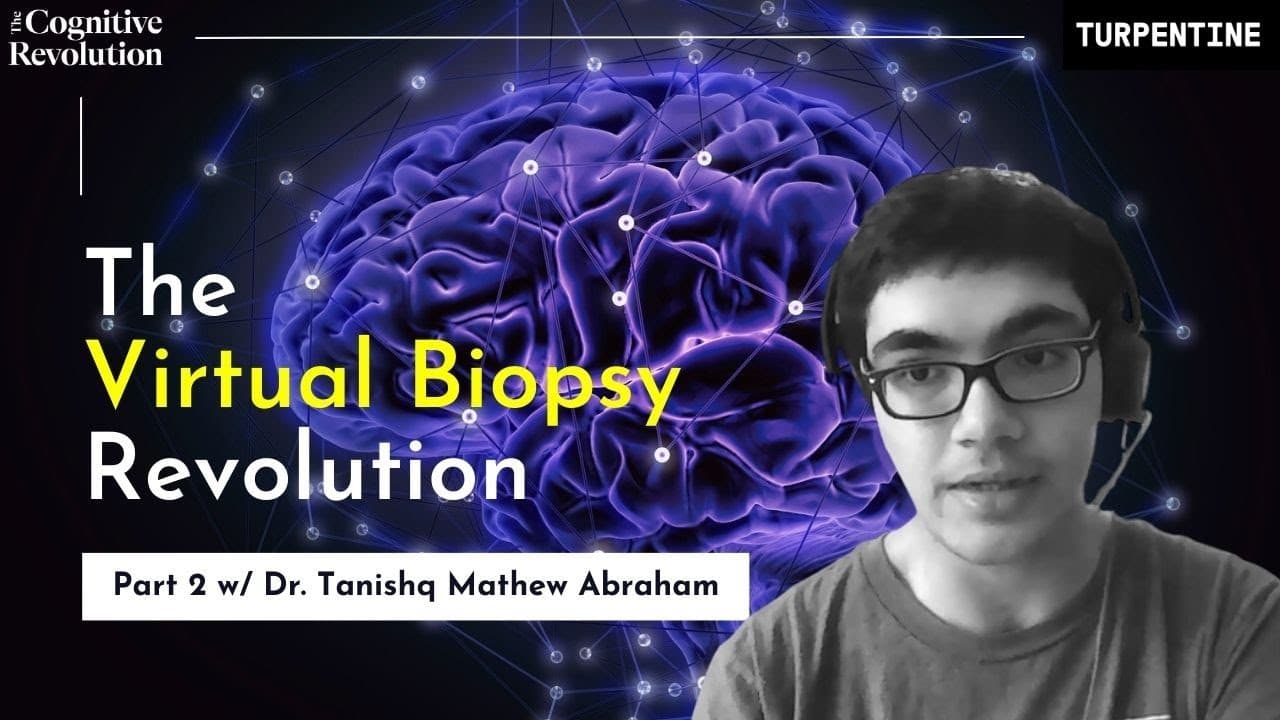
The Virtual Biopsy Revolution with Dr. Tanishq Mathew Abraham (Part 2 of 2)
TL;DR
AI revolutionizes biopsies, making them faster, cheaper, and less invasive.
Transcript
and I'd be very excited about and medical applications of AI and and using AI to improve patient care I'm excited about using AI for Education being able to learn whatever we want to learn there may be concerns of AI being used for polarization of society but I also think that AI could be used for bringing Society together and being able to connect... Read More
Key Insights
- The new AI-powered biopsy technique drastically reduces the time from eight hours to one second by using 3D imaging and virtual staining.
- Quantitative oblique back illumination microscopy (qOBM) is a novel technology that enables non-invasive, label-free imaging of tissues.
- CycleGAN, an older AI model, is effectively used to perform unpaired image-to-image translation, crucial for virtual staining.
- The technique allows for real-time diagnostic support during surgeries, potentially improving surgical outcomes and reducing unnecessary tissue removal.
- The research highlights the importance of high-quality data and data-centric AI approaches, which can outperform even the most advanced models.
- The AI model was trained on a small dataset, emphasizing the challenges of acquiring medical data and the need for innovative solutions.
- The collaboration with institutions like Georgia Tech and support from organizations like Stability AI are critical to advancing this research.
- Despite the promise, further validation and clinical trials are necessary before this technology can be widely adopted in medical practice.
Install to Summarize YouTube Videos and Get Transcripts
Explore YouTube Video Summarizer or Get YouTube Transcript Extractor
Questions & Answers
Q: What is the main benefit of the new AI-powered biopsy technique?
The main benefit of the new AI-powered biopsy technique is its ability to drastically reduce the time required for tissue analysis from over eight hours to just one second. This is achieved through the use of 3D imaging and virtual staining, which allows for real-time diagnostic support during surgeries. The technique is also less invasive and more cost-effective than traditional methods.
Q: How does CycleGAN contribute to the virtual biopsy process?
CycleGAN is used to perform unpaired image-to-image translation, which is crucial for the virtual staining process. It enables the transformation of 3D qOBM images into virtually stained images that resemble traditional histology slides. Despite being an older AI model, CycleGAN effectively handles the challenge of limited and unpaired medical datasets, making it suitable for this application.
Q: What challenges does the research face in terms of data acquisition?
The research faces significant challenges in acquiring high-quality medical data due to the limited availability of specimens and the complexity of obtaining paired images. The novel technology requires fresh tissue imaging, which complicates the creation of corresponding traditional histology slides. This necessitates innovative data-centric AI approaches to maximize the effectiveness of available data.
Q: How does the new technique impact surgical procedures?
The new technique has the potential to significantly impact surgical procedures by providing real-time diagnostic support. Surgeons can use the 3D imaging and virtual staining technology to make more informed decisions during tumor removal surgeries, potentially improving outcomes and reducing the risk of unnecessary tissue removal. This could lead to more precise and effective surgeries.
Q: What role do organizations like Stability AI play in this research?
Organizations like Stability AI play a crucial role in supporting this research by providing computational resources and funding. Stability AI's support allows researchers to conduct experiments and develop the technology further. Their involvement highlights the importance of collaboration between research institutions and industry players in advancing medical AI applications.
Q: What are the future steps required for clinical adoption of this technology?
For clinical adoption, the technology requires extensive validation and clinical trials to ensure its safety, reliability, and effectiveness. This involves scaling up the research to include a broader range of specimens and conducting trials to demonstrate its benefits over existing methods. Regulatory approvals and integration into clinical workflows are also necessary steps for widespread adoption.
Q: How does the research emphasize the importance of data-centric AI?
The research emphasizes the importance of data-centric AI by demonstrating that high-quality data can lead to better outcomes than merely focusing on advanced models. The success of the CycleGAN approach, despite limited data, underscores the value of data preprocessing, cleaning, and understanding the model's interaction with data. It highlights the need to prioritize data quality in AI research.
Q: What are the potential societal impacts of AI in medicine according to Tanishq?
Tanishq envisions AI in medicine as a transformative force that can improve patient care, enhance surgical outcomes, and provide personalized education. However, he also acknowledges the potential for societal challenges, such as increased polarization and biases. He hopes AI will connect people and augment creativity, contributing positively to society while addressing ethical and reliability concerns.
Summary & Key Takeaways
-
Tanishq Mathew Abraham's research focuses on a novel AI-powered biopsy technique using qOBM and CycleGAN to virtually stain 3D tissue images. This approach significantly reduces the time required for biopsy analysis, making it feasible for real-time surgical applications.
-
The technique leverages deep learning to overcome the challenges of limited and unpaired medical datasets, demonstrating the potential of older AI models like CycleGAN in solving complex medical imaging problems.
-
Future adoption of this technology in clinical settings will require extensive validation and clinical trials, but its potential to improve patient care and surgical outcomes is significant. Support from organizations like Stability AI plays a crucial role in advancing this research.
Read in Other Languages (beta)
Share This Summary 📚
Summarize YouTube Videos and Get Video Transcripts with 1-Click
Try YouTube Summary with ChatGPT & Claude or YouTube Transcript Generator
Explore More Summaries from Cognitive Revolution "How AI Changes Everything" 📚






Summarize YouTube Videos and Get Video Transcripts with 1-Click
Try YouTube Summary with ChatGPT & Claude or YouTube Transcript Generator