How to Identify IPv4 Address Classes
TL;DR
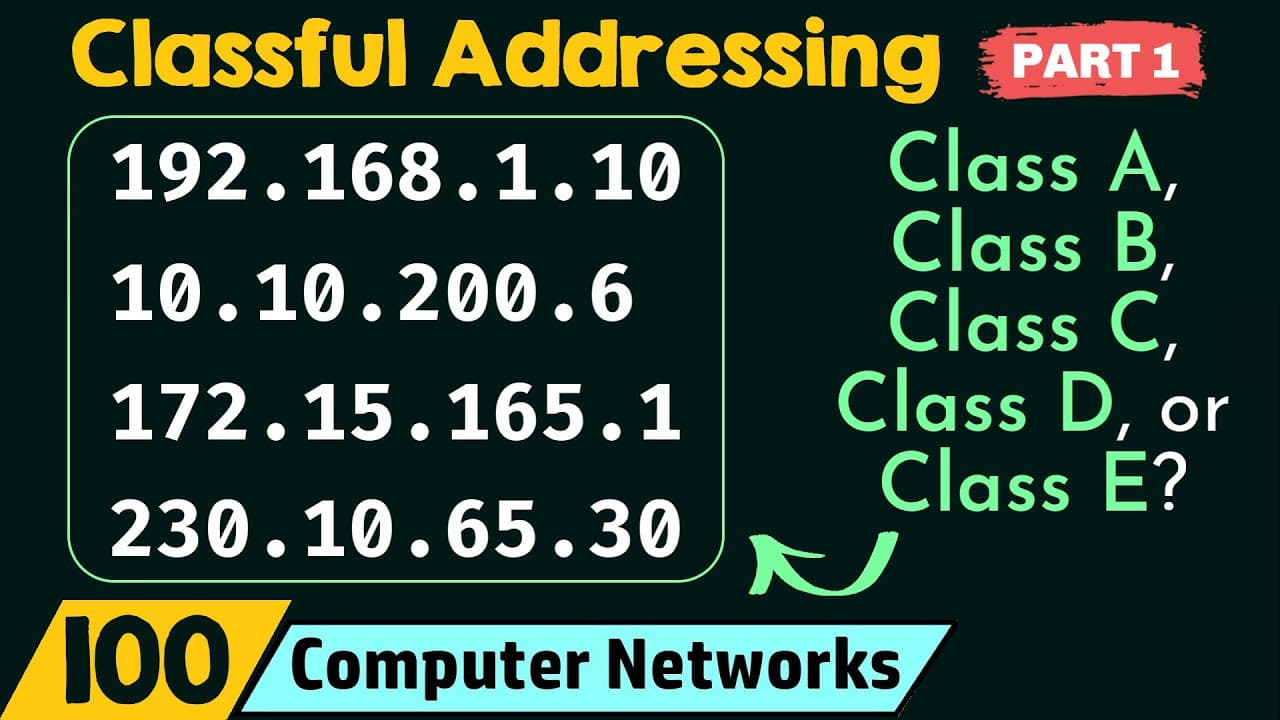
There are five classes of IPv4 addresses: Class A, B, C, D, and E. Each class is identified by the value of the first octet in dot decimal notation or by specific starting bits in binary notation, determining their ranges from 0-255.
Transcript
hello everyone welcome back in today's lecture we will see the part one of class full addressing we will start the session with the outcomes upon the completion of the session the learner will be able to outcome number one we will understand various classes of ipv4 address outcome number two we will identify the class of ip address with the help of... Read More
Key Insights
- 🔙 There are five classes of IPv4 addresses: Class A, B, C, D, and E.
- 🫥 IPv4 addresses can be represented in binary or dot decimal notation.
- 🫥 The class of an IPv4 address can be determined by examining the starting bits in binary notation or the value of the first octet in dot decimal notation.
- 🏛️ Class D addresses are reserved for multicast purposes.
Install to Summarize YouTube Videos and Get Transcripts
Explore YouTube Video Summarizer or Get YouTube Transcript Extractor
Questions & Answers
Q: How many classes of IPv4 addresses are there?
There are a total of five classes of IPv4 addresses: Class A, B, C, D, and E.
Q: How can you determine the class of an IPv4 address in binary notation?
To determine the class of an IPv4 address in binary notation, you need to examine the starting bits. Class A has a starting bit of 0, Class B starts with 1 0, Class C starts with 1 1 0, Class D starts with 1 1 1 0, and Class E starts with 1 1 1 1.
Q: How can you determine the class of an IPv4 address in dot decimal notation?
In dot decimal notation, the class of an IPv4 address is determined by the value of the first octet. If the first octet is between 0 and 127, it belongs to Class A. If it is between 128 and 191, it belongs to Class B. If it is between 192 and 223, it belongs to Class C. If it is between 224 and 239, it belongs to Class D. If it is between 240 and 255, it belongs to Class E.
Q: What is the purpose of Class D addresses?
Class D addresses are reserved for multicast purposes, which means they are used for efficient communication to multiple recipients simultaneously.
Key Insights:
- There are five classes of IPv4 addresses: Class A, B, C, D, and E.
- IPv4 addresses can be represented in binary or dot decimal notation.
- The class of an IPv4 address can be determined by examining the starting bits in binary notation or the value of the first octet in dot decimal notation.
- Class D addresses are reserved for multicast purposes.
- Class E addresses are reserved for experimental and research purposes.
Summary & Key Takeaways
-
There are five classes of IPv4 addresses: Class A, B, C, D, and E.
-
IPv4 addresses can be represented in binary notation or dot decimal notation.
-
Class A addresses have a starting range of 0-127, Class B addresses have a range of 128-191, Class C addresses have a range of 192-223, Class D addresses have a range of 224-239, and Class E addresses have a range of 240-255.
Read in Other Languages (beta)
Share This Summary 📚
Summarize YouTube Videos and Get Video Transcripts with 1-Click
Try YouTube Summary with ChatGPT & Claude or YouTube Transcript Generator
Explore More Summaries from Neso Academy 📚





Summarize YouTube Videos and Get Video Transcripts with 1-Click
Try YouTube Summary with ChatGPT & Claude or YouTube Transcript Generator