How do GPT-5 and rivals compare in AI tests
TL;DR
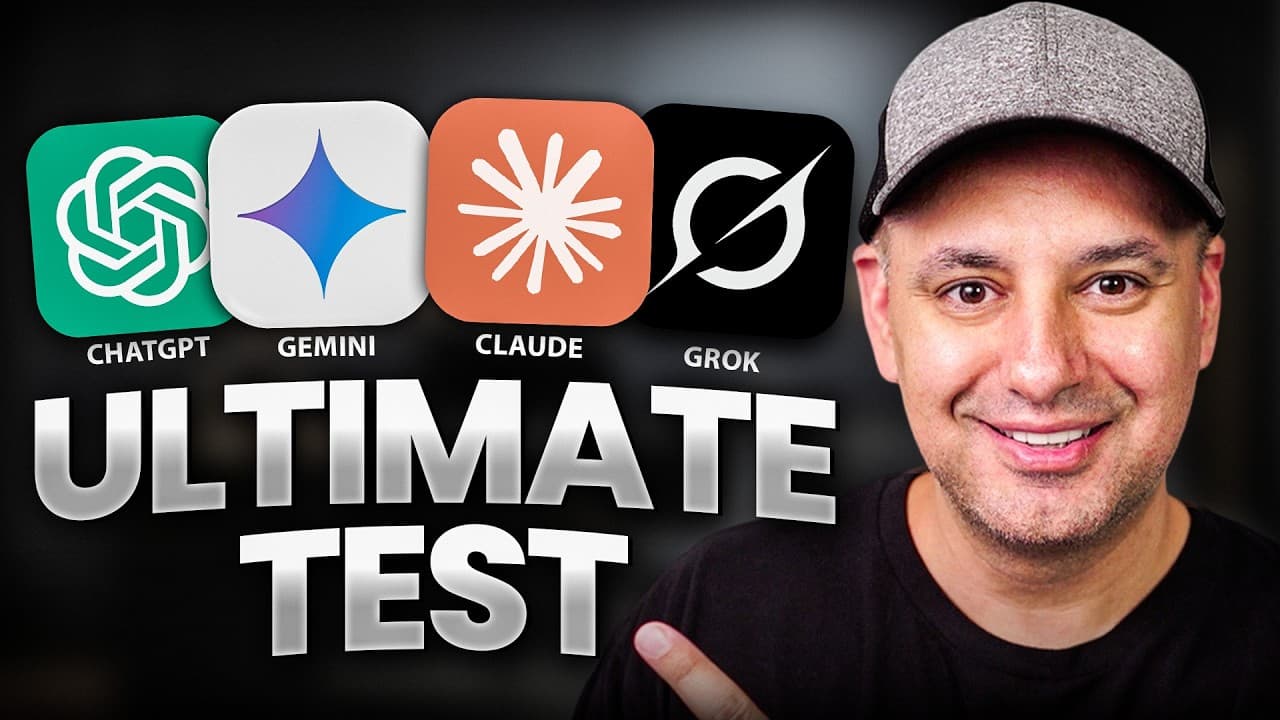
GPT-5, Gemini Pro, Grok, and Claude Opus 4.1 are pitted in a head to head evaluation across multiple tasks. Claude often leads in tool filtering and scoring, while Grok excels in tool selection, and results vary by category. The tests cover reasoning, coding, math, hallucination, and prompt following to rank the models.
Transcript
A few times a year, I put the top AI models against each other into a real head-to-head test to see who comes out on top. I'm going to test their reasoning capabilities, their coding, test them for hallucination. I'm really going to push all of them to their limit. So, we're going to test four different leading large language model. The first one i... Read More
Key Insights
- GPT-5 shows strong general reasoning and coding performance in the tests.
- Grok excels at selecting the right tools for a given prompt, often matching top tools across categories.
- Claude Opus 4.1 frequently performs best in tool based comparisons and filtering tasks.
- Gemini Pro provides solid filtering and category handling but has inconsistent link behavior in some tests.
- UI and interaction quality vary significantly between models, impacting user experience.
- Performance on hallucination related prompts is mixed, with some models resisting false claims better than others.
- The test design includes both direct prompts and prompt stress tests to gauge follow through and compliance.
- The reviewer describes the process as a multi category, weight-based scoring setup with final tallying to decide a winner.
- More videos from this channel:
- More from this channel: Skill Leap AI
Install to Summarize YouTube Videos and Get Transcripts
Explore YouTube Video Summarizer or Get YouTube Transcript Extractor
Questions & Answers
Q: What is the purpose of the head to head comparison in the video
The video uses a head to head comparison to evaluate four leading large language models on multiple tasks. It aims to assess reasoning, coding, math, hallucination handling, and prompt following. The host assigns scores from 1 to 10 for each model per category and tallies them to determine overall performance. This structured approach helps identify strengths and weaknesses across models.
Q: How many models are compared and which ones are they
Four models are compared in the video: GPT-5, Gemini Pro, Grok, and Claude Opus 4.1. The presenter pays for all four subscriptions and runs the same prompts across each to ensure a fair, side by side assessment. The setup emphasizes the models’ abilities in reasoning, tool use, and accuracy under different scenarios.
Q: What kinds of tests are used in the evaluation process
The evaluation includes ten different prompt categories designed to test reasoning, coding, math, hallucination, and prompt following. Each model receives a score from 1 to 10 in every category, and the scores are tallied at the end of the video. The tests also include image based reasoning to push multi modal capabilities where applicable.
Q: How is hallucination tested in the video
Hallucination tests are used to probe whether models confidently present false information as facts. The host asks questions with trick elements, such as historical facts without real corresponding details, or fabricated scenarios like a fictional plant discovery. The models’ responses reveal how often they resist or reveal uncertainty when information is not supported.
Q: Which model seems strongest in tool selection and filtering tasks
Claude Opus 4.1 often performs best in tool selection and filtering tasks according to the video. It demonstrates strong handling of tool lists, category filters, and practical navigation through results. The host notes Claude’s ability to present coherent pro and con analyses and effective linking to relevant tools.
Q: What does the video say about Grok’s strengths
Grok is highlighted for its strength in selecting the right tools for a given prompt. The reviewer notes Grok’s ability to identify top tools like GPT, Grock, Claude, and Gemini, even when not explicitly instructed. This focused aptitude makes Grok a reliable option for tool oriented prompts and demonstrations.
Q: How is the user interface usability described across the models
The video notes that user interface usability varies between models. Some interfaces are praised for features like dark mode and interactive comparisons, while others show navigation or rendering issues such as broken links or incomplete tool lists. These UI aspects influence the practical usability of each model beyond raw accuracy.
Q: What extra resource does the video promote regarding prompts
The video promotes a free ebook from HubSpot titled Advanced Chat GPT Prompt Engineering. It is described as a seven day playbook with prompt frameworks such as Roses, plus tips like chain of thought and persona crafting. The resource is offered to help viewers improve results across all the evaluated models.
Summary & Key Takeaways
-
In this head to head test, four leading language models are evaluated across ten categories to determine overall performance and strengths. Each model is scored on a 1 to 10 scale, and results are tallied to identify which tool shines in specific areas and which may lag behind. The video emphasizes both capabilities and limitations of each model.
-
The reviewer highlights strengths and weaknesses of each model, including UI usability, tool selection accuracy, and hallucination handling. The comparison also demonstrates how models perform under structured prompts and stress tests, providing a practical view of how they would perform in real tasks.
-
The video also integrates a discussion on prompting strategies and references a free prompt engineering resource, illustrating how prompt quality can significantly affect outcomes across all models.
Read in Other Languages (beta)
Share This Summary 📚
Summarize YouTube Videos and Get Video Transcripts with 1-Click
Try YouTube Summary with ChatGPT & Claude or YouTube Transcript Generator
Explore More Summaries from Skill Leap AI 📚

Summarize YouTube Videos and Get Video Transcripts with 1-Click
Try YouTube Summary with ChatGPT & Claude or YouTube Transcript Generator