What Is MacIntyre's Aristotelian View of Human Psychology?

TL;DR
MacIntyre's communitarianism rests on an Aristotelian psychology with two features: humans are teleological, purposive creatures who feel fulfilled only when their goals are met, and they are fundamentally other-directed. Ultimately what people want is esteem from people they esteem, achieved by subordinating themselves within shared practices and their inherited norms.
Transcript
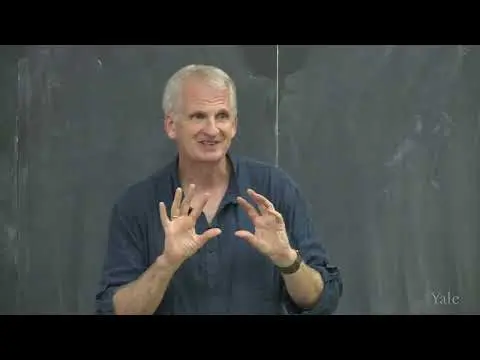
Prof: Okay, so let's pickup where we left off on Monday, and we were starting to talk in more detail about MacIntyre's argument. And one of the things I want to zero in centrally on today is his account of human psychology, or what used to be called human nature. And that differs importantly from every account of human psychology we've looked at ... Read More
Key Insights
- MacIntyre's account of human psychology is Aristotelian, meaning humans are teleological or purposive creatures who always want to know the point of an activity and are happy when purposes are met but frustrated when they are not.
- Aristotle held that we reason only about the means to achieve virtues, not the virtues themselves, and his virtues, like courage and honesty, were fixed for all time in the Nicomachean Ethics.
- MacIntyre departs from Aristotle by conceding to Enlightenment thinkers that what counts as a virtue is, to some extent, up for debate, though how that debate proceeds is a separate question.
- Human behavior is fundamentally other-directed, unlike the self-referential utilitarian view captured in Reagan's 1984 question, 'Are you better off than you were four years ago?'
- Marx was half-right that people are other-directed, but wrong that comparisons are global; autoworkers compare themselves to steelworkers, not auto executives, so relative inequalities among similar people matter.
- Interdependent utility means your happiness depends on what others actually experience, as when a parent takes pleasure in a child's success, captured in the line 'You can only be as happy as your least happy child.'
- MacIntyre goes further via a neo-Hegelian idea from Hegel's master-slave dialectic: we want recognition, but only from someone whose recognition is valuable because we esteem them at the relevant activity.
- Virtues are embedded in practices, meaning their goods can only be achieved by subordinating ourselves within the practice, learning what is due to whom, taking self-endangering risks, and heeding our own inadequacies.
Install to Summarize YouTube Videos and Get Transcripts
Explore YouTube Video Summarizer or Get YouTube Transcript Extractor
Questions & Answers
Q: What is MacIntyre's Aristotelian conception of human psychology?
MacIntyre adopts an Aristotelian conception with two central features. First, human beings are teleological or purposive creatures who always want to know the point of an activity; when their goals and purposes are met they are happy and fulfilled, and when unmet they are frustrated, unsatisfied, and discontented. Second, human behavior is fundamentally other-directed, meaning a person's happiness is conditioned upon the experience of others as it relates to them.
Q: How does MacIntyre differ from Aristotle on the virtues?
Aristotle held that the virtues, such as courage and honesty listed in the Nicomachean Ethics, were given for all time, and that we reason only about the means to achieve them, not the virtues themselves. MacIntyre departs from this by going part of the way with Enlightenment thinkers: he wants to say that what counts as a virtue is, to some extent, up for debate. Exactly how far and how that debate is conducted are questions Shapiro says he will return to later.
Q: What does it mean that human behavior is other-directed?
Other-directedness means a person's sense of welfare depends on what others get or experience, not just their own condition. Shapiro contrasts this with the self-referential utilitarian view in Reagan's 1984 question, 'Are you better off than you were four years ago?' A child given a half-full glass of orange juice is happy until his sister gets a full one, showing that the relative difference, not the absolute amount, drives his feeling of well-being.
Q: Why was Marx only half-right about other-directed psychology?
Marx made welfare reliant on what others get, arguing that whether you feel exploited depends on what your employer receives. Shapiro says Marx was right that people are often other-directed, tying the legitimacy of what they get to what others get. But he was wrong that comparisons are global: people compare themselves to those similarly situated in the socioeconomic order, so autoworkers compare themselves to steelworkers, not to auto executives, making global comparisons unlikely.
Q: What is interdependent utility?
Interdependent utility is when your happiness depends not just on what others get but on what others actually experience. A positive example is a parent taking pleasure in their child's success and feeling pain at their failure, captured in the line, 'You can only be as happy as your least happy child.' There are also interdependent negative utilities, as when a sadist's or rapist's utility rises as a byproduct of their victim's utility going down, the mirror image of the positive case.
Q: How does Hegel's master-slave dialectic inform MacIntyre's view?
In Hegel's Phenomenology, the master-slave relationship is inherently unstable because the master, not just the slave, finds it unsatisfactory. Hegel says what we most fundamentally want is recognition from others, but not recognition from someone we do not respect. A slave saying 'Yes, master' is not fulfilling; we want recognition from an equal or superior whose esteem is valuable. This neo-Hegelian idea shapes MacIntyre's notion of practices and the reciprocal relationship between people.
Q: What does MacIntyre mean by a practice?
A practice is an activity whose goods can only be achieved by subordinating ourselves within it in relationships to other practitioners. As MacIntyre writes, we have to learn to recognize what is due to whom, be prepared to take self-endangering risks demanded along the way, and listen carefully to what we are told about our own inadequacies. Shapiro illustrates it: a shed-builder and book-writer wants the carpenter to praise the shed and expert writers to praise the book, seeking esteem from those esteemed at the relevant activity.
Q: Why does every political theory need an account of human psychology?
Shapiro argues that every political theory is predicated on some account of the structure of human psychology and of how the world operates causally, though you sometimes have to dig to find them. He urges evaluating theories by asking what theory of human psychology drives them, whether it makes sense, and whether it is true to your own experience. This comparison, moving from utilitarian to Marxian to other-referential assumptions, provides a reference point for judging how the theories stack up.
Summary & Key Takeaways
-
MacIntyre's argument rests on an Aristotelian conception of human psychology that differs from every prior account in the course. Humans are teleological, purposive creatures who always want to know the point of an activity; when purposes are met they are happy and fulfilled, and when unmet they are frustrated and discontented.
-
Human behavior is fundamentally other-directed. Utilitarians saw people as self-referential, Marx tied welfare to what others get, and interdependent utility ties happiness to what others actually experience, positively for a parent and child, or negatively as with a sadist's utility rising as a victim's falls.
-
Drawing on Hegel's master-slave dialectic, MacIntyre argues we want recognition from those we esteem at the relevant activity. Virtues are embedded in practices, so their goods require subordinating ourselves within the practice, learning its norms and rules, and asking what is expected rather than renegotiating everything.
Read in Other Languages (beta)
Share This Summary 📚
Summarize YouTube Videos and Get Video Transcripts with 1-Click
Try YouTube Summary with ChatGPT & Claude or YouTube Transcript Generator
Explore More Summaries from YaleCourses 📚



Summarize YouTube Videos and Get Video Transcripts with 1-Click
Try YouTube Summary with ChatGPT & Claude or YouTube Transcript Generator