How Does Bayesian Thinking Improve Medical Tests?
TL;DR
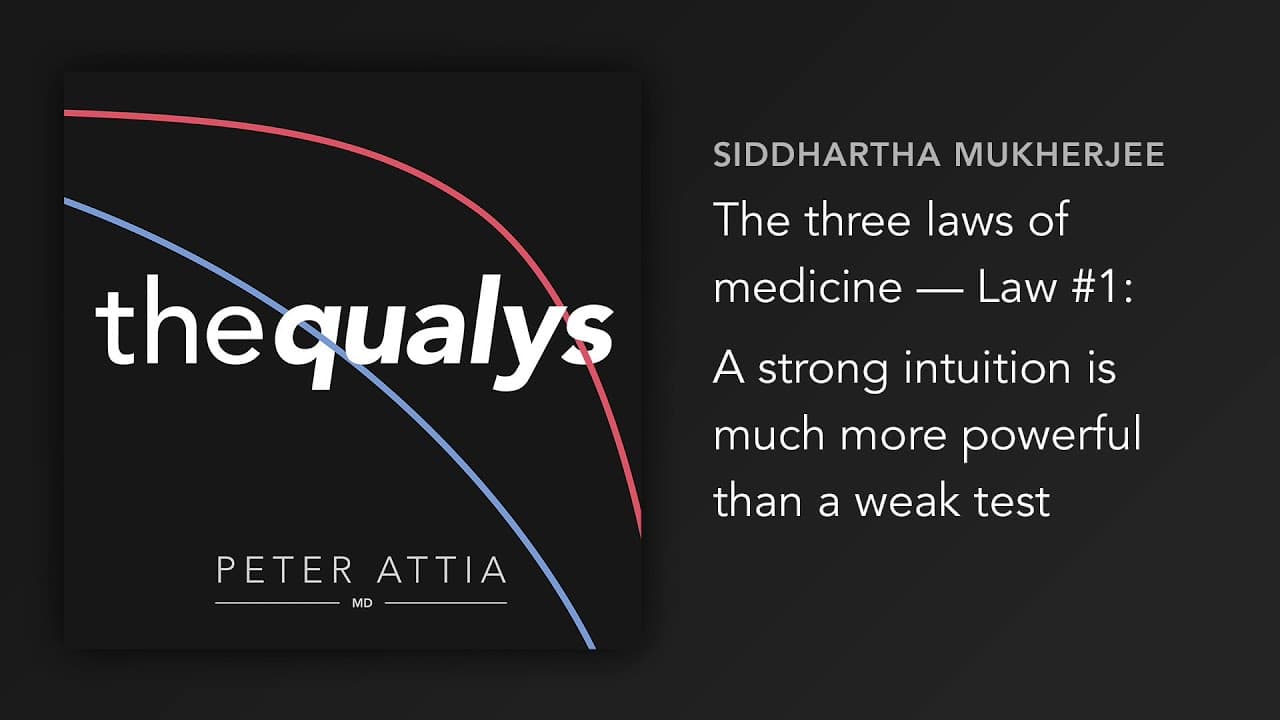
A strong prior intuition can outweigh a weak test because test results only become meaningful when interpreted alongside what was already likely. Bayesian thinking uses prior history and a test's past predictive performance to update judgment, while recognizing that reliance on the past can still miss surprises.
Transcript
Welcome to The Qualies, a subscriber exclusive podcast. Qualies is just a shorthand slang for a qualification round, which is something you do prior to the race, just a little bit quicker. Qualies podcast features episodes that are short, eh, we're hoping for less than ten minutes each, which highlight the best questions, topics, tactics, et cetera... Read More
Key Insights
- Strong intuition is more powerful than a weak test when the intuition reflects well-founded prior knowledge and the test offers limited evidence. The law emphasizes that a result cannot be evaluated intelligently without considering what was already likely before the test occurred.
- Bayesian reasoning is based on understanding priors before interpreting posteriors. The world has history, so observations do not arise independently in a newly created context each time. Previous evidence shapes how strongly a person should update a belief after receiving new information.
- The twenty-flip coin example shows why context can outweigh a simple probability calculation. After twenty consecutive tails, a child may reasonably suspect a rigged coin, while a mathematician who ignores the sequence's history may continue assigning equal odds to heads and tails.
- A test is interpretable only in light of what it has predicted in the past. Past performance does not determine every future outcome, but it provides information that should influence how much confidence a person places in a current result.
- Human reasoning naturally uses prior antecedents when solving problems. People commonly ask what happened before and whether a pattern has remained consistent, rather than treating every event as entirely independent from the history that preceded it.
- The past functions as a weighted guide rather than an absolute rule. Mukherjee compares Bayesian judgment to a rheostat that gives substantial weight to historical evidence while still allowing a current observation to modify expectations.
- Bayesian thinking has limitations because historical patterns can fail and unexpected events can occur. A person who relies too heavily on prior evidence may overlook a genuine surprise, so prior knowledge should guide interpretation without making conclusions inflexible.
- Medicine often neglects explicit Bayesian interpretation even though physicians may use it innately. Clinical judgment benefits from combining prior expectations with test evidence, while the conversation separately notes that physicians may perform poorly when reasoning about asymmetric risk.
Install to Summarize YouTube Videos and Get Transcripts
Explore YouTube Video Summarizer or Get YouTube Transcript Extractor
Questions & Answers
Q: What does the first law of medicine mean?
The first law states that a strong intuition is much more powerful than a weak test. It means that a test result should not automatically override a well-supported prior expectation. The strength of the existing evidence, the history surrounding the case, and the test's previous predictive performance all affect how much the new result should change a judgment.
Q: How does Bayesian thinking apply to medical tests?
Bayesian thinking applies to medicine by requiring a test result to be interpreted in light of what was likely before the test and what the test has predicted in the past. A result is not treated as isolated evidence. Instead, it updates an existing judgment, with the size of that update depending on the strength of both the prior belief and the test.
Q: Why can strong intuition outweigh a weak test?
Strong intuition can outweigh a weak test when the intuition is grounded in substantial prior evidence and the test provides only limited predictive value. A single weak observation may not justify abandoning a conclusion supported by a long and consistent history. The test still matters, but its influence should be proportional to how reliably it has predicted outcomes before.
Q: What does the coin-flipping example demonstrate?
The example asks people to predict the next result after a coin lands on tails twenty consecutive times. A mathematician may say that heads and tails remain equally likely, while a child may suspect that the coin is rigged. The contrast demonstrates that practical reasoning considers observed history and does not always assume that each event begins without prior context.
Q: What are priors and posteriors in the discussion?
Priors are the expectations formed from antecedent conditions and previous observations before receiving new evidence. Posteriors are the updated expectations reached after considering that evidence. Mukherjee's central point is that a posterior cannot be understood properly without first examining the prior, because real-world events occur within histories rather than in isolation.
Q: Why does the past matter when interpreting evidence?
The past matters because previous patterns and predictive performance provide information about what is likely to happen next. Mukherjee describes history as a strongly weighted guide, not a perfect guarantee. People use prior events to judge current evidence in medicine and in other areas of thought, including economic and climate-oriented reasoning mentioned in the conversation.
Q: What are the limitations of Bayesian reasoning?
Bayesian reasoning can miss surprises when a person gives too much weight to historical patterns. The past provides useful guidance, but it does not establish every future result with certainty. Mukherjee explicitly acknowledges loopholes and gaps in this approach, emphasizing that prior evidence should shape judgment without eliminating openness to unexpected events or changed circumstances.
Q: Do physicians naturally use Bayesian judgment?
The conversation suggests that physicians may apply Bayesian reasoning innately even when they do not identify it by name. They often interpret findings against a patient's prior context rather than viewing each result independently. However, the principle is also described as a forgotten rule in medicine, and the discussion notes a separate concern that physicians may reason poorly about asymmetric risk.
Summary & Key Takeaways
-
Siddhartha Mukherjee describes The Laws of Medicine as a short book commissioned through TED to expand one incisive idea. Its first law states that strong intuition can be more powerful than a weak test, reflecting a Bayesian approach in which evidence must be evaluated against prior knowledge rather than interpreted alone.
-
A coin-flipping thought experiment illustrates the principle. After a coin produces tails twenty consecutive times, a mathematician may still predict equal odds on the next flip, while a child suspects the coin is rigged. The child accounts for observed history, showing why real-world reasoning depends on prior probabilities.
-
Bayesian reasoning treats past evidence as a weighted guide to future judgment. In medicine, a test should be interpreted according to prior expectations and what the test has predicted previously. This approach is valuable but incomplete because unexpected events can occur, and excessive reliance on history may cause people to miss surprises.
Read in Other Languages (beta)
Share This Summary 📚
Summarize YouTube Videos and Get Video Transcripts with 1-Click
Try YouTube Summary with ChatGPT & Claude or YouTube Transcript Generator
Explore More Summaries from Peter Attia MD 📚



Summarize YouTube Videos and Get Video Transcripts with 1-Click
Try YouTube Summary with ChatGPT & Claude or YouTube Transcript Generator