How to Test Facebook Ads Without Overspending
TL;DR
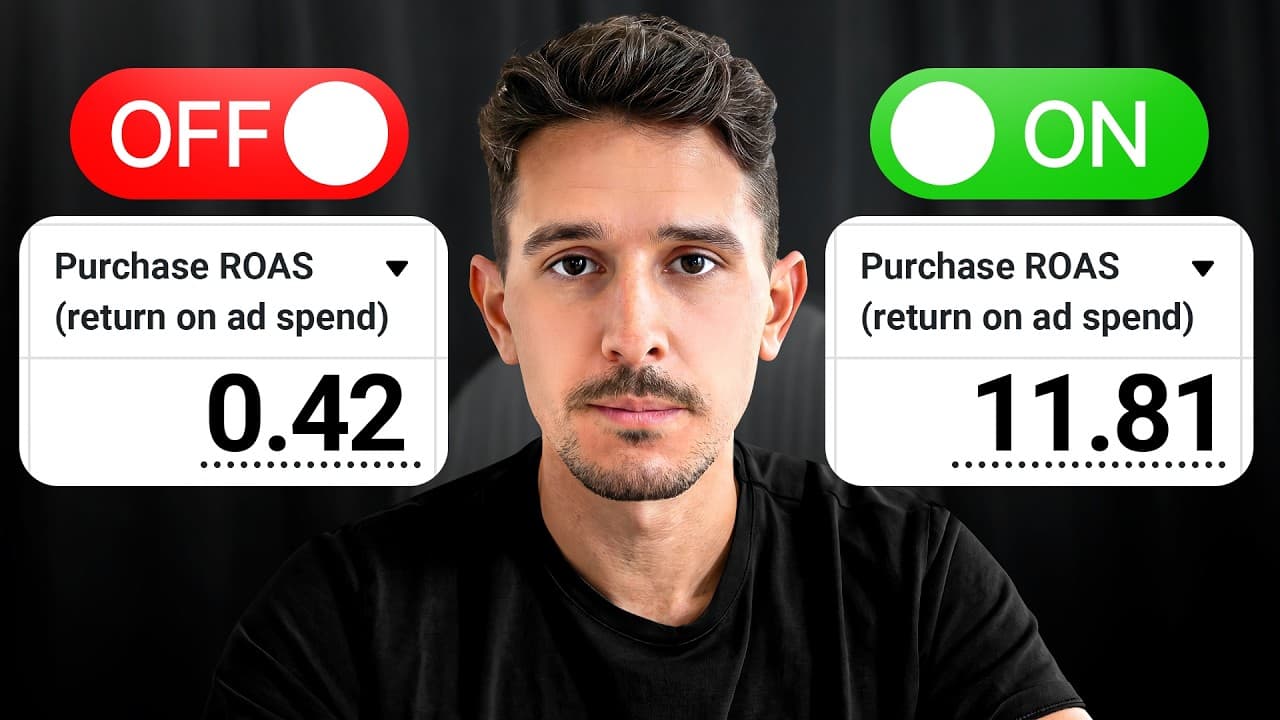
Set a seven-day minimum budget on each new ad set within a prospecting CBO campaign, then remove the minimum while keeping the ad set active. For low-budget accounts, cap the minimum at 20% of the total daily budget; for medium- or high-budget accounts, set it to one times the target cost per acquisition.
Transcript
There is one setting in Facebook ads that is the difference between overspending and adequately testing your new ads. One of the worst things that could happen when you're running Facebook ads is you launch new ads and they don't get any spent. You're not sure if things are being tested properly and you have total trust in the algorithm, but you co... Read More
Key Insights
- Testing is intended to determine whether a new ad can outperform alternatives and scale. Its purpose is not merely to identify something that looks promising, but to establish whether the winning option deserves continued spending alongside ads that have already demonstrated results.
- Proven ads are more important than unproven creative because current winners already support performance. New ads should receive enough budget for a fair evaluation, but they should not automatically take spending away from established winners simply because they are new.
- The ideal test spends as little as possible while still revealing whether an ad is a winner or loser. A fixed rule requiring 20% of the total budget for testing can waste money when a smaller amount would produce sufficient evidence.
- A single campaign containing all ads favors the algorithm, but it limits the operator's available adjustments. When performance declines, the main options are pausing ads or reducing the campaign budget, which provides less control over how individual ad sets are evaluated.
- A highly fragmented account provides more manual control but is less friendly to campaign-level optimization. Separate testing campaigns, isolated ad sets, and winners-versus-losers structures can also duplicate ads, waste spending, and separate accumulated engagement and learning from the ads intended to scale.
- Campaign budget optimization sets spending at the campaign level and distributes it across multiple ad sets. A prospecting CBO campaign can contain dozens of active ad sets, provided that new ad sets receive a controlled opportunity to spend and prove their purchase performance.
- A seven-day minimum budget gives each new ad set a fair test without permanently forcing spending toward it. After the seven-day period, the minimum is removed while the ad set remains active, allowing campaign budget optimization to determine its subsequent allocation.
- Minimum-budget sizing depends on account spending. A low-budget account should assign no more than 20% of its total daily budget to the minimum, while a medium- or high-budget account should set the minimum at one times its target cost per acquisition.
- More videos from this channel:
- More from this channel: Sam Piliero
Install to Summarize YouTube Videos and Get Transcripts
Explore YouTube Video Summarizer or Get YouTube Transcript Extractor
Questions & Answers
Q: How should I test new Facebook ads without overspending?
Place new ads in a new ad set within a prospecting campaign that uses campaign budget optimization, then assign that ad set a minimum budget for seven days. This gives the ads enough spending to demonstrate whether they can generate purchases. After seven days, remove the minimum budget but keep the ad set active so proven ads can continue receiving most of the campaign's spending.
Q: What Facebook Ads setting helps new ad sets receive spend?
The recommended setting is an ad set minimum budget applied for the first seven days after launch. It prevents a new ad set from receiving only a negligible share of a campaign budget already dominated by established ad sets. Once the test period ends, remove the minimum rather than pausing the ad set, allowing the CBO system to allocate future spending based on performance.
Q: How long should a minimum budget remain on a new ad set?
The minimum budget should remain active for the first seven days of the new ad set's test. At the end of that period, pause or remove the minimum budget while leaving the ad set itself active. This creates a defined testing window without permanently forcing campaign funds toward the new ads after they have had an opportunity to produce purchase results.
Q: How much should a low-budget account spend on ad testing?
For a low-budget setup, the seven-day minimum assigned to a new ad set should never exceed 20% of the account's total daily budget. The example given is a campaign spending $100 per day, where the maximum minimum budget would be $20. This cap gives the new ads a test while protecting most spending for ads that are already proven.
Q: How should medium- and high-budget accounts set test budgets?
A medium- or high-budget account should set the new ad set's minimum budget equal to one times its target cost per acquisition. If the target acquisition cost is $47, the minimum is set to $47. The purpose is to provide enough spending over the seven-day period for a genuine creative winner to demonstrate its ability to generate purchases.
Q: Why can new ad sets receive too little spend in a CBO campaign?
Campaign budget optimization distributes money across ad sets according to the algorithm's allocation. Existing ad sets may already consume the full campaign budget, leaving a newly launched ad set with very little spending. In the example, three established ad sets divide a $1,000 budget as $700, $100, and $200, while the new ad set may receive only about $10.
Q: Why not use a separate creative testing campaign?
Separate creative testing campaigns can force spending toward unproven ads and create wasted spend. They can also produce wasted learning when ads are duplicated across the account, because engagement and post IDs do not transfer perfectly as described in the transcript. Keeping ads in their original ad set preserves their accumulated position and allows winners to continue without restarting from zero.
Q: Which metrics should determine whether a Facebook ad wins?
Purchases are the primary result used to prove whether a creative can win and scale. Add-to-cart and initiated-checkout activity can serve as leading or proxy metrics, but they do not replace purchase results. The seven-day minimum-budget test is designed to give a strong creative enough spending to demonstrate that it can drive actual acquisitions at the account's target cost.
Summary & Key Takeaways
-
Facebook ad testing should determine whether new ads can generate purchases and scale, while preserving most spending for existing proven winners. The ideal test uses as little money as possible, rather than automatically assigning a fixed percentage of the total advertising budget to creative testing regardless of performance.
-
A prospecting campaign using campaign budget optimization places the budget at the campaign level and distributes it among multiple ad sets. Without intervention, established ad sets can consume nearly the entire budget, leaving a newly launched ad set with too little spending to produce meaningful purchase data or receive a fair evaluation.
-
The recommended setting is a minimum budget applied to each new ad set for its first seven days. Low-budget accounts should limit that minimum to no more than 20% of total daily spending, while medium- and high-budget accounts can use one times their target cost per acquisition before removing the minimum.
Read in Other Languages (beta)
Share This Summary 📚
Summarize YouTube Videos and Get Video Transcripts with 1-Click
Try YouTube Summary with ChatGPT & Claude or YouTube Transcript Generator
Explore More Summaries from Sam Piliero 📚




Summarize YouTube Videos and Get Video Transcripts with 1-Click
Try YouTube Summary with ChatGPT & Claude or YouTube Transcript Generator