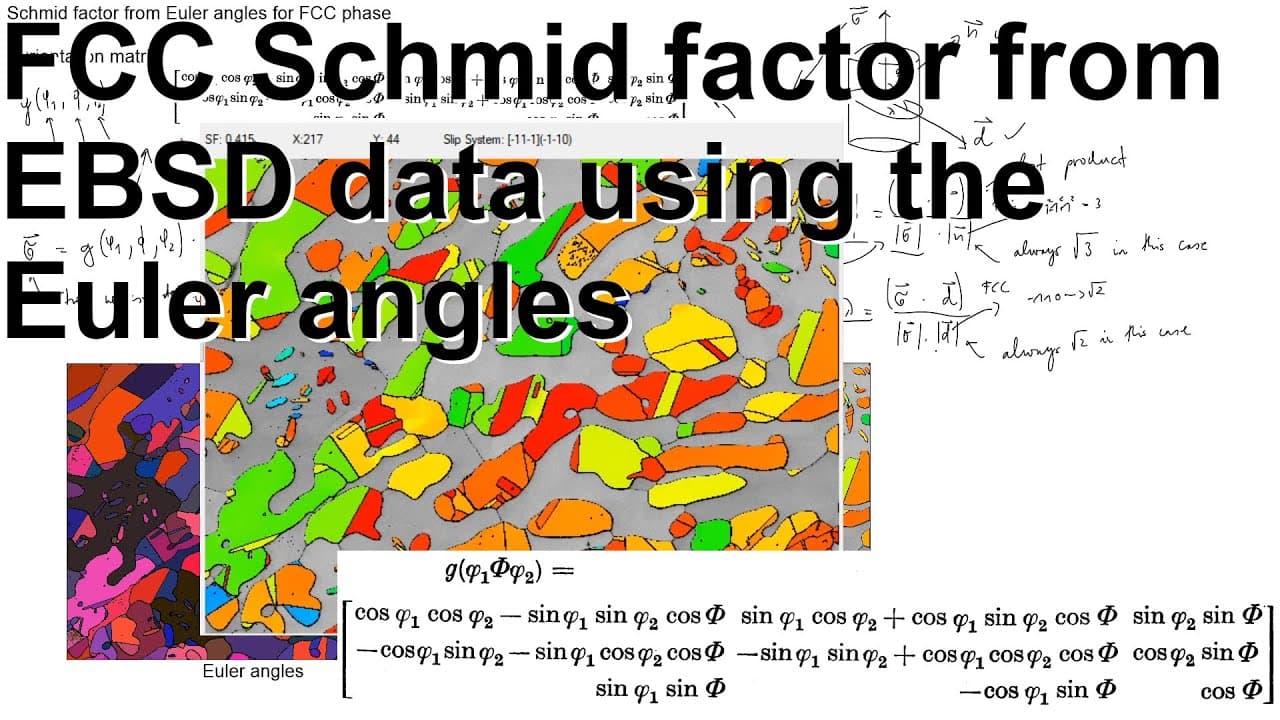
FCC Schmid factor from Euler angles using the orientation matrix
TL;DR
This video explains how to calculate Schmidt factors for FCC materials using Euler angles and orientation matrices.
Transcript
like on everyone in this video I'm going to show you how to get the Schmidt factors for an FCC phase using the Euler angles so in my previous video I already showed you what we can do with the Euler angles and how we can represent different orientations using it and how we can switch between different coordinate systems because the Euler angles are... Read More
Key Insights
- 👻 Euler angles allow precise representation of crystal orientations necessary for calculating Schmidt factors in deformation studies.
- 🧑🏭 Orientation matrices act as bridges between the specimen and crystal coordinate systems, facilitating accurate stress transformations.
- 💋 Understanding the slip systems in FCC materials is essential for predicting mechanical behaviors under diverse conditions of applied stress.
- ❓ Matrix operations can efficiently collate data across multiple pixels in crystalline microstructures, enhancing analytical capabilities.
- 📐 Consistency in angular units is vital for precise calculations in materials science, particularly for trigonometric applications.
- 🧑🏭 Schmidt factors are central to assessing the deformation potential of materials, significantly impacting applications in engineering and design.
- 🦾 The software aids in visualizing grain structures and correlating them with calculated mechanical properties, enhancing research outputs.
Install to Summarize YouTube Videos and Get Transcripts
Explore YouTube Video Summarizer or Get YouTube Transcript Extractor
Questions & Answers
Q: What are Schmidt factors and why are they important?
Schmidt factors quantify the effectiveness of a given slip system in a crystalline material under applied stress. They indicate how favorably a material can deform, which is crucial in predicting material response during processes like deformation or fracture. A higher Schmidt factor means a greater likelihood for slip to occur, affecting the material's mechanical properties.
Q: How do Euler angles relate to the calculation of Schmidt factors?
Euler angles are used to represent the orientation of a crystal in three-dimensional space. By defining the rotation of the specimen coordinate system relative to the crystal coordinate system, these angles facilitate the creation of an orientation matrix, which is essential for transforming stress components needed to calculate the Schmidt factor.
Q: What is the significance of using a transformation matrix in this calculation?
The transformation matrix, or orientation matrix, allows us to convert stresses from the specimen coordinate system to the crystal coordinate system. This conversion is critical for accurately calculating the Schmidt factor, as it ensures that the applied stresses correspond effectively to the orientations of slip systems within the crystal structure.
Q: Why do we calculate both HKL and UVW values?
HKL values denote the Miller indices of crystal planes, while UVW values represent the directions in the crystal lattice. Calculating both provides a complete understanding of the crystallographic context for the applied stresses, which is vital for determining the slip systems involved and the corresponding Schmidt factors in various orientations.
Q: How does the software facilitate determining Schmidt factors for multiple pixels?
The software automates the calculation process for numerous pixels in micrographs, allowing for the efficient generation of Schmidt factor maps. By calculating orientation matrices and performing necessary matrix multiplications for potentially hundreds of thousands of pixels, it streamlines what would otherwise be a time-consuming manual process.
Q: What is the impact of defining angles in degrees versus radians?
Defining angles in either degrees or radians is crucial since incorrect assumptions can lead to erroneous calculations. The video highlights the importance of maintaining consistency in angle measurement, as even minor discrepancies can result in significant errors when computing trigonometric functions involved in calculating the Schmidt factor.
Q: How can viewers practice the calculations introduced in the video?
The video provides a link to a shared table that allows viewers to input their Euler angles and perform the calculations described. This tool serves as a practical way for individuals to enhance their understanding of the material and validate their calculations in determining Schmidt factors.
Q: What additional features might the software provide for studying FCC materials?
Beyond calculating Schmidt factors, the software may include functionalities such as visualizing crystal orientations, simulating stress responses under varying conditions, or providing insights into material fatigue and failure. These features can help researchers and students analyze FCC materials comprehensively and enhance their learning experience.
Summary & Key Takeaways
-
The video focuses on calculating Schmidt factors for face-centered cubic (FCC) structures using Euler angles and transformation matrices, known as orientation matrices.
-
Viewers learn to manipulate stress represented in the specimen's coordinate system and translate it into the crystal's coordinate system, employing mathematical procedures for accurate results.
-
The breakdown of the Schmidt factor calculation includes a detailed examination of stress directions and slip systems, ultimately identifying the maximum Schmidt factor for specified conditions.
Read in Other Languages (beta)
Share This Summary 📚
Summarize YouTube Videos and Get Video Transcripts with 1-Click
Try YouTube Summary with ChatGPT & Claude or YouTube Transcript Generator
Explore More Summaries from Curious Scientist 📚

![Building a Peltier cooler-based cooling box - First iteration, improvements [Part 2/6] thumbnail](/_next/image?url=https%3A%2F%2Fi.ytimg.com%2Fvi%2F0YlNw0EGnzI%2Fhqdefault.jpg&w=750&q=75)




Summarize YouTube Videos and Get Video Transcripts with 1-Click
Try YouTube Summary with ChatGPT & Claude or YouTube Transcript Generator