How Did Ideas Drive the American Revolution?
TL;DR
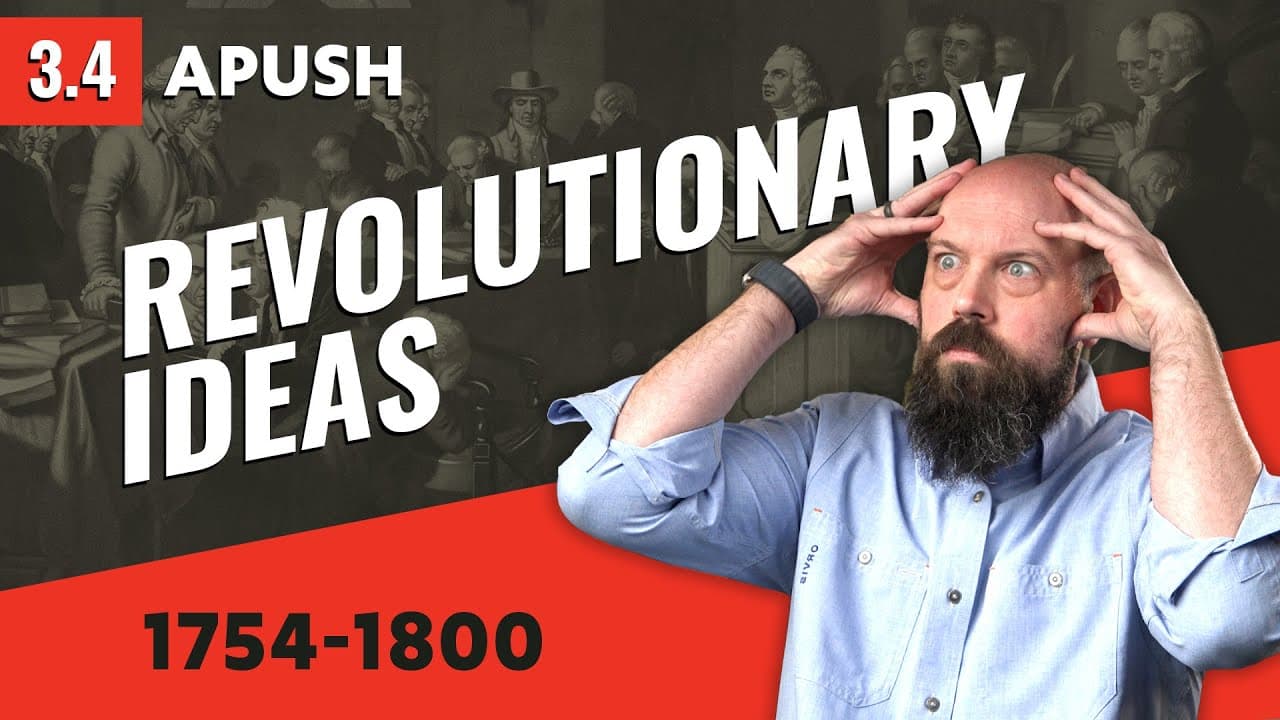
Enlightenment principles, radical Whig warnings, and First Great Awakening beliefs taught colonists to defend individual rights and distrust abusive authority. After Britain rejected peaceful appeals, Thomas Paine's Common Sense combined natural rights, social contract theory, republicanism, and biblical arguments, helping persuade colonists that independence was the only viable response to tyranny.
Transcript
Now, the American Revolution didn't just happen because the colonists were having feelings about Big Mama Britain's increasingly oppressive policies. No, there was a whole set of revolutionary ideas swirling around their thinkythinky parts that taken together became a significant cause for the independence movement. And I reckon we ought to talk ab... Read More
Key Insights
- Independence was not the colonists' dominant goal even as late as 1775. Most wanted to remain British subjects while compelling Britain to respect the rights they believed they possessed within the empire, but oppressive policies and changing political ideas gradually made separation appear necessary.
- The North American colonies were unusually receptive to Enlightenment ideas because settlers had built new societies without the same weight of centuries of European social tradition. This environment functioned as an experimental setting in which new ideas about government, society, and human nature could spread.
- Natural rights are rights that every individual receives from God, including life, liberty, and property. This principle challenged monarchy because it implied that rulers did not create those rights and therefore possessed no legitimate authority to violate them.
- The social contract is an agreement in which individuals establish government and surrender certain freedoms in exchange for protection and security. When government becomes tyrannical and violates natural rights, the contract is broken, giving the people the right to overthrow and replace it.
- Radical Whig thought warned that political corruption and arbitrary power could lead to tyranny. Its criticism of authority inherited through monarchs and aristocratic families encouraged colonists to value individual talent over hereditary privilege and to distrust officials whose power did not arise from merit.
- First Great Awakening beliefs strengthened colonial resistance by portraying American liberty as a gift from God and elevating individual religious experience above formal church hierarchies. These habits encouraged suspicion toward systems of authority when British policies appeared to threaten colonial rights.
- The Continental Congresses transformed resistance from scattered local action into a coordinated colonial response. The first encouraged continued boycotts after the Intolerable Acts, while the second acted as a provisional government, organized responses to British aggression, and debated negotiation against independence.
- Common Sense persuaded many colonists that independence was the only way forward by combining Enlightenment principles, republicanism, biblical criticism of monarchy, and accessible appeals to ordinary people. Its arguments became especially powerful after King George III rejected congressional petitions seeking peace and restored rights.
Install to Summarize YouTube Videos and Get Transcripts
Explore YouTube Video Summarizer or Get YouTube Transcript Extractor
Questions & Answers
Q: How did Enlightenment ideas cause the American Revolution?
Enlightenment ideas changed how colonists understood people, rights, and political authority. Thinkers elevated the individual, described life, liberty, and property as natural rights granted by God, and argued that governments were created through a social contract. If Britain violated those rights and became tyrannical, colonists could conclude that the government had broken its contract and could legitimately be replaced.
Q: What natural rights did colonists believe individuals possessed?
Natural rights included life, liberty, and property. These rights were understood as belonging to every individual from birth and as coming from God rather than from a monarch. That distinction carried a powerful political implication: because rulers did not grant natural rights, they had no legitimate authority to infringe upon them, and government existed primarily to protect them.
Q: What is the social contract in American revolutionary thought?
The social contract is the idea that individuals with natural rights voluntarily construct governments to protect their rights and security. People agree to surrender certain freedoms in exchange for that protection, so political power ultimately rests with them. If a government becomes tyrannical and violates the agreement, the people have the right to overthrow it and establish a replacement.
Q: How did radical Whig ideas influence American colonists?
Radical Whig political theorists warned colonists about corruption, tyranny, and the arbitrary power exercised by monarchs and aristocrats. They particularly criticized hereditary authority, which placed power in the hands of people born into favored families regardless of ability. These arguments shaped colonial political thinking and encouraged Americans to emphasize individual talent instead of inherited privilege.
Q: How did the First Great Awakening encourage resistance to Britain?
The First Great Awakening strengthened religious identity and fervor while encouraging two beliefs relevant to resistance. Many colonists viewed the relative liberty enjoyed in America as a gift from God. The movement also emphasized individual religious experience over submission to formal church hierarchies, teaching people to question established authority and making them wary of British policies that threatened their rights.
Q: Why were the Continental Congresses important to colonial resistance?
The First Continental Congress met in Philadelphia in 1774 after the Intolerable Acts and sought a united response to violations of colonial rights, including continued boycotts of British goods. Its importance was the centralization of resistance. After armed conflict, the Second Continental Congress served as a provisional government, organized the colonial response, and debated reconciliation with Britain against independence.
Q: Why did Thomas Paine's Common Sense persuade colonists?
Common Sense appeared after petitions to the king had been rejected and colonial resentment had intensified. Thomas Paine argued that independence was the only path forward, using natural rights, social contract theory, republicanism, biblical criticism of monarchy, and direct appeals to ordinary people. Because colonists had already been shaped by Enlightenment and biblical thought, these arguments proved highly persuasive.
Q: How did the Declaration of Independence reflect revolutionary ideas?
The Declaration of Independence formally separated the colonies from British rule in 1776 and relied heavily on Enlightenment concepts such as natural rights and the social contract. Thomas Jefferson drafted it with editorial assistance from John Adams and Benjamin Franklin. Its ideas also drew from numerous state and local declarations, including the Virginia Declaration of Rights, rather than originating from Jefferson alone.
Summary & Key Takeaways
-
Enlightenment thought transformed colonial views of legitimate government by elevating the individual, defining life, liberty, and property as natural rights, and presenting government as a social contract. Because political authority came from the people, colonists could conclude that a tyrannical government had violated its purpose and could rightfully be replaced.
-
Radical Whig ideas warned colonists that arbitrary power, political corruption, monarchy, and hereditary privilege could produce tyranny. Religious ideas from the First Great Awakening reinforced this suspicion of authority by emphasizing individual religious experience. Many colonists also understood their relative liberty in the colonies as a gift from God that required protection.
-
Colonial resistance developed from coordinated protest into independence. The First Continental Congress centralized opposition, while armed conflict and the Second Continental Congress created a provisional government. After the Olive Branch Petition failed, Thomas Paine's Common Sense popularized independence, and the Declaration of Independence formally separated the colonies from British rule in 1776.
Read in Other Languages (beta)
Share This Summary 📚
Summarize YouTube Videos and Get Video Transcripts with 1-Click
Try YouTube Summary with ChatGPT & Claude or YouTube Transcript Generator
Explore More Summaries from Heimler's History 📚

Summarize YouTube Videos and Get Video Transcripts with 1-Click
Try YouTube Summary with ChatGPT & Claude or YouTube Transcript Generator