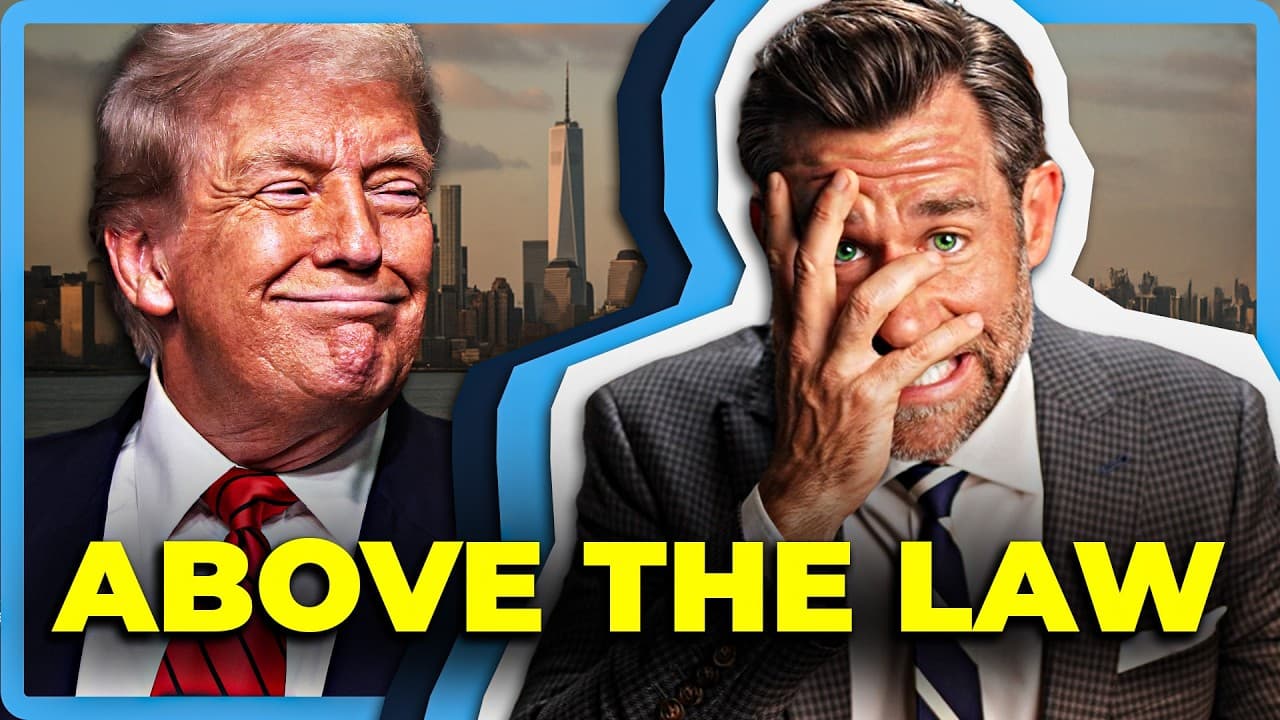
Trump's Massive Fines Cancelled by Appellate Court (For Now)
TL;DR
The appellate court upheld the finding that Donald Trump and his organization committed fraud but tossed out the nearly half-billion-dollar penalty as an unconstitutional excessive fine. The case involved inflated statements of financial condition, including a 30,000-square-foot claim for an apartment that was actually about 11,000 square feet. Read on for the evidence, the unusual judicial split, and what may happen next.
Transcript
Despite what you might have heard, Donald Trump still defrauded New York, but probably won't be paying half a billion dollars as punishment. The verdict stands, but the punishment disappears for now. But this is complicated, and this opinion is a complete mess. Yes, a New York appellet court dropped a bombshell on Attorney General Leticia James' ve... Read More
Key Insights
- The appellate court upheld the fraud verdict against Trump but overturned the nearly half-billion-dollar fine, citing it as excessive.
- The case was prosecuted under New York's Executive Law Section 6312, targeting repeated fraudulent or illegal conduct.
- Trump's inflated asset valuations included misrepresentations of his triplex apartment size and Mar-a-Lago's development rights.
- The court found Trump and his executives intentionally inflated asset values, gaining hundreds of millions without adequate oversight.
- Despite proving fraud, the court vacated the fine due to lack of direct harm to private parties and disproportionate penalty.
- The decision involved a complex procedural twist, with four judges crafting a majority opinion to keep the case out of New York's highest court.
- The appellate court's ruling allows for continued monitoring of Trump's business practices as a deterrent against future misconduct.
- The decision is not final, as further appeals are expected, potentially reaching New York's highest court.
Install to Summarize YouTube Videos and Get Transcripts
Explore YouTube Video Summarizer or Get YouTube Transcript Extractor
Questions & Answers
Q: Why were Donald Trump’s massive fines cancelled by the appellate court?
The appellate court concluded that the nearly half-billion-dollar penalties amounted to an unconstitutional excessive fine. It removed that punishment for now while leaving the underlying fraud verdict intact.
Q: Did the appellate court overturn the fraud verdict against Trump?
No. The court upheld the trial court’s conclusion that Donald Trump, his company, and other defendants committed repeated and persistent fraud, but it tossed out the financial penalties.
Q: What law did New York Attorney General Letitia James use to prosecute the Trump case?
James brought the case under New York Executive Law Section 6312. According to the transcript, the statute allows the attorney general to seek injunctions against people or businesses that repeatedly engage in fraudulent or illegal conduct, as well as restitution, damages, and, in serious cases, cancellation of a company’s license to operate in New York.
Q: How was Trump’s triplex apartment misrepresented?
Trump’s statements of financial condition listed the triplex as 30,000 square feet, almost three times its actual size of about 11,000 square feet. After Forbes presented public records showing the true size, the Trump Organization did not correct the statement and finalized the 2016 document four days later with the inflated figure.
Q: Why did the court find the Mar-a-Lago valuations fraudulent?
The statements valued Mar-a-Lago as though it could be redeveloped into luxury residences, even though a conservation easement permanently barred residential development. From 2011 through 2021, the Trump Organization valued it between $347 million and $739 million, while the county’s assessed value was between $18 million and $28 million after the restriction.
Q: How did the Trump Organization allegedly inflate Trump’s stated net worth?
Witness testimony indicated that Trump directed CFO Alan Weisselberg that his net worth on the statements needed to increase. Between 2011 and 2015, Weisselberg and Michael Cohen then reverse-engineered asset values to match the target figure before obtaining Trump’s approval and sending the statements to Mazars USA.
Q: What was misleading about Trump’s interest in Vornado Realty Trust?
The statements treated Trump’s minority partnership interest as $192 million in readily available cash, although the assets were neither liquid nor controlled by Trump. Companies including Zurich and HCC relied on that figure, and an HCC representative said it was a meaningful underwriting factor because it suggested strong liquidity.
Q: What procedural twist affected the appellate court’s ruling?
Four judges with different views assembled a majority opinion that isolated the lone dissenter. According to the transcript and existing summary, this avoided New York’s two-dissent rule for an automatic appeal and kept the question of the attorney general’s authority from immediately reaching the state’s highest court, although further appeals are expected.
Summary & Key Takeaways
-
The appellate court upheld the fraud verdict against Donald Trump and his organization but overturned the nearly half-billion-dollar fine, considering it an excessive punishment. The decision stemmed from the New York Attorney General's prosecution under Executive Law Section 6312, targeting repeated fraudulent conduct by Trump and his executives.
-
Key fraudulent activities included inflated valuations of Trump's properties, such as his triplex apartment and Mar-a-Lago. Despite the court's finding of fraud, the fine was vacated due to lack of direct harm to private parties and the disproportionate nature of the penalty.
-
The appellate decision involved a complex procedural twist, with judges crafting a majority opinion to prevent the case from reaching New York's highest court. The ruling allows for continued monitoring of Trump's business practices as a deterrent against future misconduct, though further appeals are expected.
Read in Other Languages (beta)
Share This Summary 📚
Summarize YouTube Videos and Get Video Transcripts with 1-Click
Try YouTube Summary with ChatGPT & Claude or YouTube Transcript Generator
Explore More Summaries from LegalEagle 📚






Summarize YouTube Videos and Get Video Transcripts with 1-Click
Try YouTube Summary with ChatGPT & Claude or YouTube Transcript Generator