Which AI Model Builds Better One-Shot Apps?
TL;DR
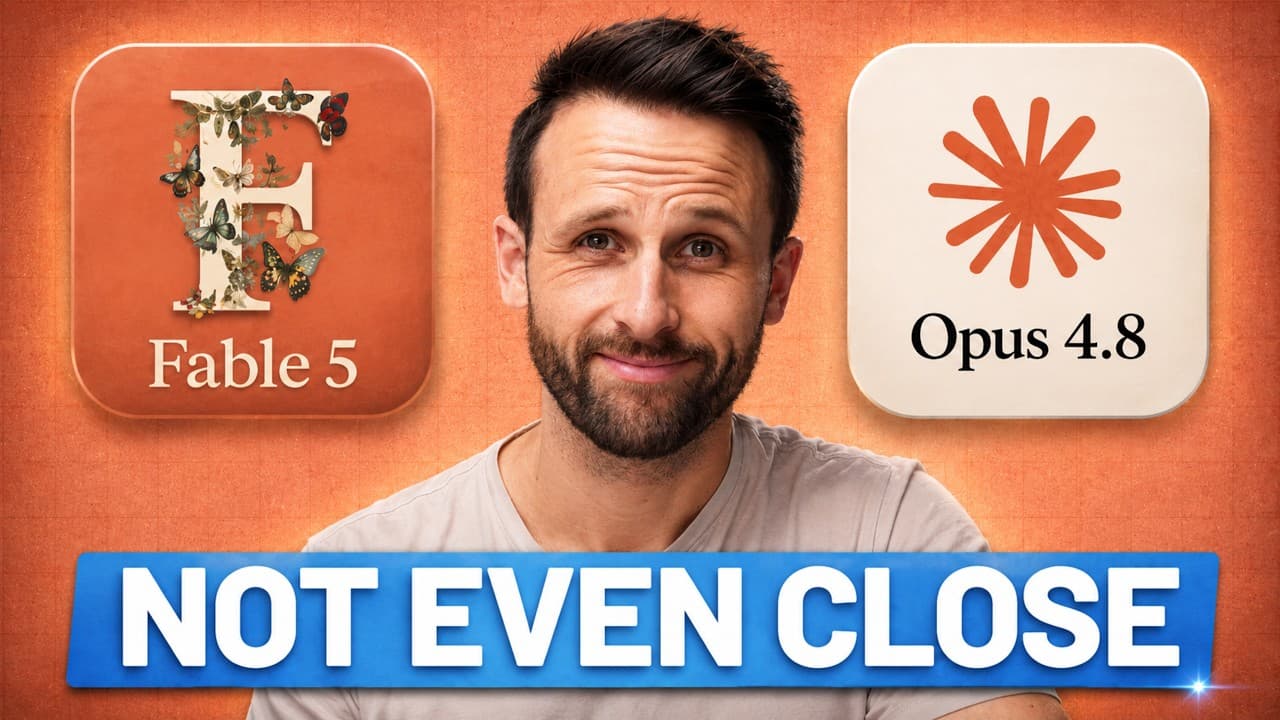
Fable 5 produced the stronger e-commerce build, with cleaner navigation, more coherent product imagery, better filters, and a more convincing retail aesthetic. It also finished faster and used fewer output tokens than Opus 4.8, although the broader comparison included additional tests involving an interactive art museum and a strategy game.
Transcript
So, I just gave the exact same prompt to Opus48 and Claude's brand new flagship model, Fable 5, across three builds, a fully functioning e-commerce store, an entire 3D world of famous art pieces, and finally, an Age of Empires clone. Same rules for both models, a single one-shot output, no revisions, deployed live in the internet. This is Opus 48 v... Read More
Key Insights
- The comparison used equivalent prompts and one-shot constraints for both models, with no revision cycle after generation. Each application was deployed live, allowing the presenter to judge the models through working outputs rather than code samples or incomplete demonstrations.
- The e-commerce task tested more than visual design because it required a landing page, product catalog, database, application architecture, filtering, product details, and cart behavior. The prompt also explicitly required distinct product imagery, readable text, strong contrast, and product labeling.
- Opus 4.8 produced a functional store with readable text, labeled candle images, category pages, product pages, hover effects, and a working cart drawer. Its weaknesses included awkward hero composition, excessive filter choices, confusing navigation behavior, inconsistent section colors, and a cart icon resembling a trash can.
- Fable 5 created a cleaner retail interface with a recognizable promotional banner, stronger calls to action, better product presentation, ritual-based shopping categories, practical filters, a coherent product grid, and a polished footer. These details made its output feel more like an established e-commerce store.
- Fable 5 handled image prompting more effectively within the tested workflow. Its candle images used coordinated colors, textured settings, shadows, branches, weather cues, and complementary backgrounds, while maintaining visual differences between products and a consistent overall brand aesthetic.
- Fable 5 was more token-efficient in the e-commerce test because it generated fewer output tokens than Opus 4.8. The presenter also reported that Fable 5 completed the build sooner, making its stronger visual result notable from both efficiency and execution perspectives.
- The interactive art museum was designed as a zoomable timeline connecting major art periods, artists, biographical placards, and three-dimensional galleries. It also required extracting, storing, and organizing paintings from Wikimedia Commons and Wikipedia-related data into a database.
- The complete benchmark extended beyond e-commerce to include an interactive art-history environment and an Age of Empires-style strategy game. These builds were selected to test interface design, application architecture, structured data processing, realistic three-dimensional presentation, and complex interactive behavior under the same one-shot approach.
Install to Summarize YouTube Videos and Get Transcripts
Explore YouTube Video Summarizer or Get YouTube Transcript Extractor
Questions & Answers
Q: Which model built the better e-commerce store?
Fable 5 built the stronger e-commerce store in the presented comparison. Its output had cleaner navigation, more convincing calls to action, useful ritual-based categories, better filters, a polished product grid, and more coherent product photography. Opus 4.8 produced a working and readable store, but several interface choices felt confusing, visually inconsistent, or less appropriate for a real retail experience.
Q: What requirements were included in the e-commerce prompt?
The prompt asked for a complete, production-quality store for Slowburn, a fictional small-batch candle company, designed to resemble a real Shopify store. It required distinct products, visually different product images, readable text, sufficient contrast, and clear product labels. The build also tested the landing page, catalog organization, underlying database, application architecture, filtering, product details, and cart interactions.
Q: What worked well in the Opus 4.8 e-commerce build?
Opus 4.8 delivered a functional store whose text was generally readable and whose generated candle images included product labels. It created category sections, product cards, subtle hover animations, individual product pages, an add-to-cart action, and a cart drawer. It also added playful testimonial copy and improved substantially over the earlier dynamic-workflows result described by the presenter.
Q: What problems appeared in the Opus 4.8 store?
The Opus 4.8 store had several design and usability issues. Its hero candle competed with the headline, one call-to-action button looked awkward, section colors felt inconsistent, and the catalog exposed too many poorly organized filters. The navigation interaction was described as bad user experience, while the cart icon looked similar to a trash can and could confuse shoppers.
Q: Why did the Fable 5 store look more polished?
Fable 5 combined several small design decisions into a more coherent retail experience. It used a familiar promotional banner, stronger buttons, a cleaner hero section, subtle gradients, ritual-based shopping categories, useful filters, a structured product grid, restrained image animations, a clear usage section, testimonial content, and a polished footer. The overall visual language remained consistent across the storefront.
Q: How did the models differ in generated product imagery?
Both models generated distinct candle imagery, but Fable 5 produced a more cohesive and carefully styled collection. Its images incorporated coordinated candle colors, textured surfaces, branches, shadows, sunlight, and weather-related backgrounds that matched individual product concepts. The presenter attributed this difference to Fable 5 giving the image-generation system more effective prompts while preserving a consistent candle-brand aesthetic.
Q: How did Fable 5 compare with Opus 4.8 on efficiency?
Fable 5 generated fewer output tokens and completed the e-commerce application sooner than Opus 4.8 in the reported test. The presenter therefore viewed it as more token-efficient as well as visually stronger for that build. The comparison used an estimated usage-based cost tracker, but the larger conclusion was based on relative output size, completion time, and application quality.
Q: What was the interactive art museum supposed to do?
The museum was intended to present art history as a zoomable timeline rather than a textbook or disconnected reference search. A user could enter an art period, select a notable artist, read a museum-style placard, and explore paintings in a dedicated three-dimensional gallery. The application also needed to retrieve, store, organize, and display a large collection of artwork data.
Summary & Key Takeaways
-
Claude Opus 4.8 and Fable 5 received equivalent prompts and constraints for several ambitious application builds. Each model had to generate a deployable result in one shot, without revisions. The comparison examined visual quality, functionality, architecture, data handling, token usage, estimated usage-based cost, and completion time.
-
The e-commerce prompt requested a production-quality store for Slowburn, a fictional small-batch candle company. Opus 4.8 created a functional and readable store with labeled products, categories, product pages, and a cart drawer, but its filters, navigation, color choices, iconography, and hero composition contained noticeable usability and design problems.
-
Fable 5 delivered a more polished e-commerce experience through cleaner navigation, stronger buttons, coherent imagery, useful ritual-based filters, a structured product grid, and thoughtful retail details. The comparison then expanded to an interactive art-history museum and an Age of Empires-style game, testing whether the models could handle data-intensive, three-dimensional, and interactive applications.
Read in Other Languages (beta)
Share This Summary 📚
Summarize YouTube Videos and Get Video Transcripts with 1-Click
Try YouTube Summary with ChatGPT & Claude or YouTube Transcript Generator
Explore More Summaries from Pat Simmons 📚

Summarize YouTube Videos and Get Video Transcripts with 1-Click
Try YouTube Summary with ChatGPT & Claude or YouTube Transcript Generator