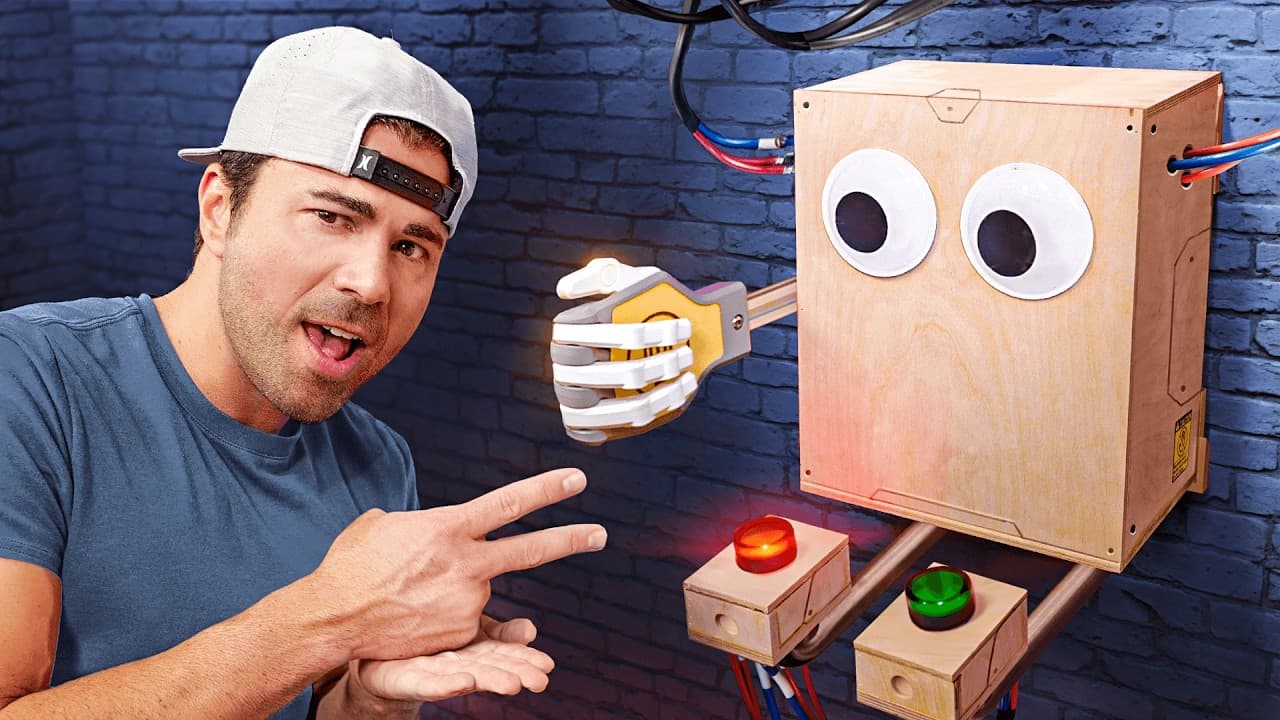
How Does a Rock Paper Scissors Robot Never Lose?

TL;DR
Ten CrunchLabs builds share one trait: each exploits a simple physical or perceptual principle. A floor of 3.5 million airsoft BBs becomes nearly frictionless because every BB acts like a tiny wheel, the same principle behind ball bearings. A water wave looks frozen on camera when a subwoofer vibrates a tube at 30Hz and the camera records at 30 frames per second.
Transcript
This is a friendly robot that's impossible to beat at rock, paper, scissors. This is an infinite slinky staircase that can run for days. And this is basically a room temperature ice rink. Today we're not only going to countdown ten of the coolest things we've built at CrunchLabs over the past year. But we’re going to also break down the science of ... Read More
Key Insights
- A floor made of 3.5 million airsoft BBs is almost completely frictionless because each BB rolls smoothly against both the ground and your foot, so standing on hundreds of them is like standing on hundreds of perfect wheels that slide you in any direction.
- Ball bearings work by exactly the same principle as the BB floor: replace the ground and the foot with metal, connect the top surface to itself and the bottom surface to itself, and the two surfaces still slide freely relative to each other.
- Ball bearings appear anywhere smooth low friction rotation is required, including bike, skateboard and rollerblade wheels where they connect to the axles, plus aircraft engines, washing machines, fidget spinners and many other tools.
- A rubber screaming chicken makes noise through a kazoo style part inside it. Squeezing it and letting it expand back to its original shape pulls air over a diaphragm, which vibrates and produces the sound. Twenty-two of them on a 100 psi airline become a lunchtime alarm.
- A deflagration wave is a slow moving wave of fire that spreads because of heat. In Science Bob's deflagration tube, loaded gas is ignited, the flame traces through the tubes, and at the end it mixes with oxygen to make a small explosion that launches a bottle placed in the way.
- The frozen water wave illusion works only through a camera. A subwoofer at 30Hz wiggles a vinyl tube 30 times per second, and a phone recording at 30 frames per second captures the wave at the same position each time, so the motion becomes virtually undetectable.
- Changing the subwoofer frequency changes the apparent direction of the wave. At 31Hz each frame catches the wave slightly further forward, so it appears to travel forward slowly, and reducing the frequency has the opposite effect. Adding a second speaker for side to side motion produces a spiral.
- Laminar flow is different from the camera illusion. It is when the layers of a fluid slide over one another in a predictable pattern instead of going turbulent and unpredictable, and unlike the speaker trick it looks impressive in real time to the naked eye, not just on a camera feed.
Install to Summarize YouTube Videos and Get Transcripts
Explore YouTube Video Summarizer or Get YouTube Transcript Extractor
Questions & Answers
Q: Why is a floor of airsoft BBs more slippery than ice?
Any given BB rolls smoothly on the ground, and your foot rolls smoothly on top of the BB. With hundreds of BBs underneath you, it is like having hundreds of perfect wheels that can slide you in any direction, making the surface almost completely frictionless. The build used 3.5 million airsoft BBs, and it was described as the most slippery surface anyone on the team had stood on, even more slippery than ice. Skating, surfing and bowling were all attempted on it, but stopping was essentially impossible, so a ten-year-old competitive skateboarder named Anna was brought in to handle the tricks.
Q: How do ball bearings reduce friction?
Ball bearings use the same mechanism as the BB floor. Take the floor and replace it with metal, take your foot and replace it with metal, then connect the top surface to itself and the bottom surface to itself. The two surfaces still slide relative to each other just as freely as a foot slides across a bed of loose BBs, because the balls in between roll rather than drag. That is why ball bearings show up in bike, skateboard and rollerblade wheels at the point where the wheel meets the axle, in aircraft engines, in washing machines, in fidget spinners, and in pretty much anything that rotates where smooth low friction motion is required.
Q: What makes a rubber screaming chicken produce its sound?
Cutting one open reveals that it is basically just a kazoo, similar to one of those party blowers. When you squeeze the chicken and release it, the body expands back to its original shape, and that expansion pulls air over a diaphragm inside. The diaphragm vibrates as the air passes over it, which creates the loud, unpleasant noise the toy is known for. The CrunchLabs team scaled this up by hooking 22 chicken heads to an airline pressurized at 100 psi, so opening a single valve fires all of them at once as a lunchtime announcement in place of a conventional bell.
Q: How does the frozen water wave illusion work?
A vinyl tube that spits out water is attached to a subwoofer speaker. Running the subwoofer at 30Hz means it vibrates up and down 30 times per second, which wiggles the tube at that same rate. If a phone camera records at 30 frames per second, it only takes a picture when the wave is at the exact same position each time, once every thirtieth of a second. On playback the motion is virtually undetectable, so the stream appears to be a frozen standing wave of water. The effect exists only in the camera feed, not to the naked eye.
Q: How do you make the water wave appear to move forward or backward?
You change the speaker frequency away from the camera's frame rate. At 31Hz, meaning 31 vibrations per second against a 30 frames per second recording, each captured frame shows the water wave just a little further forward than the last, so on playback the wave looks like it is slowly traveling forward. Reducing the frequency below the frame rate has the opposite effect and the wave appears to travel backward. Adding a second speaker that moves the wave side to side while the first moves it up and down combines the two motions into a spiral, which the team confirmed actually works.
Q: How can you recreate the water wave effect at home?
You only need a hose, some tape, a cordless drill and a bit. Start by folding the tape into a flag shape to provide an offset weight, then secure the hose to the bottom of the cordless drill. Turn both the water and the drill on. The natural vibrations of the spinning drill cause the hose tip to rotate in a circle at close to the magical rate of 30 times per second, which matches a standard camera frame rate. Slightly changing the drill's speed with the trigger will make the apparent wave change directions, just like adjusting the subwoofer frequency does in the full setup.
Q: What is laminar flow and how is it different from the speaker wave?
Laminar flow is when the layers of a fluid interact by sliding over one another in a predictable pattern, instead of going turbulent and unpredictable. Many people confuse it with the subwoofer water wave, but they are not the same thing. The speaker effect is only impressive through a camera feed, because it depends on the frame rate matching the wiggle rate of the tube. Laminar flow looks striking in real time with your own eyes, with no camera required. A simple home version uses a balloon filled with water: tape a tic-tac-toe square onto it, then cut right in the middle.
Q: How is a chair made from a single sheet of plywood?
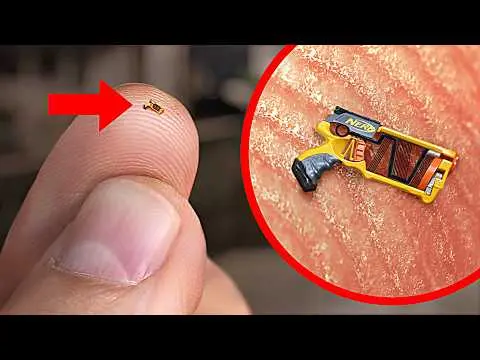
You start with a flat sheet of plywood, give it a paint job, then place it on a CNC router machine and have it cut into a very specific pattern. After cutting, you take out the middle part and fold the remainder into a functional chair. It works because it is a compliant mechanism, which takes advantage of the fact that even solid materials can flex and bend if you give them the right shape. The chair was designed in the BYU Compliant Mechanisms Lab, the same lab behind the world's smallest Nerf gun, and a 3D printable file for a mini version is linked in the video description.
Summary & Key Takeaways
-
The countdown runs from number ten to number one, covering a choir of 22 screaming rubber chickens triggered by 100 psi air, a deflagration tube that launches a bottle, a floor of 3.5 million airsoft BBs, folding plywood chairs, a subwoofer water wave, a Nerf dart collecting Roomba, a hidden mirror trophy display, and a Simon game solver.
-
The science segments explain why each build works. Squeezed rubber chickens pull air over a vibrating diaphragm like a kazoo. BBs roll like miniature wheels and behave like the particles computers use to simulate water. The plywood chair is a compliant mechanism from the BYU Compliant Mechanisms Lab, bending because of its cut pattern.
-
Several builds are presented as recreatable at home. A hose taped to a cordless drill with a folded tape flag reproduces the rotating water wave effect. A water filled balloon with a tic-tac-toe cut produces laminar flow. A printable single sheet chair file is linked in the video description via flexi-chair, Printables, and Thingiverse.
Read in Other Languages (beta)
Share This Summary 📚
Summarize YouTube Videos and Get Video Transcripts with 1-Click
Try YouTube Summary with ChatGPT & Claude or YouTube Transcript Generator
Explore More Summaries from Mark Rober 📚

Summarize YouTube Videos and Get Video Transcripts with 1-Click
Try YouTube Summary with ChatGPT & Claude or YouTube Transcript Generator