How Does Giant Elephant Toothpaste Scale Up?

TL;DR
Scaling elephant toothpaste requires repeated testing of outlet diameter, structural strength, reactant behavior, and other design variables. After more than 150 tests and eight months of planning, the team built a reinforced 20-foot flask for a record attempt and separately prepared six 55-gallon drums for a far hotter, faster reaction called Devil's Toothpaste.
Transcript
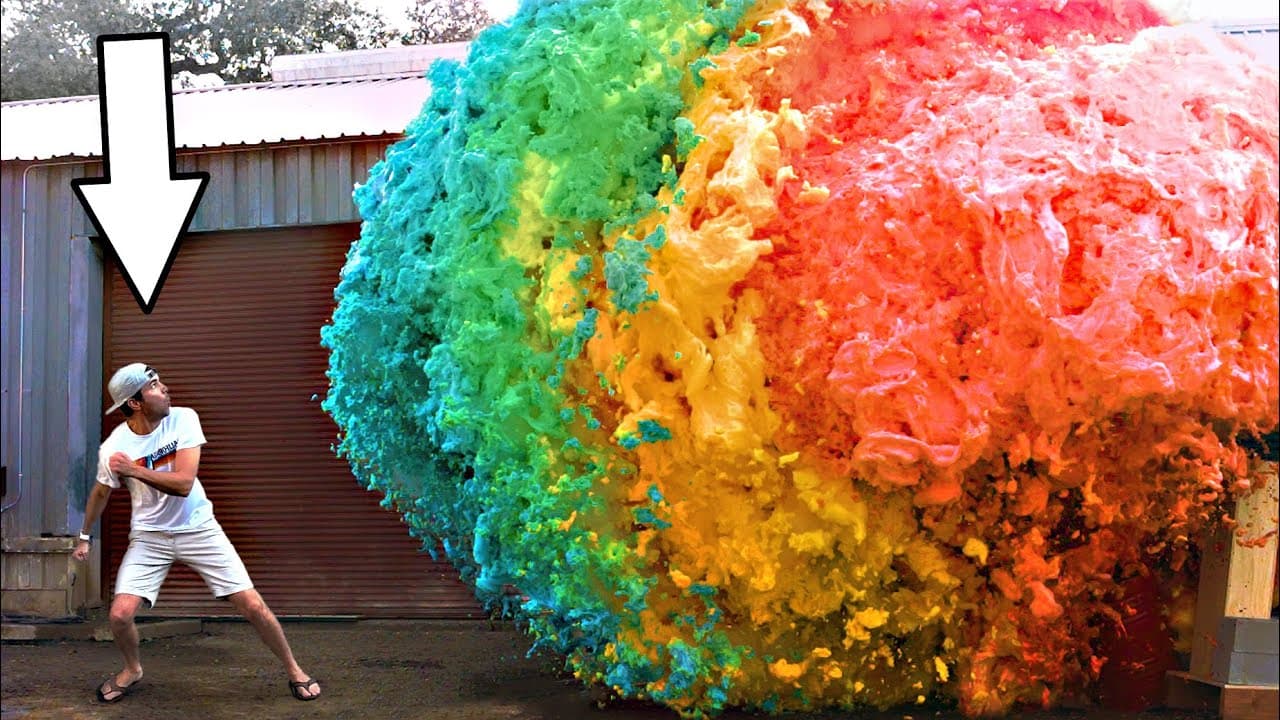
- Two, one. (structure explodes) (people shouting) - This is me reclaiming my title for the world's largest and tallest elephant toothpaste experiment, and this is a totally different kind of reaction we discovered in all our experimentation called Devil's Toothpaste, which is insanely reactive and super dangerous. I'll explain why in a minute, but... Read More
Key Insights
- The project was motivated by Fletcher's thirteenth birthday after his family relocated nearly a thousand miles so he could receive treatment at St. Jude for an exceptionally rare and dangerous form of brain cancer.
- Outlet diameter is a critical variable because a large opening produces a broad but relatively low flow, while a small opening creates a high confetti-like spray. A carefully tuned middle size creates a smooth column that still reaches substantial height.
- The squared-cube law complicates geometric scaling because doubling every linear dimension increases volume by a factor of eight. A flask enlarged proportionally therefore contains much more reacting material than its outlet and structural dimensions might initially suggest.
- Structural strength became essential as larger foam volumes generated higher internal forces. A five-foot test damaged its flask, and a ten-foot test broke screws and wood even though tape held key sections together during the failure.
- The final flask was deliberately over-engineered so the pressurized foam would have one intended escape path through the top. This approach followed repeated failures that exposed weaknesses in joints, fasteners, wood, and the overall construction.
- Devil's Toothpaste is a distinct experimental reaction that behaved much faster and hotter than the standard hydrogen peroxide, sodium iodide, and soap demonstration. Equal reactant volumes produced dramatically different results, including unusual bubbles and a shattered glass flask.
- The preparation instructions for Devil's Toothpaste were intentionally concealed with censored and nonsensical audio. The transcript therefore does not provide a usable formula, while clearly describing the reaction as explosive, extremely reactive, and dangerous.
- The development process included more than 150 tests across eight months, examining outlet dimensions, neck length, soap amounts, food-coloring brands, chemistry, and construction. The description states that the entire effort required over 1,000 total working hours.
Install to Summarize YouTube Videos and Get Transcripts
Explore YouTube Video Summarizer or Get YouTube Transcript Extractor
Questions & Answers
Q: How do you scale up an elephant toothpaste experiment?
Scaling elephant toothpaste requires testing more than the overall flask dimensions. The team varied outlet diameter, neck length, soap amounts, food-coloring brands, chemistry, and structural construction across more than 150 tests. Because greater reaction volume produced substantial internal forces, the final 20-foot flask was heavily reinforced so the foam and pressure would be directed through the opening at the top.
Q: Why does nozzle size matter for giant elephant toothpaste?
Nozzle size determines both the shape and height of the escaping foam. An opening that is too large can create an attractive flow that does not rise very high. An opening that is too small can send foam higher but break it into a confetti-like spray. Testing identified a middle, Goldilocks diameter that produced a smooth-looking column while preserving substantial height.
Q: Why can’t a laboratory flask simply be enlarged proportionally?
Proportional enlargement changes volume much faster than it changes each linear dimension. The transcript demonstrates that doubling a block's dimensions increases its volume by a factor of eight. During the first five-foot flask test, a geometrically scaled design produced a confetti-like result. The team consequently adjusted the outlet diameter independently instead of relying only on proportional scaling.
Q: What caused the large elephant toothpaste prototypes to fail?
The prototypes failed because larger volumes of reacting foam generated forces that their structures and joints could not reliably contain. One five-foot test revealed damage after producing a strong column. During the ten-foot test, the outlet performed well, but screws and wood broke through as the reaction expanded. These failures showed that the final structure needed extensive reinforcement.
Q: What is Devil's Toothpaste in the experiment?
Devil's Toothpaste is the name given to a different reaction discovered during the team's testing. Compared with the standard hydrogen peroxide, sodium iodide, and soap formula, the same volume of Devil's Toothpaste reactants responded much faster and became much hotter. Demonstrations produced distinctive bubble formations, an explosive release, and enough force to shatter an Erlenmeyer flask.
Q: How do you make Devil's Toothpaste?
The source does not reveal a usable method for making Devil's Toothpaste. The relevant ingredients and steps are replaced by beeps and deliberately nonsensical phrases, including references to Oprah Winfrey and rabbit fur. This censorship is significant because the reaction is described as extremely reactive, hotter than standard elephant toothpaste, explosive, and capable of shattering a glass flask.
Q: How much testing went into the record attempt?
The team conducted more than 150 tests during eight months of planning and experimentation. The description reports over 1,000 total working hours. Testing covered scaled flask dimensions, outlet diameter, neck length, soap amounts, food-coloring brands, structural strength, and chemistry. The final event setup then required four consecutive 14-hour days of physical construction in Gridley, California.
Q: Why was the elephant toothpaste event created for Fletcher?
The event was planned as a surprise for Fletcher's thirteenth birthday. He had been diagnosed with a fast-growing, dangerous brain tumor from a form of cancer so rare that he was described as only the sixth known child to have it. After an encouraging phone conversation before another week of chemotherapy, Mark secretly committed to organizing an exceptional celebration if Fletcher reached thirteen.
Summary & Key Takeaways
-
The project began as a plan to give Fletcher an extraordinary thirteenth birthday after his treatment for a rare and dangerous form of brain cancer. The celebration became an eight-month engineering effort to reclaim the record for elephant toothpaste while surrounding Fletcher and his family with experiments, surprises, and community support.
-
Scaling the reaction required more than enlarging a familiar laboratory flask. Tests showed that outlet diameter controlled whether the foam formed a tall, smooth column, a lower broad flow, or a confetti-like spray. Increased volume also created substantial internal forces, requiring a heavily reinforced structure that directed pressure through the top opening.
-
More than 150 tests examined flask dimensions, neck length, soap quantities, food coloring, structural joints, and reaction behavior. The experiments also produced Devil's Toothpaste, a hotter and much more reactive variation whose preparation was deliberately censored. The final event paired a 20-foot flask with six 55-gallon drums and several additional science attractions.
Read in Other Languages (beta)
Share This Summary 📚
Summarize YouTube Videos and Get Video Transcripts with 1-Click
Try YouTube Summary with ChatGPT & Claude or YouTube Transcript Generator
Explore More Summaries from Mark Rober 📚


Summarize YouTube Videos and Get Video Transcripts with 1-Click
Try YouTube Summary with ChatGPT & Claude or YouTube Transcript Generator