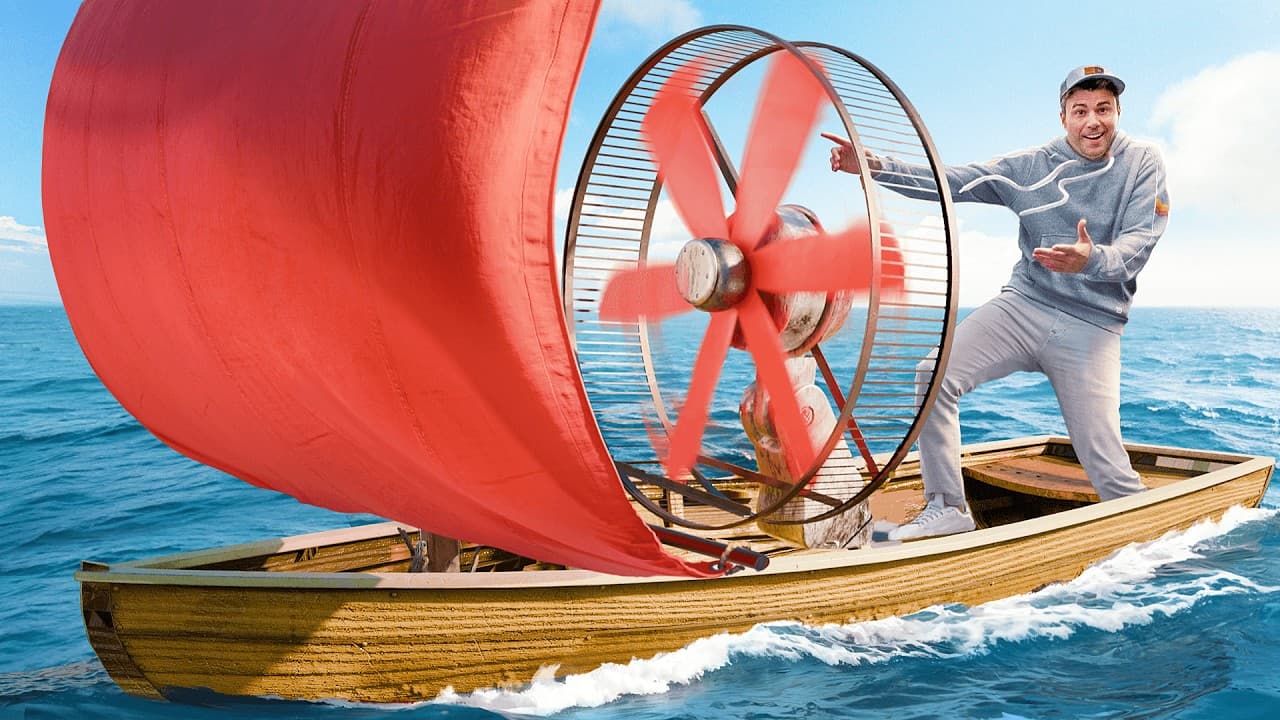
Can You Propel a Boat by Blowing Your Own Sail?

TL;DR
Blowing on a sail does not propel a boat forward due to equal and opposite forces canceling each other. The video explores various physics phenomena, including the Coriolis effect and the behavior of objects in motion, using simple demonstrations. It debunks myths and explains scientific principles with engaging experiments.
Transcript
I'm about to plug in this fan to test whether blowing on this sail will move the boat forward. And then I'm traveling 4000 miles to the equator where I'm actually standing in both the northern and southern hemispheres, because this line here is the equator, and I'm here to investigate whether or not this demo for tourists is a scam. Basically, they... Read More
Key Insights
- Blowing on a sail can't propel a boat due to equal and opposite forces.
- The Coriolis effect influences large-scale weather patterns, not small drains.
- The moon appears differently in each hemisphere due to Earth's curvature.
- An ellipse reflects light from one focal point to another consistently.
- Newton's laws explain why objects move differently in accelerating vehicles.
- A floating backpack might reduce impact but adds extra weight.
- The equator tourist demonstration is a trick, not a scientific phenomenon.
- CrunchLabs offers engaging STEM learning through monthly toy kits.
Install to Summarize YouTube Videos and Get Transcripts
Explore YouTube Video Summarizer or Get YouTube Transcript Extractor
Questions & Answers
Q: How can blowing on a sail fail to move a boat?
Blowing on a sail fails to move a boat because the forces involved cancel each other out. When you blow air into the sail, it creates an equal and opposite force that negates any forward motion. This is similar to how a fan on a stationary cart won't move it if the air is directed into a sail attached to the same cart.
Q: What is the Coriolis effect and its impact?
The Coriolis effect is the deflection of moving objects when viewed in a rotating reference frame, such as Earth. It significantly influences large-scale weather patterns, causing cyclones to spin clockwise in the southern hemisphere and counterclockwise in the northern hemisphere. However, its impact on small-scale phenomena like sinks and toilets is negligible without perfect conditions.
Q: Why does the moon appear different in each hemisphere?
The moon appears different in each hemisphere due to Earth's spherical shape. Observers in the northern hemisphere see the moon in one orientation, while those in the southern hemisphere see it upside down. This is because the perspective changes as you move from one hemisphere to the other, altering the apparent orientation of the moon.
Q: What is special about an ellipse's focal points?
An ellipse's focal points have a unique property where any line or ray emanating from one focal point will reflect off the ellipse's boundary and pass through the other focal point. This reflective property is consistent regardless of the direction of the line, making ellipses useful in applications like whispering galleries and optical devices.
Q: How do Newton's laws explain object motion in vehicles?
Newton's laws explain object motion in vehicles by describing inertia and the effect of forces. When a vehicle accelerates or decelerates, objects inside tend to maintain their state of motion due to inertia (Newton's first law). The mass of objects determines the force needed to change their motion (Newton's second law), explaining why heavier objects require more force to move.
Q: Is a floating backpack effective for hiking?
A floating backpack can reduce impact forces by allowing the pack to move independently of the hiker's motion, theoretically making it easier to carry. However, the added weight of the suspension system and the potential for imbalance on uneven terrain can make it less practical for hiking. Its effectiveness varies depending on the hiking conditions and terrain.
Q: Is the equator water swirling demo a scam?
The equator water swirling demo is a scam because the Coriolis effect is too weak to influence small-scale water drainage. The demonstrator uses a subtle twisting motion when pouring water to create the illusion of different swirling directions. Additionally, the demo location is often not precisely on the equator, further debunking its scientific validity.
Q: What does CrunchLabs offer for STEM learning?
CrunchLabs offers a subscription service that delivers monthly STEM kits designed to teach physics and engineering principles through hands-on activities. Each kit includes a toy and a video explaining the science behind it, encouraging learning through play. The program aims to inspire a passion for STEM by making complex concepts accessible and enjoyable for children and families.
Summary & Key Takeaways
-
Blowing on a sail doesn't move a boat forward because the forces cancel each other out. The video explores this and other physics phenomena like the Coriolis effect, which affects large-scale weather but not small drains. It uses simple demonstrations to debunk myths and explain scientific principles.
-
The moon appears upside down in the southern hemisphere compared to the northern hemisphere due to Earth's curvature. An ellipse reflects light consistently between its focal points, and Newton's laws explain object motion in accelerating vehicles. These concepts are explored through engaging experiments.
-
A floating backpack may reduce impact but adds weight, making it impractical on rough terrain. The equator tourist demo is a trick involving water swirling directions. CrunchLabs offers monthly STEM kits to learn physics and engineering through hands-on activities.
Read in Other Languages (beta)
Share This Summary 📚
Summarize YouTube Videos and Get Video Transcripts with 1-Click
Try YouTube Summary with ChatGPT & Claude or YouTube Transcript Generator
Explore More Summaries from Mark Rober 📚

Summarize YouTube Videos and Get Video Transcripts with 1-Click
Try YouTube Summary with ChatGPT & Claude or YouTube Transcript Generator