How to Make Record-Breaking Elephant Toothpaste Foam

100.9M views
•
August 29, 2019
by
Mark Rober
YouTube video player
How to Make Record-Breaking Elephant Toothpaste Foam

TL;DR

Elephant toothpaste works because hydrogen peroxide's weak hydrogen-oxygen bonds release oxygen, and a catalyst like potassium iodide makes that slow decomposition happen almost instantly. Adding soap traps the escaping oxygen into foam, and food coloring plus a tapered flask focuses the eruption. Scaling it to a swimming pool took over 150 tests, baking yeast as a safe catalyst, and 181 one-pound bags.

Transcript

  • This is the brand new Guinness World Record, largest ever elephant toothpaste foam experiment. In today's video, which is partially sponsored by LastPass, I'm gonna walk you through everything we have to go through to get to this point, as well as some really cool side discoveries we made in our hundreds of hours of testing along the way. The mai... Read More

Key Insights

  • Hydrogen peroxide decomposes on its own because the bonds holding its hydrogen and oxygen together are weak. Left in an open container it keeps releasing oxygen until only water is left behind, which is why a catalyst is needed to make the reaction visible.
  • A catalyst such as potassium iodide converts hydrogen peroxide's slow, invisible decomposition into an almost instantaneous release of oxygen. The catalyst is what separates a container of liquid that does nothing interesting from a reaction that hisses and erupts within seconds.
  • Soap is not part of the chemical reaction but is what makes elephant toothpaste visible. When oxygen is released from the peroxide, the soap captures it and turns the escaping gas into bubbles and foam rather than letting it disperse invisibly into the air.
  • A flask that tapers toward the opening focuses the expansion of the foam into a narrow column. Combined with food coloring, this container geometry is what produces the classic striped, fountain-like eruption rather than a shapeless spreading pile of bubbles.
  • The elephant toothpaste reaction is highly exothermic, generating heat as a byproduct. Infrared footage showed the foam immediately after the reaction reaching almost 200 degrees Fahrenheit, hot enough that the planned prank of spraying kids with a foam gun was cancelled for safety.
  • Ordinary baking yeast was chosen as the catalyst for the record attempt specifically so the resulting foam would be safe for children to play in afterward. The tradeoff was logistical: buying it in one pound bags was cheaper than buckets, requiring 181 bags to be cut open.
  • Chemistry scaled up unpredictably compared to physics and engineering, which is why over 150 tests were run before the attempt. Physics problems allow the parameters to be understood upfront, while the chemistry felt like trial and error with no guarantee it would scale.
  • The record attempt overshot its target and overflowed the swimming pool, which is exactly why an emergency tarp system had been built in advance. Three tarp frames also held the yeast catalyst solution and were cut open to release it into the pool at once.

Install to Summarize YouTube Videos and Get Transcripts

Explore YouTube Video Summarizer or Get YouTube Transcript Extractor

Questions & Answers

Q: What is elephant toothpaste and how does it work?

Elephant toothpaste is a foam produced by rapidly decomposing hydrogen peroxide, the same liquid used to disinfect a scrape. The bonds holding hydrogen and oxygen together in peroxide are weak, so it naturally releases oxygen over time and eventually leaves only water. Adding a catalyst such as potassium iodide makes that slow release happen almost instantly. Soap is then added so the escaping oxygen gets captured as bubbles instead of dispersing invisibly, and the result is a large volume of foam erupting out of the container.

Q: Why do you need to add soap to elephant toothpaste?

Soap is not part of the chemical reaction at all. The reaction between hydrogen peroxide and the catalyst releases oxygen gas regardless of whether soap is present, but without soap that gas simply escapes into the air and there is nothing dramatic to see. Soap captures the released oxygen and traps it as bubbles, which is what creates the thick foam people recognize as elephant toothpaste. In the record attempt, soap was added separately from the peroxide and the yeast catalyst, poured in from buckets before the food coloring.

Q: How do you make elephant toothpaste look like the classic striped eruption?

Two additions turn a plain foam reaction into the recognizable version. First, food coloring is added so the foam has visible color as it expands. Second, the container matters: using a flask that tapers toward the opening focuses the expansion of the foam so it shoots upward in a concentrated column rather than spreading out shapelessly. Doing everything else the same and changing only these two variables is what makes the reaction look, in Mark Rober's words, maximum awesome.

Q: Is elephant toothpaste foam hot or dangerous to touch?

The reaction is highly exothermic, meaning it generates heat as a byproduct. Infrared footage of the testing showed that the temperature of the foam right after the reaction can reach almost 200 degrees Fahrenheit. This was a real safety concern during production: the original plan was to spray a group of kids with an elephant toothpaste gun as revenge for a cockroach prank, but that plan was shelved after the heat was discovered, and the kids were told to watch from a safe distance instead. The foam had to cool before anyone could play in it.

Q: Why was baking yeast used as the catalyst instead of potassium iodide?

The goal for the world record attempt was foam that would be safe for kids to play in afterward, so ordinary baking yeast was used as the catalyst rather than potassium iodide. Yeast works as a catalyst for the same peroxide decomposition but keeps the resulting foam safe for contact. The practical downside was quantity and packaging: buying yeast in big buckets was an option, but it turned out cheaper to buy one pound bags, which meant someone had to cut open 181 individual bags before the attempt.

Q: How much testing went into the elephant toothpaste world record?

The team spent literally hundreds of hours over a few weeks running experiments with friends to calculate the best raw ingredient combinations, and also to brainstorm other things they could do with the foam. In total they ran over 150 tests before the attempt, sometimes at great peril to things they cared about. Rober framed this as necessary because he is not a chemist: unlike physics or engineering problems where he can understand the parameters upfront, chemistry felt like trial and error with no guarantee the results would scale up predictably.

Q: What happened when they tried to break the elephant toothpaste world record?

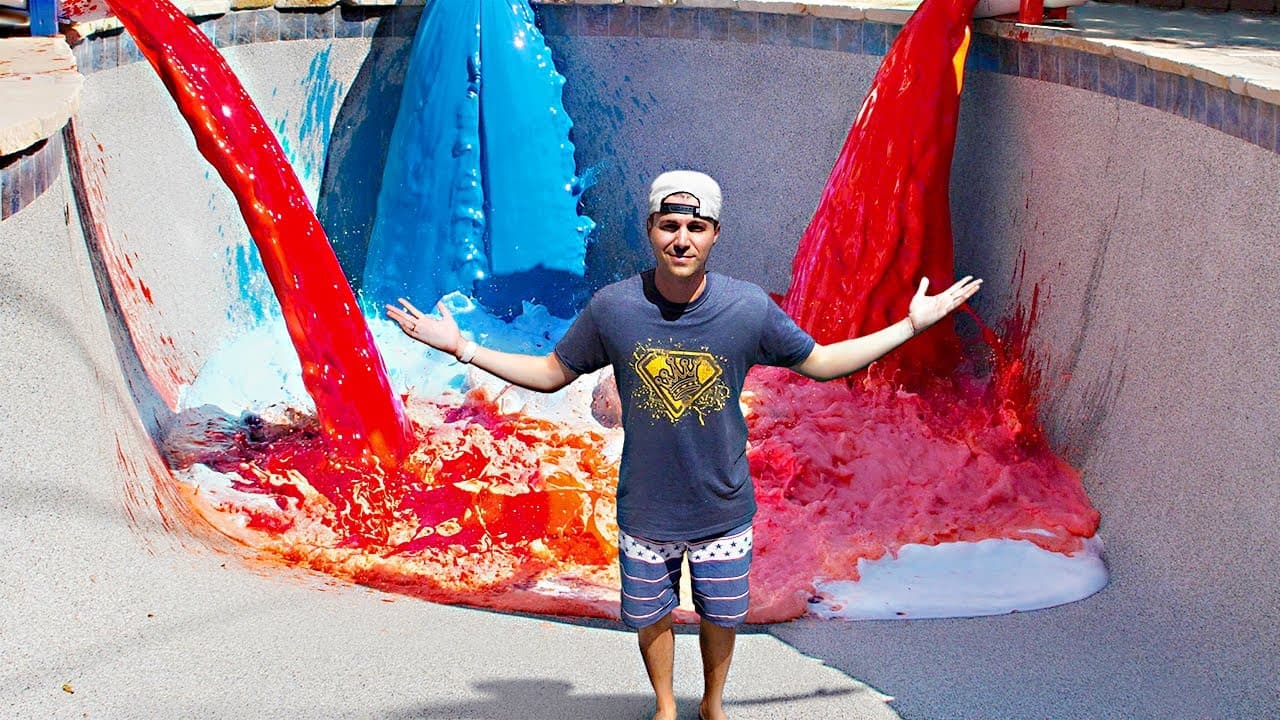
The attempt took place in an empty swimming pool with the goal of quadrupling the existing record, which was held by Science Bob Pflugfelder. The team built three tarp frames to hold the yeast catalyst solution, which were cut open to release it. The record was broken, but the volume overshot expectations and the foam overflowed the pool in what Rober called the great tsunami, forcing everyone to grab cameras and pull back. An emergency tarp system built in advance contained the overflow so it did not spread through the yard and neighborhood.

Q: Who held the previous elephant toothpaste world record?

Science Bob Pflugfelder held the existing Guinness World Record before this attempt, and had held it for over a year. Rober specifically invited him out to participate in the attempt that would take the record away from him, and Bob ended up cutting open the yeast bags during preparation. After the new record was set, Rober told him he was still a world record holder because Bob was being added to the new record alongside him. Bob's reaction was that he had been mad, but that it was a lot of fun.

Summary & Key Takeaways

  • Hydrogen peroxide is the main ingredient in elephant toothpaste, the same liquid poured on a scrape to disinfect it. The bonds holding its hydrogen and oxygen together are weak, so left alone it slowly releases oxygen until only water remains. A catalyst such as potassium iodide compresses that slow process into an almost instant reaction.

  • Soap is what turns the reaction into the recognizable foam. Soap is not part of the chemical reaction itself, but it captures the released oxygen and creates bubbles. Adding food coloring and using a flask that tapers toward the top focuses the expanding foam upward, making the eruption look as dramatic as possible.

  • Breaking the Guinness World Record required hundreds of hours and over 150 tests with friends to calculate the best raw ingredient combinations. Baking yeast replaced potassium iodide as the catalyst so the foam would be safe for kids to play in, which meant cutting open 181 one-pound bags of yeast by hand.


Read in Other Languages (beta)

Share This Summary 📚

Explore More Summaries from Mark Rober 📚