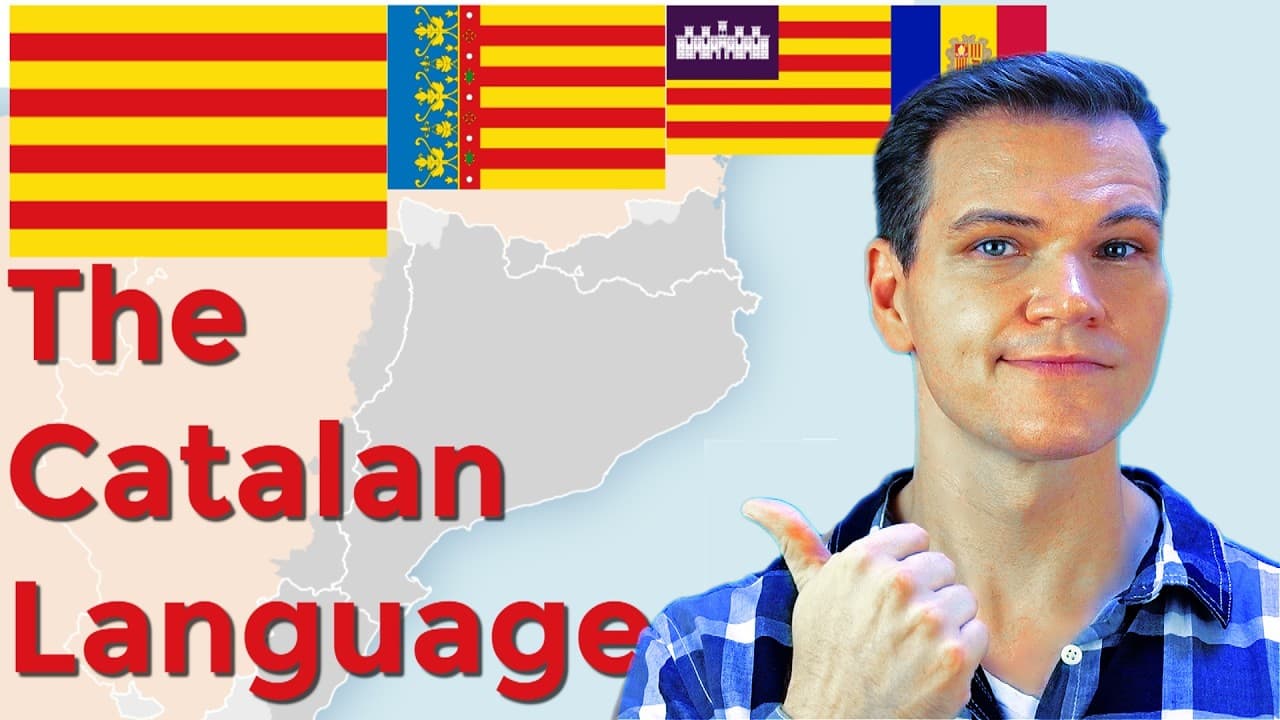
EL CATALÀ! The Catalan Language is Fascinating
TL;DR
Catalan is a widely spoken Romance language with unique features.
Transcript
(Background music) Hello everyone, welcome to the Langfocus Channel and my name is Paul. Today we're going to focus on a language called Catalan. Catalan is a member of the Occitano-Romance branch of the Romance language family. It's mainly spoken in and around Catalonia, an autonomous community in Spain, as well as in another autonomous community,... Read More
Key Insights
- Catalan is part of the Occitano-Romance branch of the Romance language family, mainly spoken in Catalonia, Valencia, and the Balearic Islands.
- Valencian is considered by some as a separate language, but most linguists view it as a Catalan dialect.
- Catalan is the sixth most spoken Romance language and the most spoken non-state language in Europe.
- Historically, Catalan was widely used across the Mediterranean but declined after the union with the Crown of Castile.
- Catalan grammar includes unique features like the personal article and the periphrastic past tense.
- The language shares similarities with other Romance languages, yet maintains distinct phonological and grammatical characteristics.
- Catalan's influence and usage have been revitalized since the late 20th century, especially in education.
- Catalan verbs are conjugated in ways similar to other Romance languages, with some unique forms and irregularities.
Install to Summarize YouTube Videos and Get Transcripts
Explore YouTube Video Summarizer or Get YouTube Transcript Extractor
Questions & Answers
Q: Why is Valencian considered a dialect of Catalan by most linguists?
Most linguists consider Valencian a dialect of Catalan due to the high degree of mutual intelligibility and shared linguistic features. Although some Valencians argue for its status as a separate language, the linguistic similarities in grammar, vocabulary, and phonology support its classification as a Catalan dialect.
Q: How has Catalan's status changed since the late 20th century?
Since the late 20th century, Catalan has gained co-official status in Catalonia, Valencia, and the Balearic Islands, leading to its revitalization. Educational policies now mandate instruction in Catalan, significantly increasing its use in schools and public life, reversing the previous decline in its influence.
Q: What is the periphrastic past tense in Catalan?
The periphrastic past tense in Catalan is a unique construction using an auxiliary verb related to 'anar' (to go) followed by the infinitive of the main verb. It expresses past actions and is similar in form to the periphrastic future, but distinct in its use and meaning, showing Catalan's unique grammatical features.
Q: How does Catalan compare to other Romance languages?
Catalan shares many similarities with other Romance languages, like grammatical structures and vocabulary, yet it has distinct phonological and grammatical features. It includes unique elements such as the personal article and specific verb conjugations, making it recognizable but distinct from languages like Spanish, French, and Italian.
Q: What role did the Crown of Aragon play in the spread of Catalan?
The Crown of Aragon expanded significantly during the 12th to 15th centuries, spreading Catalan across the Mediterranean. Catalan became a dominant language in trade and culture, especially in cities like Barcelona and Valencia, until the union with Castile, which led to the rise of Spanish influence.
Q: Why is Catalan considered the most spoken non-state language in Europe?
Catalan is considered the most spoken non-state language in Europe because it is not recognized as an official language at the national level in Spain, despite having over 10 million speakers. Its official status is limited to regional levels in Spain and as the national language of Andorra.
Q: What are the key phonological features of Catalan?
Catalan phonology includes features like the use of definite articles before names, silent or unreleased final consonants, and the simplification of final consonant clusters. These phonetic characteristics differentiate Catalan from other Romance languages and contribute to its distinct sound.
Q: How is Catalan taught in schools in Catalonia?
In Catalonia, Catalan is the primary language of instruction in schools, with most subjects taught in Catalan. This policy aims to promote the language and ensure proficiency among students, contributing to its revitalization and continued use in public life and administration.
Summary & Key Takeaways
-
Catalan is a Romance language spoken in Catalonia, Valencia, and the Balearic Islands, with debates about its classification in Valencia.
-
Historically significant, Catalan's influence waned after the Crown of Aragon's union with Castile, but it has seen revitalization since 1975.
-
Catalan grammar features unique elements like personal articles and the periphrastic past, while sharing similarities with other Romance languages.
Read in Other Languages (beta)
Share This Summary 📚
Summarize YouTube Videos and Get Video Transcripts with 1-Click
Try YouTube Summary with ChatGPT & Claude or YouTube Transcript Generator
Explore More Summaries from Langfocus 📚


Summarize YouTube Videos and Get Video Transcripts with 1-Click
Try YouTube Summary with ChatGPT & Claude or YouTube Transcript Generator