How to enable agentic storage with MCP for persistent AI
TL;DR
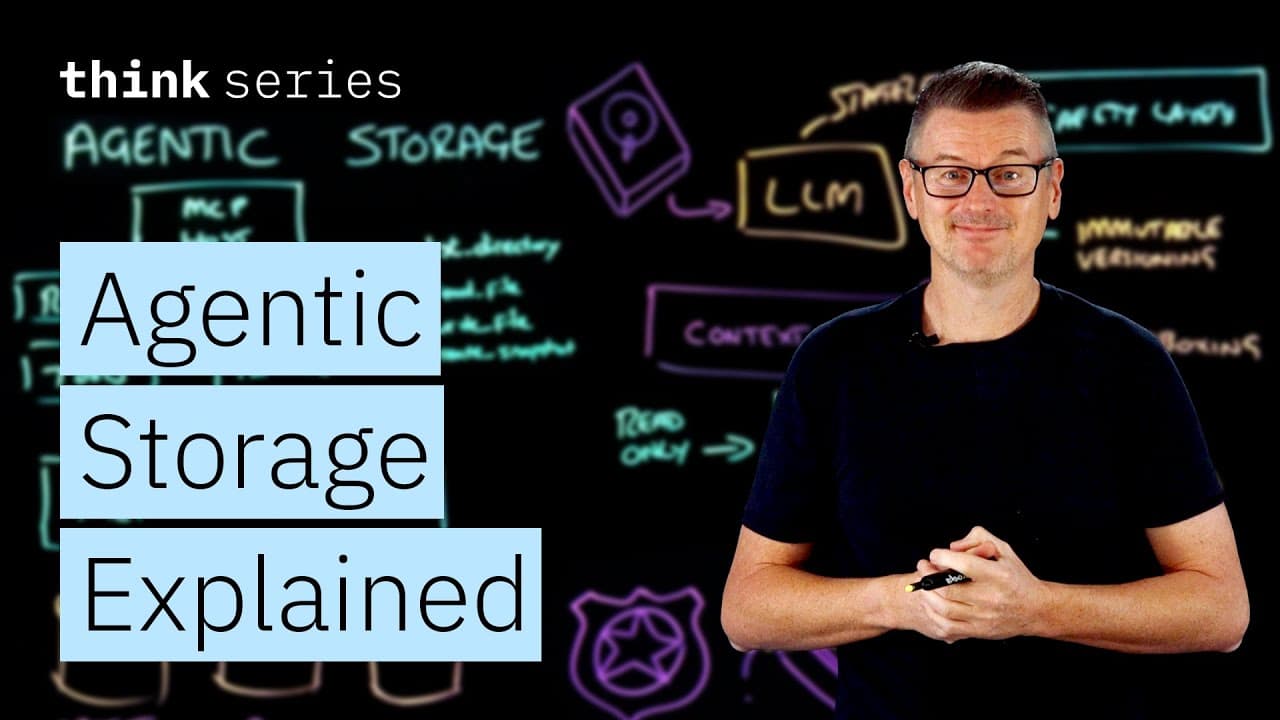
Agentic storage gives AI agents a persistent memory by pairing a storage layer with a standard interface called MCP. It uses resources for data and tools for actions, with safety layers like immutable versioning, sandboxing, and intent validation to prevent risky operations. This approach overcomes RAM-like volatility and expands AI autonomy safely.
Transcript
What is agentic storage? And why do we need it? Well, agentic AI systems, they're powered by LLMs, large language models, but they're not chatbots. They're systems that actually go out and do work autonomously, like write code and remediate incidents. And LLMs are essentially stateless entities. When you spin up an AI agent, its entire memory exist... Read More
Key Insights
- Agentic storage is described as more than a hard drive, designed for autonomous agents and their memory beyond the RAM-like context window.
- MCP acts as a standard interface between the agent and the storage layer, using a host and a server to present a uniform API.
- Resources are passive data objects and tools are executable functions, enabling the agent to read, write, or list data without exposing underlying storage details.
- Immutable versioning ensures every write creates a new version, enabling archiving and full audit trails instead of actual deletion.
- Sandboxing constrains the agent to specific directories and operations, mitigating the confused deputy problem and limiting impact of actions.
- Intent validation requires the agent to justify high impact operations before execution, adding a reasoning check from the storage layer.
- RAG helps feed information into the model from a vector database, but remains read-only for output, highlighting the need for persistent storage for outputs.
- The MCP server translates calls for different storage systems, allowing a single interface regardless of whether the backend is object, block, or NAS storage.
Install to Summarize YouTube Videos and Get Transcripts
Explore YouTube Video Summarizer or Get YouTube Transcript Extractor
Questions & Answers
Q: How does MCP unify interaction between AI agents and different storage backends
MCP provides a uniform interface that sits between the AI agent and the storage layer. The MCP server translates the agent's requests into backend-specific operations for object, block, or NAS storage, while exposing standardized capabilities through resources and tools. This uniformity reduces the need for custom integrations for each storage type and enables consistent behavior across systems.
Q: What are the two main roles in the MCP setup
The MCP setup includes an MCP host, where the agent runs, and an MCP server, which represents the storage layer. The host sends requests via the MCP protocol, typically JSON RPC, and the server implements the requested capabilities, such as listing a directory or reading a file, providing a clean separation between agent logic and storage mechanics.
Q: What are the primary capabilities exposed by MCP
MCP exposes two core capabilities: resources and tools. Resources are passive data objects like file contents and database records that the agent can request to gain context. Tools are executable functions that perform actions such as list directory, read file, write file, or create a snapshot, enabling the agent to interact with storage without direct access to the underlying systems.
Q: Why is immutable versioning important in agentic storage
Immutable versioning ensures every write operation creates a new version rather than overwriting existing data. This preserves a complete audit trail and enables rollback of any action. By preventing true deletion, it provides a safety net for investigations and rollbacks, safeguarding against accidental or malicious modifications and preserving historical context for the agent’s work.
Q: How does sandboxing improve safety for autonomous agents
Sandboxing confines the agent to a restricted environment with access only to approved directories and operations. This reduces risk by preventing access to system binaries or other sensitive areas. It mitigates the confused deputy problem, where an agent with broad permissions could be tricked into performing unintended actions outside its scope.
Q: What is the role of intent validation in agentic storage
Intent validation requires the agent to justify high impact operations before they are executed. By generating a reasoned explanation, such as a retention policy for deleting old files, the storage layer can verify the claim and ensure alignment with safety policies. This adds a cognitive check that reduces impulsive or harmful actions.
Q: How does RAG complement agentic storage
RAG links the AI model to a vector database to retrieve contextual information and feed it into the model’s context window. While RAG helps with input data and context, it remains read-only for output, so it does not solve the need for persistent work products. Agentic storage complements RAG by persisting outputs across sessions.
Q: Why is a standardized protocol like MCP necessary for AI agents
A standardized protocol like MCP is necessary to allow AI agents to interact with diverse storage systems through a single, uniform interface. It abstracts away hardware and API differences, enabling scalable, secure, and auditable storage interactions. By exposing resources and tools via JSON RPC, MCP simplifies integration and safety controls across storage backends.
Summary & Key Takeaways
-
Agentic storage provides persistent memory for AI by coupling a storage layer with MCP, enabling agents to store and access work products across sessions.
-
Safety is built into the storage layer through immutable versioning, sandboxing, and intent validation to reduce risk and improve auditability.
-
The MCP protocol exposes resources and tools via JSON RPC, allowing uniform interaction with various storage backends like object, block, or NAS storage.
Read in Other Languages (beta)
Share This Summary 📚
Summarize YouTube Videos and Get Video Transcripts with 1-Click
Try YouTube Summary with ChatGPT & Claude or YouTube Transcript Generator
Explore More Summaries from IBM Technology 📚
Summarize YouTube Videos and Get Video Transcripts with 1-Click
Try YouTube Summary with ChatGPT & Claude or YouTube Transcript Generator