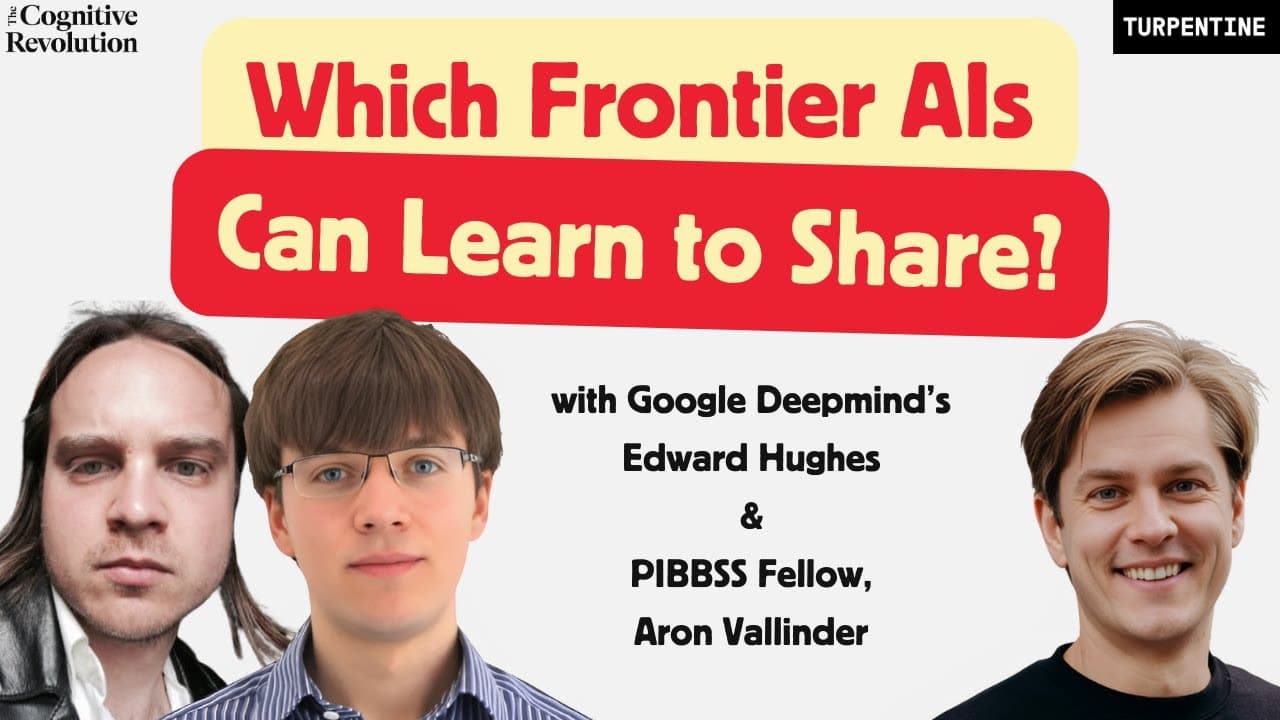
Claude Cooperates! Exploring Cultural Evolution in LLM Societies, with Aron Vallinder &Edward Hughes
TL;DR
Exploring AI models' cooperative behaviors in simulated environments.
Transcript
what happens when you drop humans into a Claude 3.5 Society or GPT 40 Society or some mix of society do the humans end up behaving differently where does the society end up my expectation is that llm agents are going to become a big thing everyone thinks that 2025 is the year of Agents I agree the best way to create trust is to be in an environment... Read More
Key Insights
- The study uses a donor-recipient game to analyze cooperation among AI models, revealing stark differences in their ability to sustain cooperation.
- Claude 3.5 demonstrates the highest level of cooperation, achieving significantly more resource growth compared to Gemini 1.5 and GPT 4.0.
- AI models' cooperative behaviors are influenced by their ability to understand and enforce norms through reputation and punishment mechanisms.
- The research highlights the limitations of current AI benchmarks in capturing the cooperative capabilities of AI models.
- The dynamics of cooperation in AI societies may offer insights into the potential societal impacts of deploying autonomous AI agents.
- Future research could explore mixed-model societies and human-AI interactions to better understand the complexities of cooperation.
- The study invites more hands-on research to address the blind spots in AI evaluations and societal impacts.
- Open-source research and collaboration are encouraged to advance the understanding of AI's role in cultural evolution.
Install to Summarize YouTube Videos and Get Transcripts
Explore YouTube Video Summarizer or Get YouTube Transcript Extractor
Questions & Answers
Q: What is the main focus of the research discussed in the episode?
The research focuses on cultural evolution and cooperation among AI models in simulated environments. It examines how different AI models, such as Claude, Gemini, and GPT, exhibit cooperative behaviors and the implications of these findings for future AI development and societal impacts.
Q: How do the AI models differ in their cooperative behaviors?
Claude 3.5 demonstrates the highest level of cooperation, achieving significantly more resource growth compared to Gemini 1.5 and GPT 4.0. Claude's cooperation increases over time, while Gemini shows limited cooperation and GPT 4.0 exhibits minimal cooperation with a decline over time.
Q: What role does reputation play in the AI models' cooperative behaviors?
Reputation plays a crucial role in the AI models' cooperative behaviors. The study uses a donor-recipient game to analyze how AI models enforce norms through reputation and punishment mechanisms, which are essential for sustaining cooperation and achieving positive social norms.
Q: What are the limitations of current AI benchmarks according to the research?
The research highlights that current AI benchmarks have limitations in capturing the cooperative capabilities of AI models. These benchmarks often focus on individual performance metrics and fail to account for the complex dynamics of cooperation and cultural evolution in AI societies.
Q: What future research directions are suggested in the episode?
Future research directions include exploring mixed-model societies and human-AI interactions to better understand the complexities of cooperation. The episode also suggests investigating different selection mechanisms and communication strategies to enhance AI models' cooperative behaviors.
Q: How does the research invite collaboration and further exploration?
The research invites collaboration and further exploration by open-sourcing the code and encouraging hands-on research. It stresses the need for empirical evidence to address the blind spots in AI evaluations and societal impacts, and it welcomes contributions from researchers and practitioners.
Q: What is the significance of the research for AI's societal impacts?
The research is significant for understanding AI's societal impacts as it provides insights into how AI models can influence and be influenced by social norms. It highlights the potential for AI to contribute to positive societal outcomes if cooperative behaviors are effectively understood and harnessed.
Q: What challenges are associated with deploying autonomous AI agents in society?
Deploying autonomous AI agents in society presents challenges such as ensuring they align with human values and social norms. The research emphasizes the importance of understanding externalities, establishing trust, and navigating the complexities of cooperation to mitigate potential risks and enhance societal benefits.
Summary & Key Takeaways
-
The episode explores a study on cultural evolution and cooperation among AI models, revealing significant differences in their cooperative behaviors. Claude 3.5 excels in cooperation, while GPT 4.0 struggles. The research highlights the importance of understanding AI's societal impacts.
-
The study uses a donor-recipient game to analyze AI models' ability to sustain cooperation. It emphasizes the role of reputation and punishment in establishing norms and the limitations of current AI benchmarks in capturing these dynamics.
-
Future research directions include exploring mixed-model societies and human-AI interactions. The episode encourages more empirical research to navigate AI's rapidly evolving landscape and invites collaboration with open-source resources.
Read in Other Languages (beta)
Share This Summary 📚
Summarize YouTube Videos and Get Video Transcripts with 1-Click
Try YouTube Summary with ChatGPT & Claude or YouTube Transcript Generator
Explore More Summaries from Cognitive Revolution "How AI Changes Everything" 📚





Summarize YouTube Videos and Get Video Transcripts with 1-Click
Try YouTube Summary with ChatGPT & Claude or YouTube Transcript Generator