How to Build AI Agents with Claude in Google Cloud’s Vertex AI | Code w/ Claude
TL;DR
Build AI agents with Claude in Vertex AI by accessing Claude through Model Garden, creating agents with the open-source Agent Development Kit, enhancing them with pre-built tools and MCP, and deploying them on Agent Engine. Google Cloud’s four-part agent stack also includes the agent-to-agent protocol for collaboration across frameworks. Read on to understand how each component addresses development, integration, communication, and production operations.
Transcript
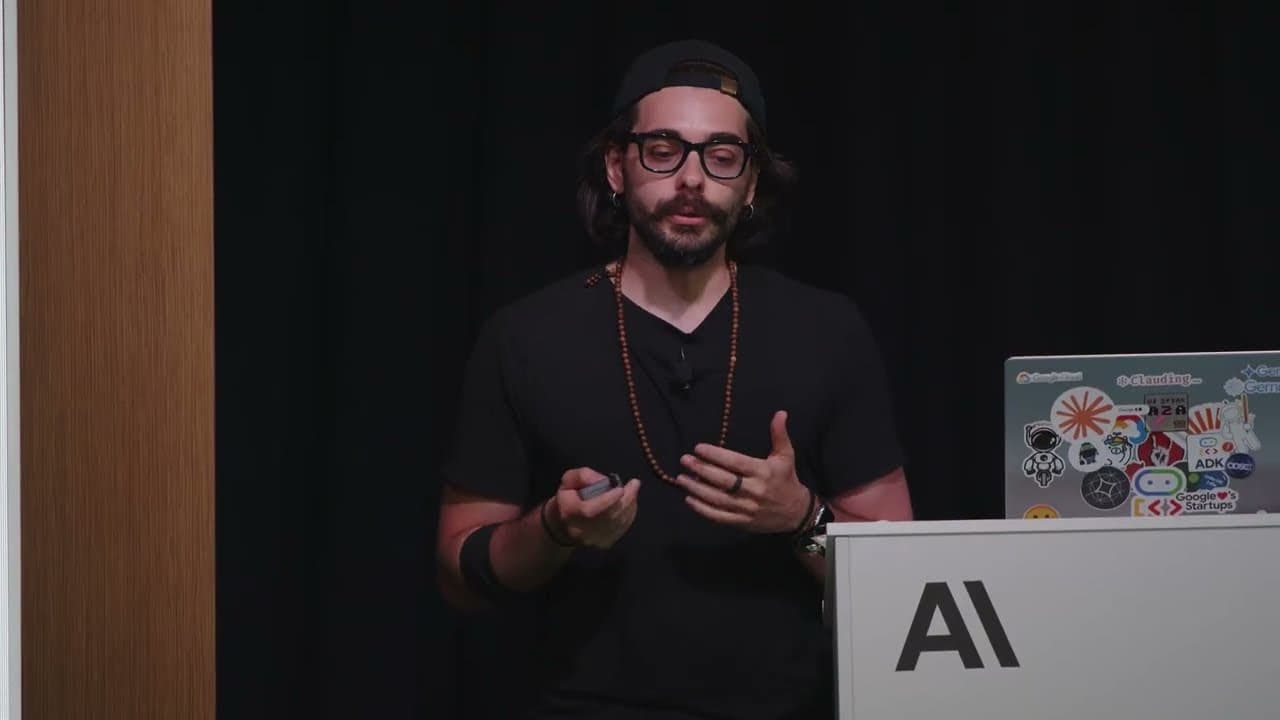
Hello everyone. Uh thank you for joining this uh this session. So in this session we are going to talk about how you can build uh AI agents uh using uh cloud on vertex AI. So before to start let's see the uh let's set the scene. So as you probably know like building AI agent is very powerful. with the II agents you can build such a cool applica... Read More
Key Insights
- Building AI agents is powerful but challenging to productionalize due to fragmented frameworks.
- An agent development kit can standardize agent creation and enhance scalability.
- MCP (Multi-Channel Processing) integration allows agents to communicate with various tools and applications.
- Vert.x AI engine is a managed platform for deploying and scaling AI agents in production.
- Agent-to-agent protocol enables seamless communication between agents built with different frameworks.
- Google Cloud's agent stack includes ADK, MCP, and agent engine for comprehensive agent development.
- Agents can be deployed at scale with observability and monitoring through the agent engine.
- Agent skills and cards describe agent capabilities and facilitate communication in multi-agent systems.
Install to Summarize YouTube Videos and Get Transcripts
Explore YouTube Video Summarizer or Get YouTube Transcript Extractor
Questions & Answers
Q: How do you build AI agents with Claude in Vertex AI?
Access Claude models through Vertex AI Model Garden, then build an agent with the Agent Development Kit. You can enhance the agent with pre-built tools and MCP, deploy it on Agent Engine, and connect multiple agents through the agent-to-agent protocol.
Q: How can you access Claude models in Vertex AI?
Claude models are available through Vertex AI Model Garden, a centralized hub for discovering, deploying, and managing foundational and open models. After providing the required credentials, you can use the model through an API or the console.
Q: What is Google Cloud’s agent stack?
The stack has four main components: Agent Development Kit, MCP compatibility, Vertex AI Agent Engine, and the agent-to-agent protocol. Together, they support building and evaluating agents, connecting tools and context, deploying agents at scale, and enabling collaboration between agents.
Q: What is the Agent Development Kit?
The Agent Development Kit is an open-source, code-first, developer-friendly framework. It is designed to help developers build, evaluate, and deploy agents at scale while standardizing the development process.
Q: What role does MCP play in AI agent development?
MCP standardizes how an agent communicates with tools and applications. Its compatibility with the Agent Development Kit lets applications provide context to systems using LLMs and helps enhance agents with external capabilities.
Q: What is Vertex AI Agent Engine used for?
Vertex AI Agent Engine is a managed platform for deploying, managing, and scaling AI agents in production. It addresses operational challenges associated with production agents, including the need for monitoring and logging capabilities.
Q: Why is the agent-to-agent protocol needed?
The agent-to-agent protocol enables seamless communication and collaboration between agents built with different frameworks. It addresses the difficulty of making independently developed agents work together in a multi-agent system.
Q: Why are AI agents difficult to productionalize?
The transcript identifies three challenges: a fragmented landscape of frameworks and tools, difficulty connecting agents built with different frameworks, and the operational burden of production management. Governance, monitoring, and logging add further complexity after agents have been built.
Summary & Key Takeaways
-
Building AI agents with Claude in Vertex AI involves using an agent development kit to standardize the process. The kit helps integrate various frameworks and tools, ensuring seamless communication between agents. Deploying agents at scale is made easier with a managed platform that handles operational challenges and provides monitoring capabilities.
-
The agent stack on Google Cloud includes components like the agent development kit, MCP, and agent engine, which together facilitate the creation and deployment of AI agents. These tools address the challenges of fragmented frameworks and operational overhead, enabling scalable and efficient agent production.
-
Agent-to-agent protocol is crucial for enabling communication between agents built with different frameworks. This protocol, along with the agent engine, supports enterprise-ready agent collaboration and governance, ensuring that agents can effectively interact and achieve complex tasks in a secure environment.
Read in Other Languages (beta)
Share This Summary 📚
Summarize YouTube Videos and Get Video Transcripts with 1-Click
Try YouTube Summary with ChatGPT & Claude or YouTube Transcript Generator
Explore More Summaries from Anthropic 📚


Summarize YouTube Videos and Get Video Transcripts with 1-Click
Try YouTube Summary with ChatGPT & Claude or YouTube Transcript Generator