How Do You Build Muscle? Training Basics and Theory | Chapter 1: The Fundamentals Series
TL;DR
Building muscle starts with sustainable training supported by safety and enjoyment, followed by effort, progressive overload, prioritization, and acute training variables. Beginners should control each negative for about two seconds, use a full range of motion, select weight with the two-for-two rule, and allow adequate recovery. Read on for practical guidance on form, load progression, rest days, sleep, and workout efficiency.
Transcript
all right what's going on everyone want to welcome you all to the new fundamental series that I'm going to be running on this channel for probably the next couple of months and what I plan to do is basically cover in this series what I believe to be the main primary basics for all of the beginners out there we're wanting to build muscle and gain st... Read More
Key Insights
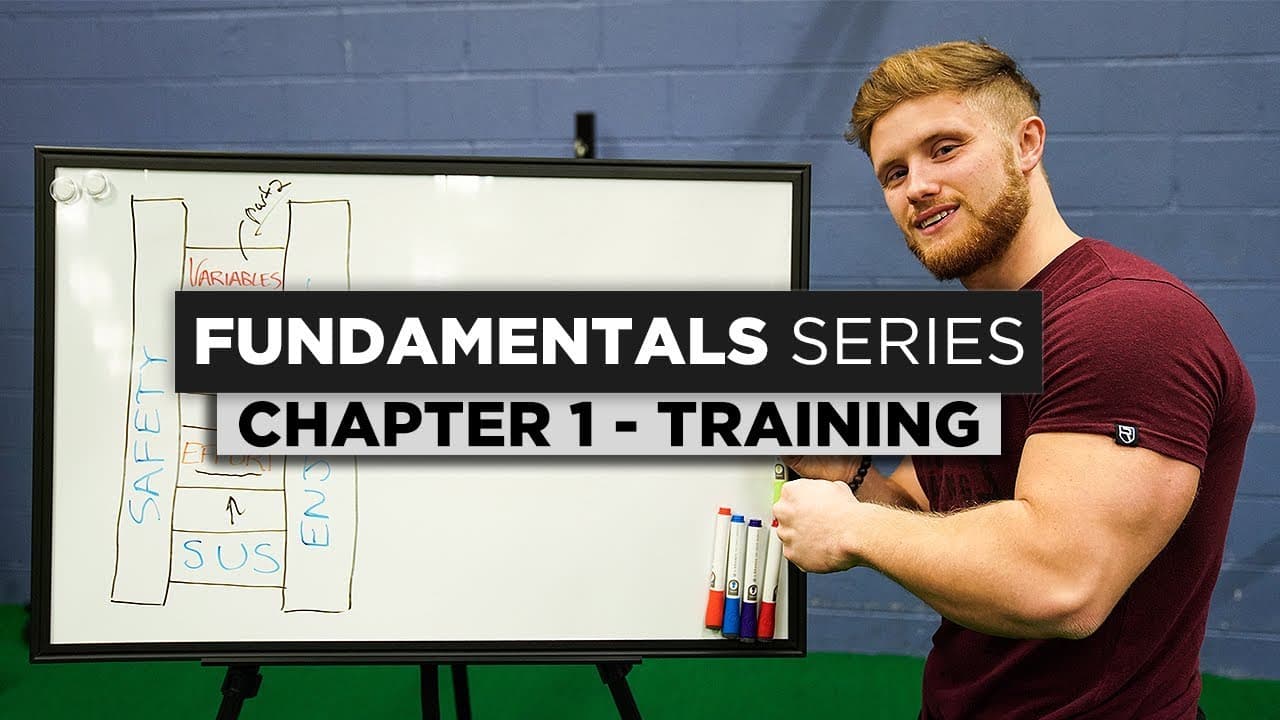
- The training fundamentals are structured as a ladder: sustainability sits at the bottom, supported by the two uprights of safety and enjoyment, then effort on rung two, progressive overload and prioritization on rung three, and the acute training variables at the top.
- Safety in weight training has three components: good form, appropriately selected weights, and adequate recovery. Neglecting safety feels boring to address but leads to regret down the road, which is why it is covered first for beginners.
- Good form means controlling the negative rather than letting the weight fall and relying on a spotter to lift it back up. Eccentric control is typically around a two-second count, or at least lowering the weight under your own control rather than gravity's.
- Full range of motion is the second element of good form. Quarter reps and half reps can have their place, but beginners should focus on taking each movement through the complete range of motion.
- The two-for-two rule tells beginners when to add weight: if for two weeks in a row you can perform two more reps than prescribed on your last set of an exercise, it is time to increase the load on that exercise.
- Adequate recovery for beginners can follow a one-on, one-off pattern, such as an upper-lower split with a rest day between each session. This lets joints, ligaments, soft tissues, and muscles recover, though the ideal frequency is individual.
- Seven to eight hours of sleep per night is significantly better for both performance and body composition than five to six hours, according to the scientific literature cited. Some evidence suggests nine to ten hours further improves athletic performance, particularly in sprinters.
- Enjoyment drives adherence: people who enjoy their training stick to their programs better and push themselves harder. For those who dislike lifting, the goal becomes designing a routine that sucks less by making workouts more efficient.
Install to Summarize YouTube Videos and Get Transcripts
Explore YouTube Video Summarizer or Get YouTube Transcript Extractor
Questions & Answers
Q: What are the training fundamentals for building muscle and gaining strength?
The fundamentals are organized as a ladder with sustainability at the bottom, supported by safety and enjoyment. Effort is the second rung, progressive overload and prioritization form the third, and acute training variables sit at the top. Those variables include training volume, intensity, rest periods, tempo, exercises, and training splits.
Q: What does sustainability mean in a muscle-building program?
Sustainability is the foundation of the training ladder and depends on safety and enjoyment. A program should protect the trainee through good form, appropriate weights, and adequate recovery while remaining enjoyable enough to follow consistently.
Q: What does good form mean in weight training?
Good form means controlling the negative, or eccentric portion, instead of letting gravity drop the weight. The suggested tempo is roughly a two-second lowering phase, or at least a descent kept under your control. Beginners should also take movements through a full range of motion rather than relying on quarter or half reps.
Q: What is the two-for-two rule in weight training?
The two-for-two rule helps beginners decide when to increase the weight. If you can perform two more repetitions than prescribed on the last set of an exercise for two consecutive weeks, increase the load. For example, completing 12 reps instead of 10 with 20 pounds for two weeks signals that it is time to add weight.
Q: How often should beginners train and take rest days?
A beginner can use a one-day-on, one-day-off schedule. With an upper-lower split, that means training the upper body, resting for a day, training the lower body, and resting again. Training frequency is individual, so unusual soreness, aches, or pain should influence the schedule.
Q: How much sleep supports training recovery?
Seven to eight hours of sleep per night is presented as significantly better for performance and body composition than five to six hours. Some cited evidence suggests that nine to ten hours may further improve athletic performance, particularly for sprinters, although its effects on body composition, strength, and hypertrophy remain uncertain.
Q: Why does enjoying your workouts matter for muscle-building results?
People who enjoy their training tend to follow their programs more consistently and push themselves harder. Because building muscle requires a long-term approach, enjoyment helps make the routine sustainable rather than merely optimal on paper.
Q: How can someone make weight training more efficient and enjoyable?
Someone who dislikes lifting can shorten and simplify training by emphasizing compound movements such as squats, bench presses, and deadlifts. Full-body workouts performed two or three times per week are another efficient option. Most people can combine some exercise variety with a consistent group of core movements.
Summary & Key Takeaways
-
This is part one of a fundamentals series covering the primary basics for beginners wanting to build muscle and gain strength, and for experienced lifters who have not pinned down the true fundamentals amid all the information available. The series spans five or six videos: two on training, two or three on nutrition, and one on supplementation.
-
The training fundamentals are laid out as a ladder. Sustainability forms the base, held up by the pillars of safety and enjoyment. Effort is the second rung, progressive overload and prioritization make up the third, and the acute training variables sit at the top, to be covered in part two.
-
Safety breaks into good form, properly selected weights, and adequate recovery. Form means eccentric control around a two-second count plus full range of motion. Weight selection uses the two-for-two rule. Recovery covers rest days, listening to soreness or injurious pain, seven to eight hours of sleep, and nutrition.
-
Enjoyment matters because people who like their training adhere better and train harder. Efficiency helps those who dislike lifting: focus on compound movements like squats, bench press, and deadlifts, or use full-body training two or three times a week. Most people benefit from blending variety with consistent core movements.
Read in Other Languages (beta)
Share This Summary 📚
Summarize YouTube Videos and Get Video Transcripts with 1-Click
Try YouTube Summary with ChatGPT & Claude or YouTube Transcript Generator
Explore More Summaries from Jeff Nippard 📚





Summarize YouTube Videos and Get Video Transcripts with 1-Click
Try YouTube Summary with ChatGPT & Claude or YouTube Transcript Generator