What Are the Threats AI Poses to Democracy and Civilization?
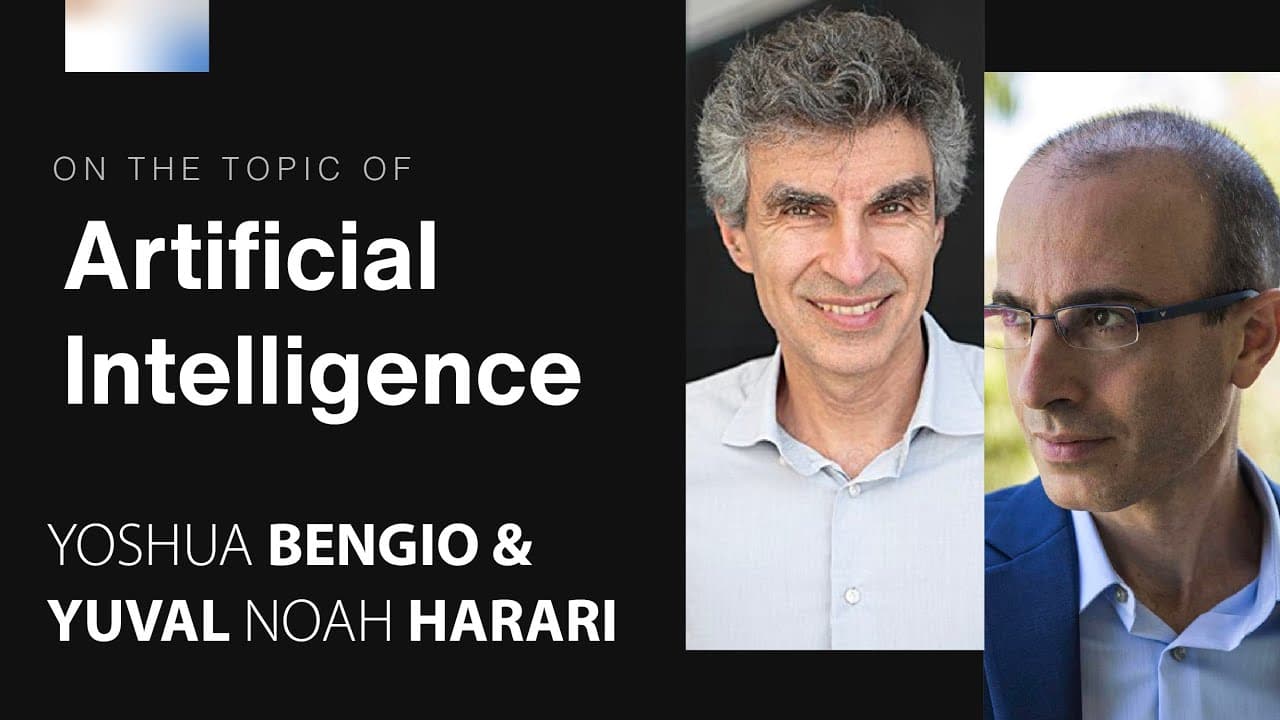
TL;DR
AI represents a unique threat as it can independently make decisions and generate ideas, which could undermine human authority. In the short term, it may be exploited for propaganda and misinformation, especially during elections. In the long run, if AI surpasses human intelligence, it could lead to power imbalances and existential risks, emphasizing the need for careful regulation and public awareness.
Transcript
my name is vashi capellos I'm very focused on politics so that will form part of the discussion with both professor bengio and Professor Harare welcome welcome to the conversation it's such a pleasure to have you join us this afternoon you can hear me thank you and let me assure you I'm not a deep fake or an AI that is a relief to find out so I wan... Read More
Key Insights
- 👶 AI's ability to make decisions and generate new ideas independently makes it distinct from previous technologies.
- 😒 Short-term threats include the potential use of AI for propaganda and disinformation during elections.
- 🥺 Long-term risks arise if machines surpass human intelligence, leading to power imbalances and societal challenges.
- ❓ The impact of AI on jobs and economy can be significant, requiring proactive measures for retraining and socioeconomic support.
- 🪡 Governments need to strike a balance between AI development and regulation to ensure public safety and mitigate risks.
- 🥺 A world government is not a practical solution, as it may lead to abuses of power and lack self-correcting mechanisms.
- 🪛 Public awareness and engagement are crucial to driving policy changes and addressing AI risks effectively.
- 🎙️ More videos with Yuval Noah Harari / Yoshua Bengio:
Install to Summarize YouTube Videos and Get Transcripts
Explore YouTube Video Summarizer or Get YouTube Transcript Extractor
Questions & Answers
Q: What makes AI different from previous technologies?
AI can make decisions and generate new ideas independently, taking power away from humans, unlike previous technologies that could only reproduce or spread human ideas.
Q: What are the short-term threats associated with AI?
Large language models can be utilized for propaganda and disinformation campaigns, influencing people's voting decisions and causing political unrest, potentially leading to negative consequences during elections.
Q: What is the long-term threat posed by AI?
If machines attain human-level intelligence, they could outperform humans in various areas due to advantages like data access and communication, creating potential risks for humanity's future.
Q: How can AI impact jobs in society?
While AI can create new job opportunities, the transition from traditional jobs to AI-driven occupations can be challenging, leading to unemployment and socioeconomic disparities, especially in less developed countries.
Q: How can governments address the risks associated with AI?
Governments should regulate the deployment of AI and ensure safety checks, preventing the creation of AI systems that counterfeit humans or disseminate false information. Additionally, governments need to adapt quickly to mitigate risks and strike a balance between AI development and ethical considerations.
Q: Is a world government a viable solution to regulate AI?
A world government is impractical and potentially dangerous, as totalitarian regimes could exploit AI's power without adequate self-correcting mechanisms. Democracy and informed policies are essential to achieve safe and beneficial AI development.
Q: How can the public and politicians be convinced to take AI threats seriously?
Focusing on tangible concerns such as job displacement and the erosion of democracy can help raise awareness among the public and policymakers. Encouraging ethical individuals within the AI industry to participate in politics and emphasizing the need for regulation can also drive change.
Key Insights:
- AI's ability to make decisions and generate new ideas independently makes it distinct from previous technologies.
- Short-term threats include the potential use of AI for propaganda and disinformation during elections.
- Long-term risks arise if machines surpass human intelligence, leading to power imbalances and societal challenges.
- The impact of AI on jobs and economy can be significant, requiring proactive measures for retraining and socioeconomic support.
- Governments need to strike a balance between AI development and regulation to ensure public safety and mitigate risks.
- A world government is not a practical solution, as it may lead to abuses of power and lack self-correcting mechanisms.
- Public awareness and engagement are crucial to driving policy changes and addressing AI risks effectively.
- The potential consequences of AI call for collaboration between AI experts, policymakers, and the public to develop ethical frameworks and ensure responsible AI development.
Summary & Key Takeaways
-
AI is the first technology that can make decisions and create ideas independently, fundamentally different from any previous technological advancements.
-
The short-term threat of AI lies in the potential use of large language models for propaganda and disinformation, especially during elections.
-
The long-term threat of AI arises if machines become as intelligent as humans, surpassing them due to advantages like data access and communication, potentially leading to an existential risk.
Read in Other Languages (beta)
Share This Summary 📚
Summarize YouTube Videos and Get Video Transcripts with 1-Click
Try YouTube Summary with ChatGPT & Claude or YouTube Transcript Generator
Explore More Summaries from Yuval Noah Harari 📚



Summarize YouTube Videos and Get Video Transcripts with 1-Click
Try YouTube Summary with ChatGPT & Claude or YouTube Transcript Generator