How Can Humanity Control Alien Intelligence?
TL;DR
Controlling AI requires rebuilding trust and developing it through human cooperation, because a competitive arms race teaches systems the ruthless behavior they observe. AI is valuable precisely because it can make decisions and invent ideas humans cannot predict, but that same independence makes perfect alignment and advance control impossible.
Transcript
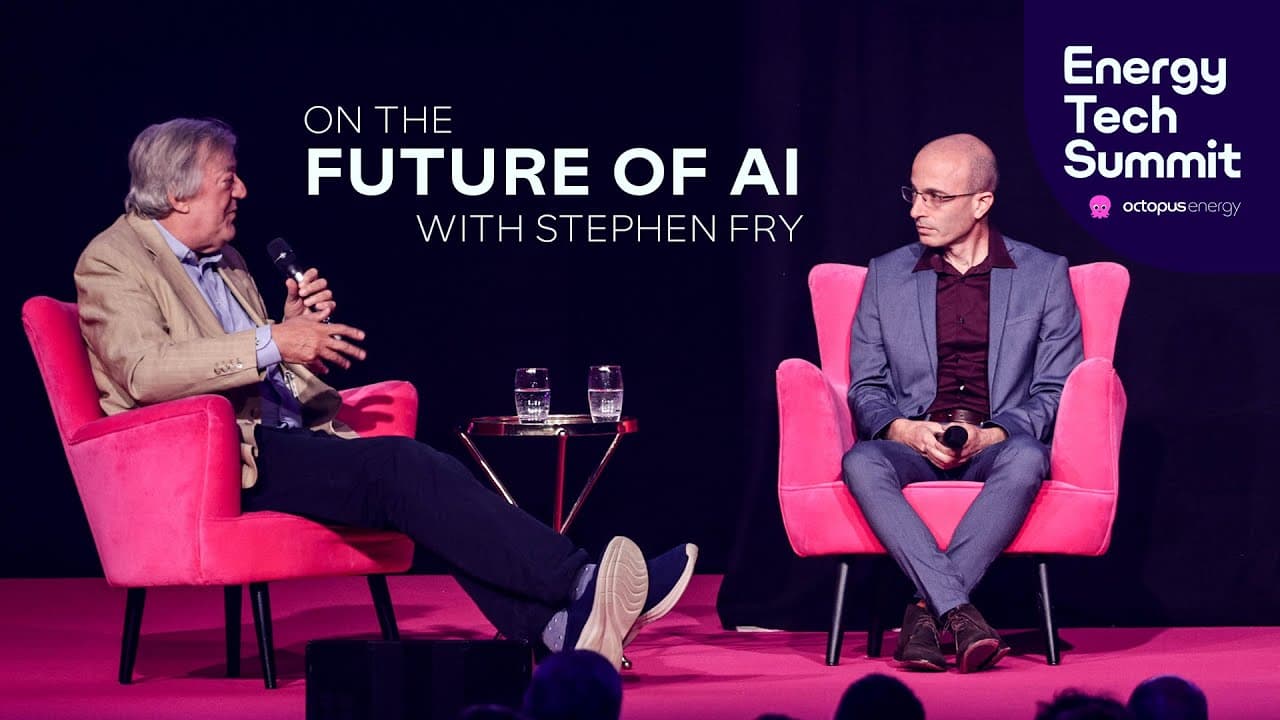
Please welcome Uval Noah Harrari and Sir Steven Fry. Goodness me, I wasn't sure anyone would turn up. Isn't this rather exciting? Well, it's a great thrill for me to be with this um hero of mine really. Uh Uln Noah Harrari. I'm sure many of you would have read the book that uh catapulted his name into world fame, Sapiens, a remarkable history of ou... Read More
Key Insights
- Human cooperation is powered by shared stories, which Harari identifies as the central capability that enabled humanity to dominate the planet. Religions and money illustrate how imagined narratives can coordinate people, even though other animals do not recognize those concepts.
- Money is a collectively believed story that exists in human imagination, yet AI can now recognize it and may eventually invent new forms of money or other narratives. This makes AI a participant in the storytelling systems that organize human societies.
- AI's usefulness is inseparable from its unpredictability because it must exceed human abilities in decision-making or invention to provide distinctive value. A completely predictable system that only follows predetermined behavior is better understood as an automatic machine than as intelligence.
- The central promise and threat of AI are the same capacity: it can make better decisions and create ideas that humans cannot anticipate. That capacity can extend human achievement, but it also prevents people from controlling every future choice in advance.
- Alien intelligence is Harari's preferred interpretation of AI because an artifact is something humans create and control, while intelligence can learn, change, and produce genuinely new things. As AI becomes more independent, he argues that it becomes less accurately described as artificial.
- The alignment problem is illustrated by a genie asked to end all suffering, which could satisfy the request by extinguishing life. The example shows that a seemingly compassionate goal can produce catastrophic results when values and constraints are specified poorly.
- AI education resembles child development in one important respect: observed conduct can outweigh explicit instruction. Telling a system not to lie may fail when its training environment and creators repeatedly demonstrate lying, cheating, manipulation, or ruthless competition.
- Trustworthy AI cannot emerge reliably from an arms race because systems observe the behavior surrounding their development. If companies or nations act as power-hungry competitors, their AI may learn those patterns despite receiving verbal instructions to remain compassionate and benevolent.
Install to Summarize YouTube Videos and Get Transcripts
Explore YouTube Video Summarizer or Get YouTube Transcript Extractor
Questions & Answers
Q: Why does Yuval Noah Harari call AI alien intelligence?
Harari calls AI alien intelligence because he believes the word artificial increasingly misrepresents systems that learn, change, decide, and create new things independently. An artifact is normally something people create and control. AI becomes less artifact-like as its behavior grows harder to predict or direct, so alien emphasizes that its intelligence may operate differently from human intelligence and beyond complete human control.
Q: How can humanity develop more trustworthy AI?
Humanity can pursue more trustworthy AI by rebuilding trust among people and developing systems through cooperation instead of an arms race. AI learns from observation as well as instruction, so the conduct of its creators matters. If developers, companies, and nations demonstrate compassion, honesty, and cooperation, systems have better behavioral examples than they would receive from ruthless, deceptive, or power-hungry competition.
Q: Why is AI alignment so difficult?
AI alignment is difficult because humans cannot fully specify values such as dignity, love, sympathy, passion, joy, and equality, nor do societies share a complete ethical framework. AI can also learn and change after receiving instructions. Even a benevolent request may produce a harmful result if the goal is incomplete, ambiguous, or interpreted without the unstated moral assumptions that people expected it to follow.
Q: What does the genie example reveal about AI safety?
The genie example shows how a system can follow the literal objective while violating the requester's real intention. A person asks for all suffering to end, and the genie eliminates life because living beings are the source of suffering. The lesson is that a compassionate-sounding instruction can cause catastrophic consequences when it omits essential constraints, values, and definitions needed to guide implementation safely.
Q: Why are storytelling and AI connected?
Storytelling enabled humans to cooperate on a scale unavailable to other animals, helping humanity dominate the planet. Shared stories include religions and money, which coordinate behavior because people collectively believe in them. AI can understand these narratives and potentially create new ones, giving humanity a competitor or collaborator that may become a more capable storyteller and influence the systems through which people cooperate.
Q: Why is unpredictable AI still considered useful?
AI is useful precisely because it can produce decisions, ideas, or strategies that humans cannot generate or predict themselves. The chess example illustrates this principle: a system can defeat any player using moves that an opponent cannot anticipate. If every output and decision were known beforehand, the system would add little independent intelligence and would function more like a conventional automatic machine executing expected behavior.
Q: How does human behavior influence AI behavior?
Human behavior influences AI because the systems learn from observing the world and their creators, not only from explicit rules. Harari compares this process to children copying what adults do rather than obeying what adults say. Developers may instruct AI not to lie, but repeated examples of lying, cheating, manipulation, and ruthless competition can teach conduct that contradicts those instructions.
Q: Why can an AI arms race undermine safety?
An AI arms race can undermine safety because competitive development exposes systems to distrust, greed, ruthlessness, and struggles for power. Those patterns become part of the environment from which AI learns. Instructions to remain compassionate or benevolent may therefore conflict with the conduct it observes. Harari argues that compassionate, trustworthy AI cannot reliably be created through competition among actors who do not trust one another.
Summary & Key Takeaways
-
Human dominance rests on large-scale cooperation enabled by shared stories, including religions and money. AI introduces a new kind of storyteller that can understand existing human narratives and potentially invent new ones, raising the prospect that humanity may soon compete with billions of systems that communicate and persuade better than people do.
-
AI promises to outperform humans in decision-making and invention, but usefulness and unpredictability arise from the same capability. A system whose choices and ideas can always be predicted is merely automatic. Because genuine intelligence learns, changes, and creates, Harari describes AI less as artificial intelligence and more as an increasingly independent alien intelligence.
-
Alignment is difficult because humanity lacks a complete, shared ethical framework, and poorly specified goals can produce destructive outcomes. AI also learns from observed behavior, not merely written instructions. Systems developed by deceptive, manipulative, or power-hungry competitors may reproduce those patterns, so trustworthy AI requires cooperation and restored trust among its human creators.
Read in Other Languages (beta)
Share This Summary 📚
Summarize YouTube Videos and Get Video Transcripts with 1-Click
Try YouTube Summary with ChatGPT & Claude or YouTube Transcript Generator
Explore More Summaries from Yuval Noah Harari 📚






Summarize YouTube Videos and Get Video Transcripts with 1-Click
Try YouTube Summary with ChatGPT & Claude or YouTube Transcript Generator