How to Structure Facebook Ad Campaigns in 2026
TL;DR
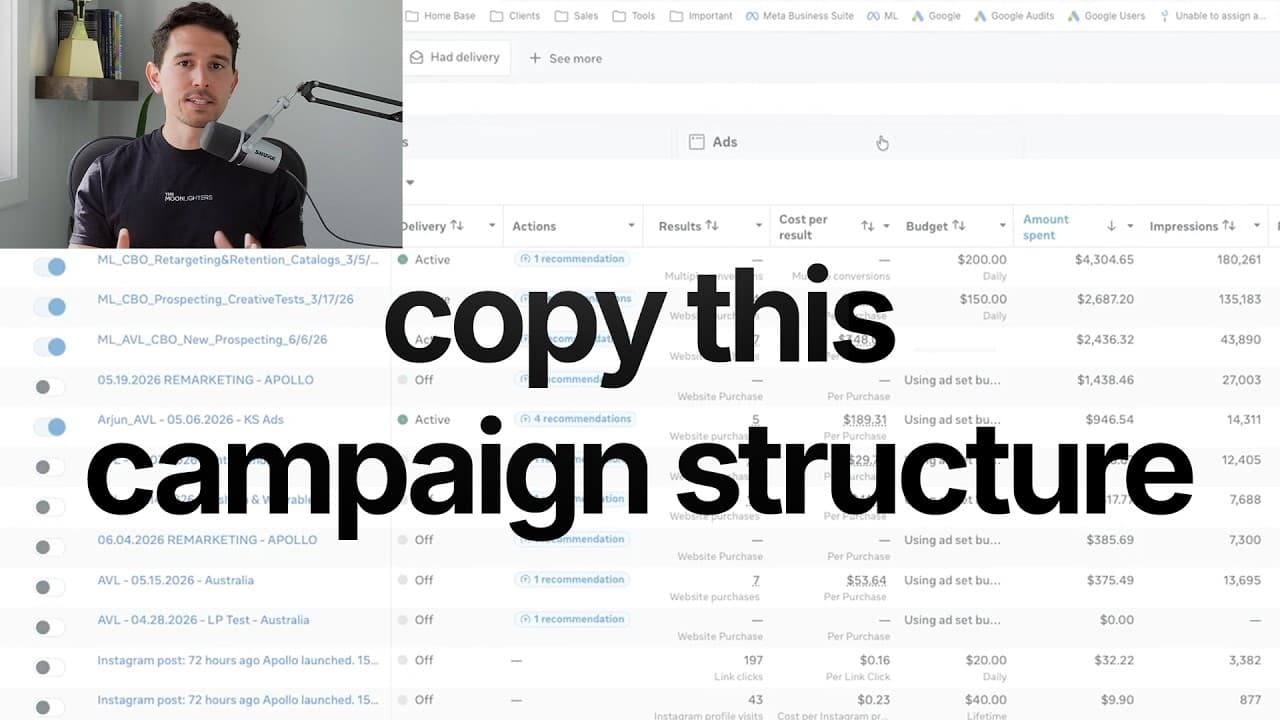
Build a consolidated sales campaign that optimizes for purchases, excludes current customers, begins with broad placements, and organizes each ad set by pack, avatar, and concept. Set the campaign budget near one target CPA at the low end, use conversion value optimization only when product prices vary meaningfully, and review account breakdowns before trimming placements or other settings based on performance data.
Transcript
In just 30 days, I increased this fashion brands return on ad spend by 121% by just making a few simple tweaks, and it all started with the campaign structure. See, over the last 10 years, I've spent over $500 million in meta ad spend to drive well north of a billion dollars in revenue for the brands that we manage. And I've set up campaign structu... Read More
Key Insights
- Campaign consolidation can improve efficiency when ads are positioned correctly. The featured fashion account reduced its active ads from 165 in the previous month to 62 in the latest 30 days, while return on ad spend rose from 0.63 to 1.4, a reported increase of 121%.
- Account breakdown analysis is part of the recommended optimization process. Placement, age, gender, platform, landing page, and day-of-week data were reviewed so spending could be oriented toward the areas producing the strongest performance and carrying meaningful spend.
- A prospecting campaign should use the sales objective and a campaign-level budget. The recommended low-end budget equals one target CPA, while spending above the break-even target can be increased through vertical scaling as aggressively as the advertiser considers appropriate.
- A consistent ad-set naming convention improves campaign organization. The format is pack number, avatar, and concept, where the pack identifies each launch group, the avatar identifies the person addressed by the advertisement, and the concept identifies the creative angle or approach.
- Past purchasers should be excluded until the business considers them churned. A 180-day exclusion is described as typical for many ecommerce businesses, while a company with a one-year repurchase cycle may extend its exclusion period from 180 to 365 days.
- Purchase should be the conversion event for sales campaigns. The recommended setup does not optimize for add to cart, add payment information, or initiate checkout, and it leaves the cost-per-result goal and value rules blank during the demonstrated configuration.
- Conversion-count optimization suits most businesses with one product, a few products, hero products, or relatively similar average order values. Conversion-value optimization may suit businesses with varied products and price points, and sufficiently funded advertisers can test the two approaches in separate campaigns simultaneously.
- Broad placements provide data before account restrictions are applied. The initial setup keeps Advantage Plus, skippable ads, and all placements active, but a placement may be removed when clear account data shows that it performs poorly for the specific business.
Install to Summarize YouTube Videos and Get Transcripts
Explore YouTube Video Summarizer or Get YouTube Transcript Extractor
Questions & Answers
Q: How should a Facebook ads prospecting campaign be structured?
Create a sales campaign with a campaign-level budget and use the highest volume or value bid strategy. Treat each ad set as a pack and name it with the pack number, intended customer avatar, and advertising concept. Select new-customer acquisition, exclude past purchasers through the applicable churn period, use the website as the conversion location, and optimize for purchases.
Q: What budget should a Facebook ads campaign start with?
The recommended low-end campaign budget is equal to one target cost per acquisition. In the demonstration, the example campaign is assigned a budget of $1,000 per day, but the actual amount is left to the advertiser's discretion. Above the break-even target, the approach calls for vertical scaling as aggressively as the business can appropriately support.
Q: How should Facebook ad sets be named for easier analysis?
Use a naming convention built from pack number, avatar, and concept, such as pack one, avatar, and concept separated by underscores. A pack represents an ad set and changes with each new launch group. The avatar identifies the person addressed by the creative, while the concept identifies the advertisement's angle or approach, making campaign data easier to identify quickly.
Q: How long should past purchasers be excluded from prospecting?
Exclude past purchasers until the point when the business considers them no longer active customers. For many ecommerce businesses, the stated typical churn period is 180 days. If customers generally repurchase on a one-year cycle, the exclusion can be extended from 180 to 365 days. The final duration should reflect the company's actual customer and repurchase behavior.
Q: Should Facebook campaigns optimize for conversions or conversion value?
Maximize the number of conversions for most businesses, particularly when the brand sells one product, only a few products, a small set of hero products, or products with relatively similar average order values. Maximize conversion value when the catalog contains substantially different products and price points. Advertisers with enough available cash can also test both approaches in separate campaigns simultaneously.
Q: Which conversion event should a Meta sales campaign use?
Use purchase as the conversion event for the demonstrated sales campaign. The structure specifically rejects optimization for add to cart, add payment information, or initiate checkout. It also leaves the cost-per-result goal and value rules blank. The selected attribution configuration is standard, with 7-day click, 1-day engagement, 1-day view, and all conversions counted.
Q: Should all Meta ad placements remain enabled at launch?
Begin with all placements enabled, including Advantage Plus placements and skippable ads, because the account initially needs data showing where performance comes from. After enough evidence is available, trim placements that clearly perform poorly for the business. If existing account data already demonstrates that a placement such as Threads performs poorly, limiting it can be justified from the start.
Q: How did campaign consolidation affect the featured fashion brand?
The featured fashion account spent $14,000 and moved from a 0.63 return on ad spend in the previous period to 1.4 in the latest 30 days, a reported 121% increase. The account also reduced active ads from 165 to 62. The improvement was attributed to campaign restructuring and analysis of performance breakdowns, not to a sale, new products, or new advertisements.
Summary & Key Takeaways
-
The recommended prospecting structure begins with a sales campaign using a campaign-level budget and the highest volume or value bid strategy. The suggested low-end daily budget equals one target CPA. Each ad set is treated as a pack and named with its pack number, intended customer avatar, and advertising concept for quick identification.
-
Customer acquisition settings should exclude past purchasers until the business-defined churn date, which is commonly 180 days for ecommerce businesses and may extend to 365 days for a one-year repurchase cycle. Website conversions should optimize for purchases, with standard attribution using 7-day click, 1-day engagement, and 1-day view windows.
-
The initial setup keeps Advantage Plus and all placements active because the account needs performance data before restrictions are introduced. Placement, age, gender, platform, landing-page, and day-of-week breakdowns can then guide adjustments. In the featured fashion account, consolidation reduced active ads from 165 to 62 while ROAS increased from 0.63 to 1.4.
Read in Other Languages (beta)
Share This Summary 📚
Summarize YouTube Videos and Get Video Transcripts with 1-Click
Try YouTube Summary with ChatGPT & Claude or YouTube Transcript Generator
Explore More Summaries from Sam Piliero 📚




Summarize YouTube Videos and Get Video Transcripts with 1-Click
Try YouTube Summary with ChatGPT & Claude or YouTube Transcript Generator