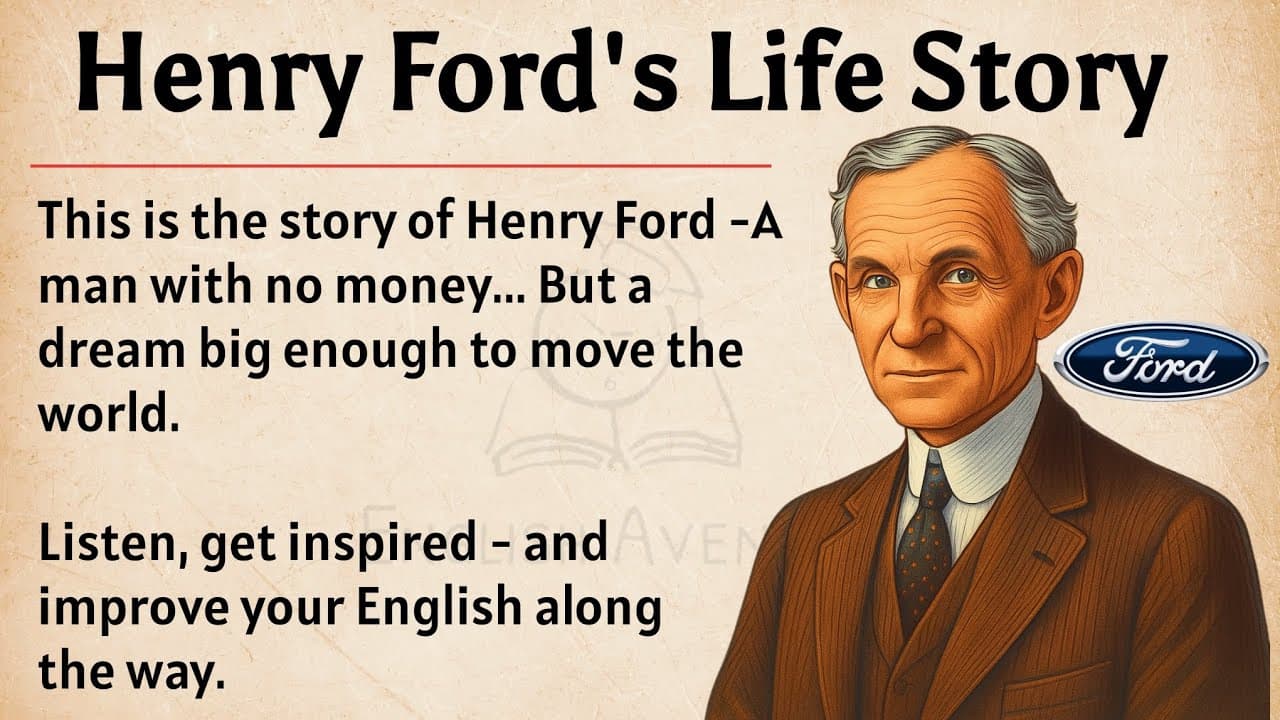
How Did Henry Ford Make Cars Affordable? | Learn English Through Story Level 2 | Graded Reader
TL;DR
Henry Ford worked to make cars affordable by simplifying his designs and pursuing vehicles that were durable, easy to repair, and suitable for ordinary workers. After the Detroit Automobile Company closed within 18 months, he studied its expensive, unreliable cars, rebuilt his designs, and regained investor support through the successful 999 racing car. Read on to see how failure shaped Ford Motor Company and his approach to building practical cars.
Transcript
Welcome to a story that can change your life. This is not a history lesson. This is not about cars, machines, or companies. This is a true story about belief. The kind of belief that refused to die even after failure, rejection, and loss. This is the story of a man who came from nothing. No money, no connections, no support. They told him, "You're ... Read More
Key Insights
- Henry Ford was born on July 30, 1863, in Greenfield Township, Michigan, where his daily childhood responsibilities included feeding animals, carrying water, collecting eggs, and cutting wood. Although raised for farm life, he repeatedly questioned why demanding work had to be completed by hand.
- A steam engine inspired Ford at age 12 because it completed in minutes work that required a person hours. The machine awakened his desire to understand mechanical systems, leading him to collect watches, scrap metal, and broken parts and build a small steam-engine model by age 15.
- Ford's commitment to machinery shaped his education outside formal institutions. After moving to Detroit at 16, he worked 10 to 12 hours daily as an apprentice machinist, earned $2.50 per week, and spent his nights reading technical books, studying blueprints, and constructing parts.
- The quadricycle was Ford's first working self-propelled vehicle, built with four bicycle wheels, a small ethanol-powered engine, a steering lever, and a simple metal frame. It carried two people but had no roof, doors, or reverse gear, showing how a basic prototype can prove a larger idea.
- Ford's first automobile company failed because its cars cost too much, broke easily, and took too long to produce. His repeated design changes also frustrated investors, and the Detroit Automobile Company closed after 18 months, leaving him without a job, company, or finished commercial car.
- Failure became a source of practical information for Ford rather than a final defeat. He returned to his garage, studied what had gone wrong, simplified the vehicle design, rebuilt the engine, and focused on producing cars that were fast, strong, and uncomplicated.
- The 999 racing car restored Ford's reputation by defeating every competitor at a racetrack near Detroit in 1901. The powerful racing vehicle attracted newspaper attention and renewed investor support, giving him another opportunity to pursue mass-market automobiles.
- Ford Motor Company began on June 16, 1903, with Henry Ford and 11 investors, $28,000 in starting funds, and a rented Detroit building. Ford served as vice president and chief engineer while pursuing cars that were affordable, durable, simple to repair, and suitable for rough roads.
Install to Summarize YouTube Videos and Get Transcripts
Explore YouTube Video Summarizer or Get YouTube Transcript Extractor
Questions & Answers
Q: How did Henry Ford work to make cars affordable?
Ford focused on making cars simple, durable, strong, and easy to repair for ordinary workers. After his first automobile company failed, he studied its expensive, unreliable vehicles and simplified his designs. He then founded Ford Motor Company with 11 investors to continue pursuing affordable cars suitable for rough roads.
Q: How did Henry Ford become interested in machines?
At age 12, Ford saw a steam engine complete in minutes work that took a person hours. The experience inspired him to collect old watches, scrap metal, and broken parts so he could study how machines worked. By age 15, he had built a small steam-engine model in a shed.
Q: Why did Henry Ford leave his family farm?
Ford preferred machines to repetitive farm work and believed there had to be a better way to perform demanding tasks. At age 16, he left the farm and moved to Detroit, where factories and workshops offered opportunities to study machinery. He became an apprentice machinist and worked 10 to 12 hours a day for $2.50 per week.
Q: What was Henry Ford's quadricycle?
The quadricycle was Ford's first working self-propelled vehicle. It had four bicycle wheels, a small ethanol-powered engine, a steering lever, and a simple metal frame, but no roof, doors, or reverse gear. It carried two people, and Ford had to break through his shed wall to move it outside in 1896.
Q: How did Thomas Edison encourage Henry Ford?
Ford described to Thomas Edison his idea for a practical gasoline-powered car that ordinary people could use. Edison encouraged him to continue developing it. Ford treated the famous inventor's approval as confirmation that his automotive idea was worth pursuing.
Q: Why did the Detroit Automobile Company fail?
The company's cars cost too much, broke easily, and took too long to produce. Ford's repeated design changes also frustrated its investors. The business closed after 18 months, but Ford responded by studying its problems and developing simpler, stronger designs.
Q: How did the 999 racing car help Henry Ford recover from failure?
The 999 restored Ford's reputation after the collapse of his first automobile company. It defeated every competitor at a racetrack near Detroit in 1901 and attracted newspaper attention. That success renewed investor interest and helped Ford pursue another automobile company.
Q: How was Ford Motor Company started?
Ford Motor Company began on June 16, 1903, with Henry Ford, 11 investors, and $28,000 in starting funds. It operated from a rented building in Detroit, with Ford serving as vice president and chief engineer. His goal was to develop affordable, durable cars that were simple to repair.
Summary & Key Takeaways
-
Henry Ford grew up on a Michigan farm but preferred machines to agricultural work. After seeing a steam engine at age 12, he collected broken parts and studied mechanics. His mother's death deeply affected him, but he continued pursuing his interests and moved to Detroit at 16 to become an apprentice machinist.
-
While employed at Edison Illuminating Company, Ford spent his nights developing a gasoline-powered vehicle. His quadricycle finally moved in 1896, although he had to break through his shed wall to get it outside. Encouragement from Thomas Edison strengthened Ford's belief that a practical gas-powered car could serve ordinary people.
-
Ford's Detroit Automobile Company failed because its cars were expensive, unreliable, and slow to produce. He responded by studying the problems and simplifying his designs. The victorious 999 racing car restored his reputation and attracted investors, leading to Ford Motor Company and a renewed mission to produce affordable, strong, repairable cars.
Read in Other Languages (beta)
Share This Summary 📚
Summarize YouTube Videos and Get Video Transcripts with 1-Click
Try YouTube Summary with ChatGPT & Claude or YouTube Transcript Generator
Explore More Summaries from English Avenue 📚






Summarize YouTube Videos and Get Video Transcripts with 1-Click
Try YouTube Summary with ChatGPT & Claude or YouTube Transcript Generator