How to Fund Growth With Profitable Customers
TL;DR
Design a deliberate sequence of offers that produces enough gross profit within 30 days to cover twice the customer acquisition cost plus delivery costs. When each customer funds the acquisition of the next customer, a business can reinvest rapidly, compete more aggressively for attention, and grow without depending on outside investors.
Transcript
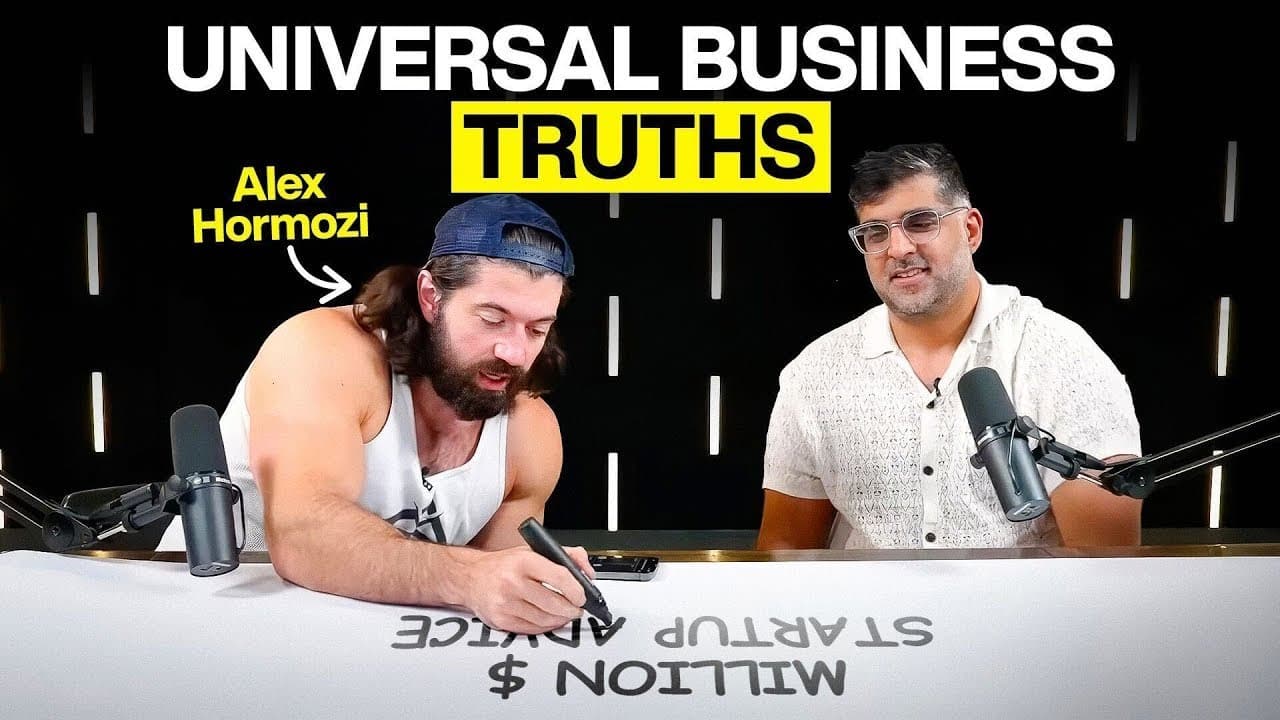
You probably recognize this guy, Alex Herozi. He's known as the $100 million man, and he's probably the most popular business teacher on YouTube. So, last week I flew to Vegas and I asked Alice to teach me the things in his new book, Money Models. Ah, how to make money. Thank you. Yeah. He says that this one concept has made him more money than any... Read More
Key Insights
- A money model is a deliberate sequence of offers arranged to accomplish a specific financial objective. Rather than relying on one initial sale, the business coordinates multiple offers across the customer journey to increase revenue, accelerate cash collection, and improve the economics of acquiring customers.
- The target financial equation is 30-day gross profit greater than twice customer acquisition cost plus cost of goods sold. Gross profit excludes overhead in the discussion, customer acquisition cost measures the expense of gaining a buyer, and cost of goods sold represents delivery expenses.
- Traditional gym promotions created slow payback because a $10 lead cost and 20% trial conversion rate produced a $50 trial acquisition cost. With only one-third of trials converting to a roughly $99 monthly membership, the gym could take about 60 days to recover acquisition spending.
- An attraction offer can collect meaningful cash before a recurring membership begins. Hormozi charged $500 for a challenge in which customers could win their money back by losing a specified amount of weight within a specified period, creating stronger upfront economics than a free or low-priced trial.
- A well-timed upsell connects the initial purchase with something the customer will need next. Forty-eight hours after selling the challenge, Hormozi offered about $200 of supplements and estimated approximately 80% gross margins, adding roughly $160 in gross profit to the initial transaction.
- Annual prepayment improves immediate cash flow by exchanging a discount for earlier payment. Hormozi offered existing members two months off if they prepaid for the year, and about 20% accepted the $2,000 upfront option, increasing average cash collected during the early customer relationship.
- Profitable customer acquisition enables a business to outspend competitors in attention auctions. Hormozi said the revised gym model cost about $50 to acquire a customer and generated about $1,000 upfront, producing economics he described as roughly 20-to-1 or 30-to-1.
- Customer-financed acquisition reduces dependence on investors because revenue from one buyer can pay for serving that buyer and attracting another. Hormozi used presales and advertising returns to finance equipment, painting, and lobby construction, allowing gym locations to become cash-flow positive when they opened.
- Related book: $100M Money Models
- Export your Kindle highlights to Glasp: How to Download Highlights and Notes from Kindle
Install to Summarize YouTube Videos and Get Transcripts
Explore YouTube Video Summarizer or Get YouTube Transcript Extractor
Questions & Answers
Q: What is a money model in business?
A money model is a deliberate sequence of offers organized to achieve a financial objective. A business may sell several products or services, but the sequence determines when and how each offer appears during the customer journey. Hormozi uses this structure to increase customer spending, collect cash sooner, repeat purchases, and remove cash flow as a constraint on growth.
Q: What financial equation does Hormozi use for customer acquisition?
Hormozi aims for gross profit generated within 30 days to exceed twice the customer acquisition cost plus the cost of goods sold. Customer acquisition cost is what the business spends to gain a buyer, while cost of goods sold is what it costs to deliver the product or service. The target can be reached through the first offer or through several sequenced offers.
Q: Why did the traditional gym trial model produce difficult economics?
The traditional example began with leads costing $10 and a 20% conversion rate into trials, making each trial cost about $50 to acquire. Only one out of three trials typically became a roughly $99 monthly membership. Recovery could therefore take about 60 days, even before fully accounting for delivery expenses, while many gym customers left within four months.
Q: How did the $500 gym challenge improve cash flow?
The gym sold a $500 challenge instead of beginning with a free month or low-priced trial. Customers could win their money back by losing a specified amount of weight within a specified time. This attraction offer collected substantially more cash at the beginning of the relationship, giving the business resources to cover acquisition expenses and fund additional advertising.
Q: How do upsells strengthen a money model?
Upsells increase revenue by offering something logically connected to the customer's initial purchase. Hormozi describes the classic principle as recognizing that a customer cannot have one thing without another, like a burger and fries. In the gym example, customers who joined the challenge were offered about $200 of supplements 48 hours later, adding approximately $160 at the stated 80% gross margin.
Q: How did annual membership prepayment affect the gym model?
After rolling challenge participants into one-year memberships, the gym offered to save them money if they prepaid for the entire year. The offer discounted two months, and about 20% of customers accepted a $2,000 upfront payment. When averaged with the challenge and supplement sales, this helped produce about $1,000 upfront per acquired customer during the same general period.
Q: How can customers finance further customer acquisition?
A customer can finance additional acquisition when the gross profit collected from that person quickly covers both service delivery and acquisition costs, with money remaining for more advertising. Hormozi describes each customer as arriving with the next customer already funded. As newly acquired customers generate the same surplus, the business can keep reinvesting and potentially double acquisition without repeated capital injections.
Q: Can a business grow without outside investors using this model?
A business can reduce its need for outside investors when customer acquisition produces positive cash flow quickly enough to fund continued growth. Hormozi said he could spend $5,000 on advertising and make $100,000 back, then use the proceeds to paint walls, build the lobby, and buy equipment before opening. Through presales, a location could become cash-flow positive on its first day.
Summary & Key Takeaways
-
A money model is a deliberate sequence of offers designed to achieve a financial objective. Hormozi targets 30-day gross profit greater than twice customer acquisition cost plus delivery costs. Reaching that threshold means each acquired customer can cover their own economics while supplying funds that help acquire the next customer.
-
Traditional gym promotions generated weak short-term economics. A $10 lead cost, 20% trial conversion rate, and one-in-three membership conversion produced a $50 customer acquisition cost and roughly $99 monthly revenue. Because recovery could take about 60 days while many customers left within four months, growth remained difficult to finance.
-
Hormozi replaced the traditional approach with a $500 challenge, supplements, membership conversion, and annual prepayment. The sequence produced about $1,000 upfront on average, compared with roughly $99 under the old model. Stronger immediate cash flow allowed greater advertising spending, profitable customer acquisition, and gym openings that were cash-flow positive from day one.
Read in Other Languages (beta)
Share This Summary 📚
Summarize YouTube Videos and Get Video Transcripts with 1-Click
Try YouTube Summary with ChatGPT & Claude or YouTube Transcript Generator
Explore More Summaries from My First Million 📚


Summarize YouTube Videos and Get Video Transcripts with 1-Click
Try YouTube Summary with ChatGPT & Claude or YouTube Transcript Generator