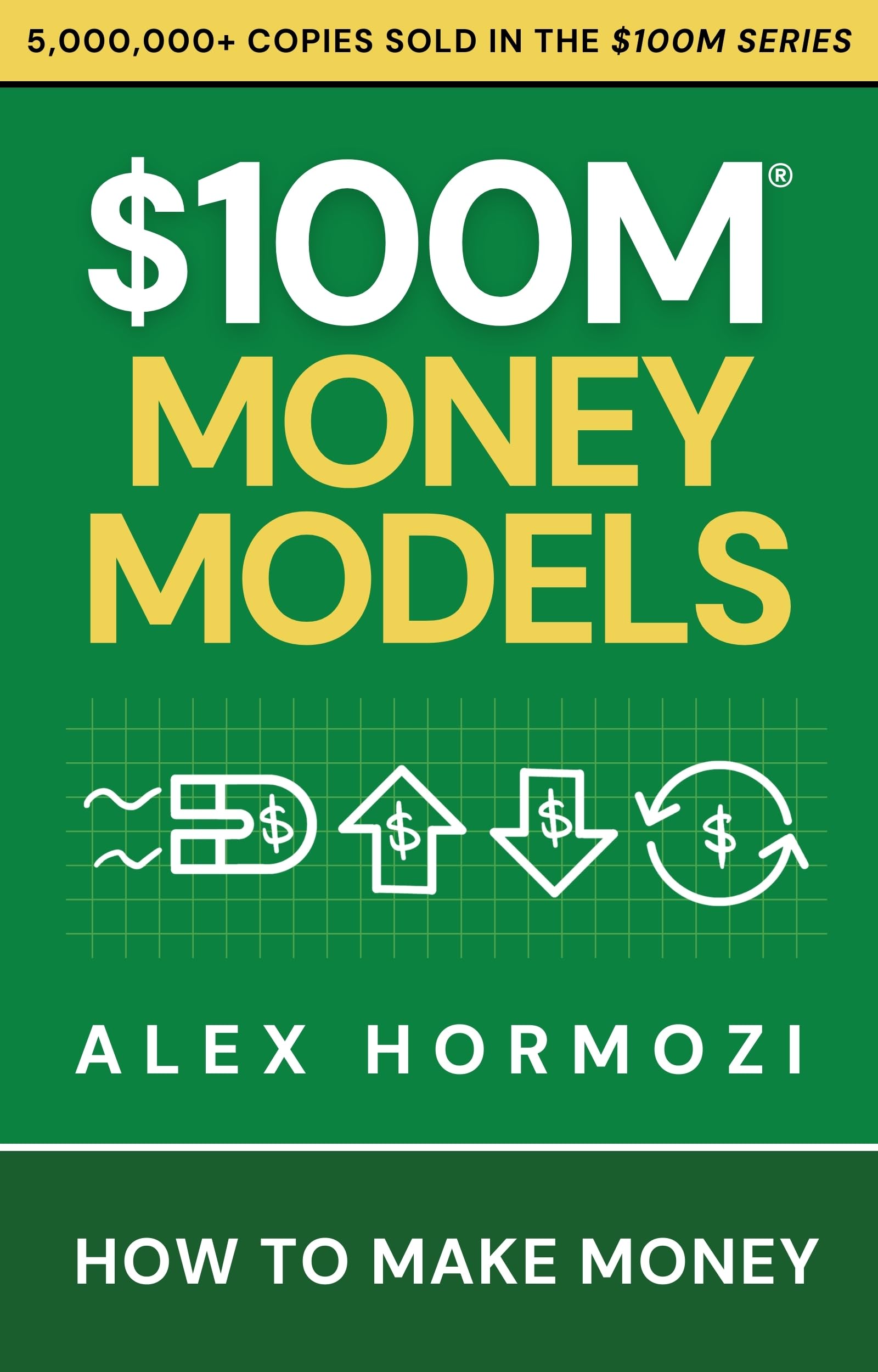
$100M Money Models: How To Make Money (Acquisition.com $100M Series)
About This Book
$100M Money Models is the fourth book in Alex Hormozi's Acquisition.com $100M Series, and it answers one question: how do you make more money from a customer than it costs to acquire them—fast? Hormozi's central concept is the Money Model: a deliberate sequence of offers, each solving the next problem the previous one created. He illustrates this with a rental car story where a $19/day booking becomes $100/day through upgrade, late-return, insurance, downsell, and prepaid-gas offers.
The book organizes everything around four offer types:
- Attraction Offers turn strangers into customers (Win Your Money Back, Giveaways, Decoy Offers, Buy X Get Y Free, Pay Less Now or Pay More Later).
- Upsell Offers get customers to spend more (Classic, Menu, Anchor, and Rollover Upsells).
- Downsell Offers turn "no" into "yes" (Payment Plans, Trial With Penalty, Feature Downsells).
- Continuity Offers keep people paying (Continuity Bonuses, Discounts, Waived Fee Offers).
A recurring financial principle anchors the whole system: recover your customer-acquisition cost within 30 days, so you can recycle interest-free credit and scale without running out of cash. Hormozi argues most businesses die because acquisition costs exceed early profit; a good Money Model flips this.
Each chapter follows the same format—a doodle, the origin story, a description, cross-industry examples, application prompts, and tactical notes. The tone is brash, practical, and example-heavy, with specifics like billing every four weeks for an 8.3% revenue bump, aligning charges to paychecks, and adding a 3% processing fee. The book closes with a step-by-step assembly guide: pick an Attraction Offer, then an Upsell, then a Downsell, then Continuity. It's positioned as a playbook of "winning lottery tickets" ready to cash in.
Key Takeaways
- 1.A Money Model is a deliberate sequence of offers—every solved problem reveals the next problem you can solve for money.
- 2.Aim to recover customer-acquisition cost within 30 days so you can recycle interest-free credit and scale without running out of cash.
- 3.Combine the four offer types—Attraction, Upsell, Downsell, Continuity—because together they make a business "unstoppable."
- 4.Anchor Upsells (showing a 5–10x premium first) make your main offer look like a far better deal and lift average spend.
- 5.Downsells turn nos into yeses by changing how customers pay or what they get—never by simply dropping the price.
- 6.Small structural tweaks compound: billing every four weeks instead of monthly adds ~8.3% annual revenue, and a 3% processing fee flows straight to profit.
- 7.Never negotiate price just to close—"don't negotiate with terrorists"—offer a payment plan or feature downsell instead to protect trust.
Top Highlights
A Money Model is a sequence of offers. At their core, we find every opportunity to solve a customer’s problem…and then offer to solve it. For that reason, Money Models tend to have many offers in a specific order. If you offer the right thing when customers realize they need it, you can make as many offers as you like.
Highlighted by 4 people
Four Types of Offers
Highlighted by 4 people
Make Enough Profit To Cover Your Costs In 30 Days Or Less I like to cover my costs of getting a customer within 30 days. Main reason: any business can get interest-free money for 30 days in the form of a credit card. If you clear your balance before the end of the month, it works just like normal money. So you can use credit to get a customer, pay it back, and then use it again to get the next customer. And if you can pay it off before the 30 days, you can go do it again. Rinse and repeat.
Highlighted by 3 people
Making one offer works better than making none. And making more offers works better than making one.
Highlighted by 3 people
There are four types of offers: Attraction Offers, Upsell Offers, Downsell Offers, and Continuity Offers.
Highlighted by 3 people
Attraction Offers turn strangers into customers.
Highlighted by 3 people
Attraction Offers generate leads and convert them into customers. They turn advertising
Highlighted by 3 people
Win Your Money Back
Highlighted by 3 people
Win Your Money Back Offer works like this. You set a goal for the customer and tell them how to reach it. If they reach it, then they qualify to get their money back or get it back as store credit.
Highlighted by 3 people
Actions and Results: Here, you hold customers accountable to following directions and getting results.
Highlighted by 3 people
AI Review
Based on Glasp's analysis of highlights from 6 readers, this is a tactically dense, highly quotable playbook whose structural clarity—four offer types assembled into a sequence—clearly resonated with readers.
Pros
- +Built around one memorable, repeatable framework: the Money Model as a sequence of offers
- +Concrete scripts, examples, and numbers readers can apply immediately across industries
- +Strong emphasis on the 30-day payback principle for cash-fueled growth
- +Covers the full funnel—Attraction, Upsell, Downsell, and Continuity—as an integrated system
- +Consistent chapter structure (story, description, examples, tactics) aids retention
Cons
- −Tactics-first style may feel aggressive or manipulative to some readers
- −Heavily oriented toward direct-response and service businesses; less applicable elsewhere
- −Some plays (giveaways, win-your-money-back) carry legal and delivery risks that demand caution
Glasp AI analysis based on highlights from 6 readers.
Who Should Read This
Founders, small-business owners, and operators who already get customers but feel starved for cash should read this. It's especially useful for gym owners, coaches, agencies, service providers, and anyone in direct-response or high-ticket sales looking to raise profit per customer. Readers benefit most if they already have an offer and understand basic margins and acquisition cost. Marketers and salespeople wanting concrete upsell/downsell scripts will find it actionable. Less suited to those seeking brand strategy, product-led growth theory, or passive-income shortcuts.
Frequently Asked Questions
What is the book about?
Who is it for?
What are the key lessons?
Is it worth reading?
What are the four types of offers?
Why does Hormozi stress recovering costs in 30 days?
What is the Rollover Upsell?
How to Apply What You Read
- 1.Map your current offers as a sequence and identify the next problem each offer creates so you can attach an upsell.
- 2.Calculate your 30-day customer profit versus acquisition cost, and redesign offers until profit covers cost within 30 days.
- 3.Build at least one premium anchor offer (5–10x your main price) to present before your core offer.
- 4.Add a standardized downsell ladder—payment plans, trial-with-penalty, and feature downsells—so fewer prospects walk away with nothing.
- 5.Launch a winback or Rollover Upsell campaign to lapsed customers, crediting past purchases toward a more expensive new offer.
Discussion Questions
- Q1.Which of the four offer types is weakest in your current business, and what would adding it change?
- Q2.Where is the line between persuasive offer design and manipulating customers, and how do you stay on the right side of it?
- Q3.How realistic is the 30-day payback rule for your specific industry and margins?
- Q4.Hormozi says "hard selling is for weak products"—do you agree, and how does that reframe your sales approach?
- Q5.Which tactic in the book felt most uncomfortable to you, and why?
- Q6.How would the Money Model framework apply to a subscription or product-led business rather than a service one?
- Q7.What legal and delivery risks would you need to manage before running giveaways or buy-X-get-Y offers?
Recommended Books




Revisit Your Highlights, Deepen Your Understanding
Import your Kindle highlights to review, organize, and share the ideas that matter most to you.
Get the free browser extension