How Will AI Agents and Humanoid Robots Evolve?
TL;DR
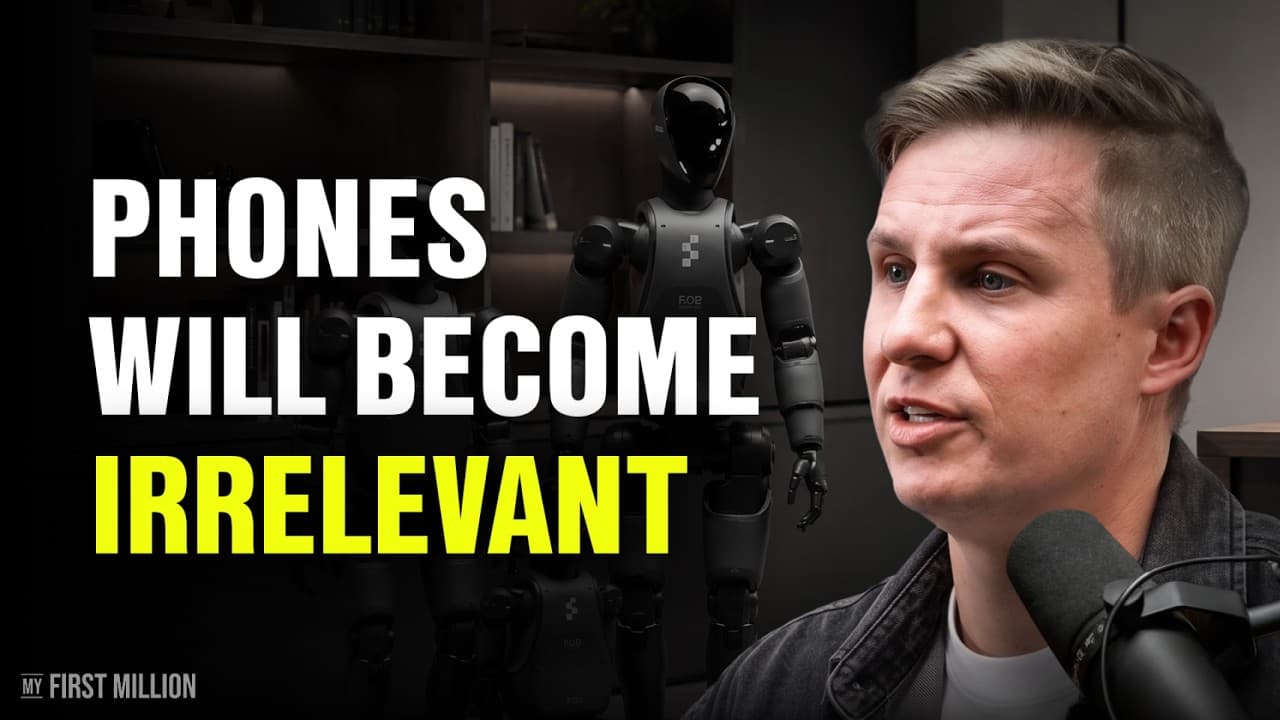
AI is likely to develop along two connected paths: humanoid robots that perform physical work and deeply personalized digital assistants that operate computers. Brett Adcock argues that useful agents must navigate ordinary websites with a screen, cursor, and keyboard because most websites lack APIs, while scalable robots must combine general-purpose human-shaped hardware with capable AI.
Transcript
I think if you Google Brett Adcock net worth according to Fortune, you're worth $19 billion. So that's like a pretty good swing. How does that make you feel? >> I don't care about that at all. Give like zero shits about that. >> Okay. So you uh Brett Adcock, the the short of it is that you were raised in a rural area of Illinois. You started a comp... Read More
Key Insights
- Adcock’s primary concern is operational execution, not his reported $19 billion net worth. He says Figure and his other companies are only reaching an inflection point, so their future value depends on whether their technologies scale rather than on current estimates.
- Figure’s near-term outcome is described as binary: humanoid robots either reach scale or they do not. Adcock believes that within five years the company could become extremely large or experience a very poor result, which creates substantial pressure to deliver working systems.
- AI could become one hundred times larger than the internet, according to Adcock’s high-level prediction. His reasoning is that deep learning is working well and development is moving faster than the trend lines he observed across roughly 15 years of software and internet experience.
- AI development is expected to follow physical and digital paths. Figure is building humanoid robots for work in homes, supply chains, and healthcare, while Hark is pursuing a personalized digital system that knows a user’s information and can perform computer-based tasks.
- General-purpose computer agents must be able to use ordinary interfaces because only one in a thousand websites has an API, according to Adcock. Depending only on APIs or MCPs would prevent an assistant from completing many consumer tasks across the internet.
- Hark’s agents work inside virtual computers that can be created independently of physical MacBooks. Each agent can inspect a screen, move a cursor, and use a keyboard, allowing many sandboxed environments to run and enabling interaction with websites through their normal user interfaces.
- Hark’s reported performance improvement comes from post-training and reinforcement learning. Adcock says the team developed a reinforcement learning process that may be distinct from other efforts, and he reports that it has become difficult to find an internet task the research preview cannot perform.
- Humanoid form is intended to provide one general-purpose hardware platform for physical work. Adcock argues that capable AI placed inside human-shaped hardware could handle varied activities such as laundry, dishes, cooking, supply-chain operations, and healthcare tasks without requiring separate machines for every activity.
Install to Summarize YouTube Videos and Get Transcripts
Explore YouTube Video Summarizer or Get YouTube Transcript Extractor
Questions & Answers
Q: Why does Brett Adcock think AI could exceed the internet?
Brett Adcock predicts that AI could become one hundred times larger than the internet because he sees deep learning working well and development moving unusually quickly. Based on roughly 15 years of experience in software and internet businesses, he says earlier technology trends did not advance faster than expected, while current AI progress is exceeding his anticipated trend line.
Q: What are the two main directions Adcock predicts for AI?
Adcock expects AI to develop in two main directions that may eventually converge. The physical direction uses humanoid robots to perform tasks in homes, supply chains, healthcare, and other environments. The digital direction creates a close human and AI partnership, with a personalized assistant that knows the user’s memories, accounts, and systems and can independently complete computer-based tasks.
Q: How does Hark enable AI agents to use the internet?
Hark gives each agent a virtual computer and the ability to inspect a screen, move a cursor, and operate a keyboard. This lets the agent navigate websites through the same visible interfaces people use instead of requiring a dedicated API. Adcock says this approach supports general-purpose tasks such as building financial models, booking flights, and ordering food online.
Q: Why are APIs insufficient for general-purpose AI agents?
APIs are insufficient because, according to Adcock, only one in a thousand websites has one. Many consumer services therefore cannot be operated end to end through APIs or MCPs alone. A broadly useful assistant needs to interpret ordinary screens and control the cursor and keyboard so it can navigate websites that expose only human-facing browser interfaces.
Q: What reportedly makes Hark’s computer-use system work better?
Adcock attributes Hark’s computer-use results to its post-training work, particularly a reinforcement learning process that he believes may not have been reproduced elsewhere. Although the transcript does not disclose the technical details, he says the first model and research preview performed broadly enough that his team now struggles to identify internet tasks it cannot complete.
Q: Why does Figure focus on humanoid robots?
Figure focuses on humanoid robots because Adcock sees the human form as a general-purpose vessel for AI in the physical world. Rather than building separate hardware for every task, the company aims to create one platform capable of handling varied work, including laundry, dishes, cooking, supply-chain activities, and roles in healthcare, when paired with sufficiently capable AI.
Q: What could a personalized digital AI assistant do?
Adcock envisions a persistent digital assistant that knows a person’s information, memories, accounts, and systems. It could be accessed whenever needed, remain active in the background, and carry out tasks rather than merely offering advice. He compares the concept to Jarvis from Iron Man and expects it to become superhuman in almost every way.
Q: What determines whether Figure succeeds over the next five years?
Figure’s success depends on whether its humanoid robots can be deployed at scale. Adcock characterizes the outcome as binary, with no stable middle path: the robots either scale or they do not. He says that within five years the result could be very large or very bad, so his attention is concentrated on delivering the technology rather than celebrating current valuations.
Summary & Key Takeaways
-
Brett Adcock describes his companies as being at an early inflection point, despite their high valuations. Figure’s outcome depends on whether humanoid robots can scale successfully. He treats that outcome as binary and directs his energy toward execution rather than his reported personal wealth, which Fortune estimated at $19 billion.
-
Adcock predicts that AI could become one hundred times larger than the internet because deep learning is working and progress is exceeding the trend lines he experienced during 15 years in software and internet businesses. He expects AI to expand into both physical environments and personal digital systems, potentially bringing those directions together.
-
Hark is developing agents that receive virtual computers and interact with websites through screens, cursors, and keyboards. This approach targets services without consumer APIs and seeks to automate tasks such as financial modeling, booking flights, and ordering food. Adcock attributes Hark’s improved computer-use performance to its post-training and reinforcement learning process.
Read in Other Languages (beta)
Share This Summary 📚
Summarize YouTube Videos and Get Video Transcripts with 1-Click
Try YouTube Summary with ChatGPT & Claude or YouTube Transcript Generator
Explore More Summaries from My First Million 📚

Summarize YouTube Videos and Get Video Transcripts with 1-Click
Try YouTube Summary with ChatGPT & Claude or YouTube Transcript Generator