How to Grow a Mobile App to $30K Monthly
TL;DR
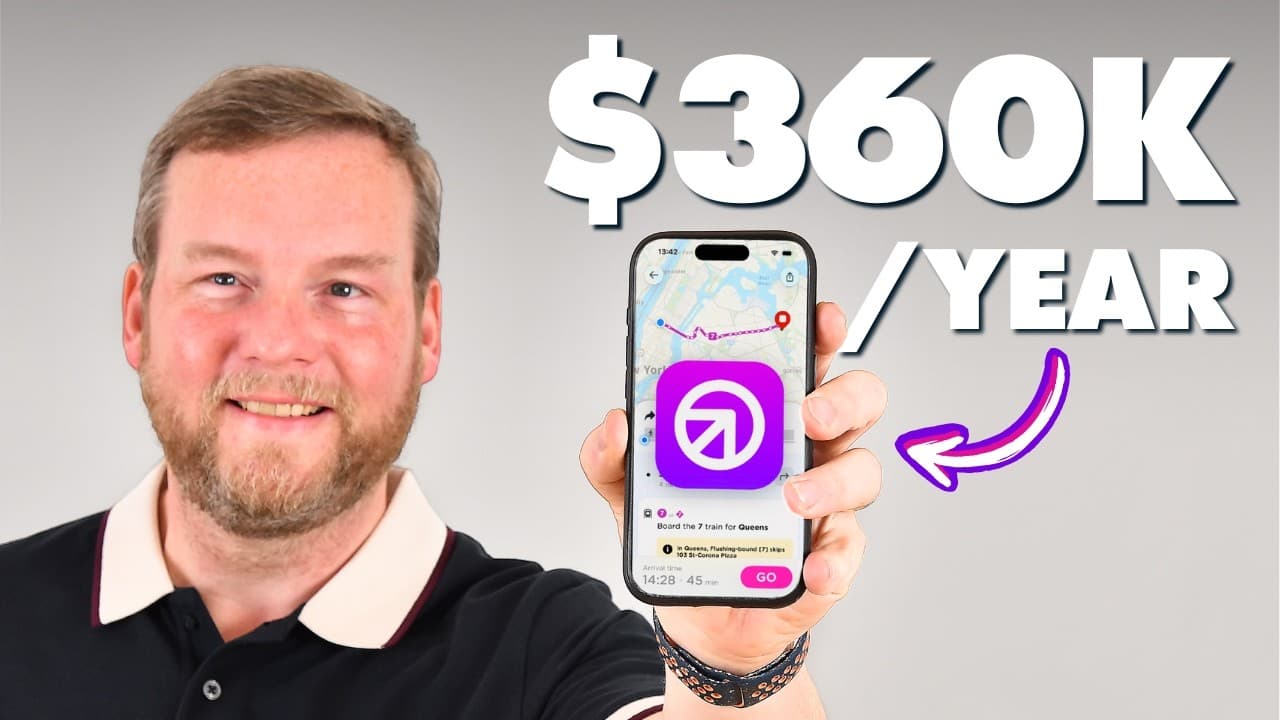
Solve a problem you personally experience, then use hyper-local App Store optimization to reach users searching for that exact solution. John McEvoy grew Momego to more than 5 million downloads and about $30,000 in monthly recurring revenue by targeting city-specific terms, requesting ratings at positive moments, and testing onboarding and paywalls until subscription conversion rose from 0.5% to 8%.
Transcript
My app has been downloaded 5 million times and I did it all by myself. This is John Makavoy, a gentleman from Scotland who taught himself how to code and built something incredible. I had a problem I needed to solve, so I built it. But here's what's even crazier. His app has been downloaded over 5 million times thanks to one simple strategy that co... Read More
Key Insights
- Momego is a bus and train tracking app that covers over 160 cities and has accumulated about 5.2 million downloads, 400,000 monthly active users, and 75,000 ratings since 2017. Its revenue is around $30,000 in monthly recurring revenue, with subscriptions providing nearly all of it.
- The original product idea came from a problem McEvoy personally experienced while working for a bus company in Edinburgh. He wanted to watch a bus approach on a map, similar to Uber, so he could finish his morning coffee instead of waiting outside in the rain.
- McEvoy's development process was self-taught and incremental. He designed the interface in Illustrator, built early versions with Xamarin and C#/.NET, then rebuilt the iOS app in native Swift and used Flutter for an interface involving maps and sliding panels.
- App Store optimization works by placing phrases that prospective users already search for into an app's title, subtitle, keyword list, and other metadata. McEvoy credits research and patience with turning this free discovery method into the primary engine behind millions of downloads.
- Hyper-local terminology is essential for matching search intent. McEvoy found that phrases such as New York's MTA subway and Chicago's CTA L train performed better than generic transit terms, while location-specific screenshots reinforced that the app worked in each user's city.
- Additional App Store localizations can expand the available keyword surface. McEvoy used keyword fields from other localizations, including Mexican Spanish, because those terms could also be indexed in the United States App Store with the same weight as the native US English localization.
- App Store search suggestions reveal specific phrases that users are likely to select. McEvoy entered the first few characters of relevant searches, studied the first and second suggested entries, and targeted highly specific terms that had enough intent but less competition for top-five placement.
- Ratings are most effective when requested during a positive product experience. Momego asks after a user taps a stop and sees a bus or train moving live on the map, creating a favorable moment that can generate continuing ratings and improve organic keyword rankings.
- Subscription growth depended on systematic experimentation rather than downloads alone. After introducing subscriptions in August 2020, McEvoy ran about 10 onboarding and paywall experiments over two or three months in 2021, raising conversion from 0.5% to 8% and increasing monthly revenue from roughly $8,000 to over $30,000.
Install to Summarize YouTube Videos and Get Transcripts
Explore YouTube Video Summarizer or Get YouTube Transcript Extractor
Questions & Answers
Q: How did John McEvoy find the idea for Momego?
John McEvoy found the idea while working for a bus company in Edinburgh, Scotland. He wanted to see a bus moving toward him on a map, much like the early Uber experience showed an approaching taxi. The practical goal was to finish his morning coffee instead of standing at a bus stop for 10 or 20 minutes in the rain. He recommends starting with a problem the developer personally experiences.
Q: How did a graphic designer build Momego without app development experience?
McEvoy began by creating the app's designs in Illustrator, then worked through development a little at a time. He drew on earlier website coding experience and initially used Xamarin with C#/.NET because that technology felt familiar. After months of building, failing, and adjusting, he launched the app and improved its messy code. He later rebuilt iOS in native Swift and used Flutter for the map-based interface and sliding panels.
Q: How does App Store optimization help a mobile app get downloads?
App Store optimization helps an app appear for phrases that prospective customers already enter into App Store search. The process starts by researching relevant terms and placing them in the app title, subtitle, keyword list, and metadata. McEvoy focused on precise, location-specific phrases, which often had less competition than broad terms. Strong placement for many targeted searches then produced organic downloads without requiring paid user acquisition.
Q: How can developers find effective App Store keywords for free?
Developers can use App Store autocomplete by entering the first few characters of a phrase related to their product. The resulting list indicates searches that users may choose, especially the first or second suggestion. McEvoy studied those suggestions to identify specific, high-impact phrases. He also notes that Apple Search Ads can test a few keywords at a time and reveal which terms convert, although the App Store search method itself is free.
Q: Why did hyper-local keywords work for Momego?
Hyper-local keywords worked because travelers in different cities use different names for similar transportation services. New York users may search for the MTA subway, while Chicago users may search for the CTA L train. McEvoy added each city's terminology to Momego's metadata and paired it with location-specific screenshots. That combination matched local search intent and clearly showed prospective users that the app supported transportation where they lived or traveled.
Q: How did ratings improve Momego's App Store rankings?
Continuing ratings helped Momego move beyond top-10 keyword positions toward the leading results. McEvoy chose what he calls a golden moment to request feedback: after a user taps a stop and sees a bus or train moving live on the map. At that point, the app has just demonstrated its central value, so the user is more likely to respond positively. A steady flow of ratings can then support stronger organic rankings.
Q: Why did Momego switch from advertising to subscriptions?
Momego initially monetized with banner advertisements and was earning around $8,000 per month. When the pandemic arrived, that advertising revenue disappeared, forcing McEvoy to change the business model quickly. As subscriptions were becoming more mainstream, he rebuilt the app around annual payments and premium features that could persuade users to subscribe. The subscription update launched in August 2020 and replaced the lost advertising revenue over the following year.
Q: How did paywall testing raise Momego's monthly revenue?
In 2021, McEvoy began A/B testing different onboarding flows and paywalls to identify which versions converted more users into subscribers. Across roughly 10 experiments conducted over two or three months, he increased the conversion rate from 0.5% to 8%. That improvement came from optimizing how the app demonstrated value, introduced premium features, used social proof, and presented the paywall. Monthly revenue subsequently rose from around $8,000 to more than $30,000.
Summary & Key Takeaways
-
John McEvoy moved from graphic design into software development through curiosity about JavaScript, backend systems, and databases. While working for a bus company in Edinburgh, he wanted to track buses on a map so he could avoid waiting outside. That personal frustration became Momego, a transit-tracking app covering over 160 cities.
-
Momego's organic growth came from hyper-local App Store optimization. McEvoy researched how each city describes its transportation system, inserted relevant phrases into titles and metadata, and created location-specific screenshots. He also used additional localizations and App Store search suggestions to target specific terms with enough relevance to achieve prominent rankings.
-
The business initially earned around $8,000 per month from banner advertising, but that revenue disappeared during the pandemic. McEvoy introduced subscriptions and premium features in August 2020. In 2021, roughly 10 onboarding and paywall experiments raised conversion from 0.5% to 8%, helping monthly revenue climb beyond $30,000.
-
Momego demonstrates how product usefulness, discoverability, and monetization can reinforce one another. A clearly felt customer problem shaped the product, localized search research supplied users without acquisition costs, well-timed rating prompts strengthened rankings, and systematic paywall testing converted a larger share of those users into annual subscribers.
Read in Other Languages (beta)
Share This Summary 📚
Summarize YouTube Videos and Get Video Transcripts with 1-Click
Try YouTube Summary with ChatGPT & Claude or YouTube Transcript Generator
Explore More Summaries from Starter Story 📚

Summarize YouTube Videos and Get Video Transcripts with 1-Click
Try YouTube Summary with ChatGPT & Claude or YouTube Transcript Generator