How to Care Less and Focus on What Matters
TL;DR
A meaningful life comes from spending limited attention on health, growth, relationships, purpose, and problems worth solving. Accepting difficult emotions, choosing durable values, taking responsibility for your responses, and tolerating uncertainty reduce unnecessary suffering while helping you build a life based on conscious choices rather than approval, comparison, or blame.
Transcript
Welcome, my friends. What if I told you that the secret to a meaningful life is not hidden in achieving more, but in caring less? Not about everything, but only about the things that truly matter. We spend most of our lives running after approval, chasing success, and worrying about problems that won't even matter 5 years from now. But the real sub... Read More
Key Insights
- Limited attention is a resource that must be allocated deliberately. Worrying about other people’s opinions, reacting to every criticism, comparing yourself online, and pursuing every opportunity can exhaust the focus and emotional strength needed for health, growth, relationships, and purpose.
- Caring less is not the same as being careless. It means refusing to spend energy on trivial concerns while choosing to care deeply about the people, values, goals, and responsibilities that make life meaningful.
- Happiness comes from solving worthwhile problems, not from eliminating difficulty. Exercise, learning, repairing relationships, and completing demanding work can involve pain, but that chosen struggle produces growth, satisfaction, and solutions to problems that genuinely affect life.
- The feedback loop from hell is a cycle in which people become distressed about their own distress. Anxiety about anxiety, sadness about sadness, or overthinking a small mistake can create more suffering than the original emotion or event.
- Acceptance breaks cycles of unnecessary emotional suffering. Recognizing that mistakes, sadness, nervousness, insecurity, and imperfection are normal allows difficult feelings to exist without letting them control an entire life.
- Durable values are based on choices within personal control. Honesty, kindness, self-respect, growth, and meaningful relationships offer stability, while money, status, appearance, and universal approval create endless comparison because external validation is never guaranteed.
- Responsibility is ownership of your response, not automatic acceptance of blame. An unfair event may not be your fault, but deciding whether to set boundaries, forgive, move forward, learn new skills, or change direction remains within your control.
- Accepting ordinariness reduces the pressure to prove constant exceptionalism. Meaning can come from honest living, gradual growth, close relationships, small contributions, and presence, without becoming a millionaire, genius, celebrity, or someone who appears extraordinary to others.
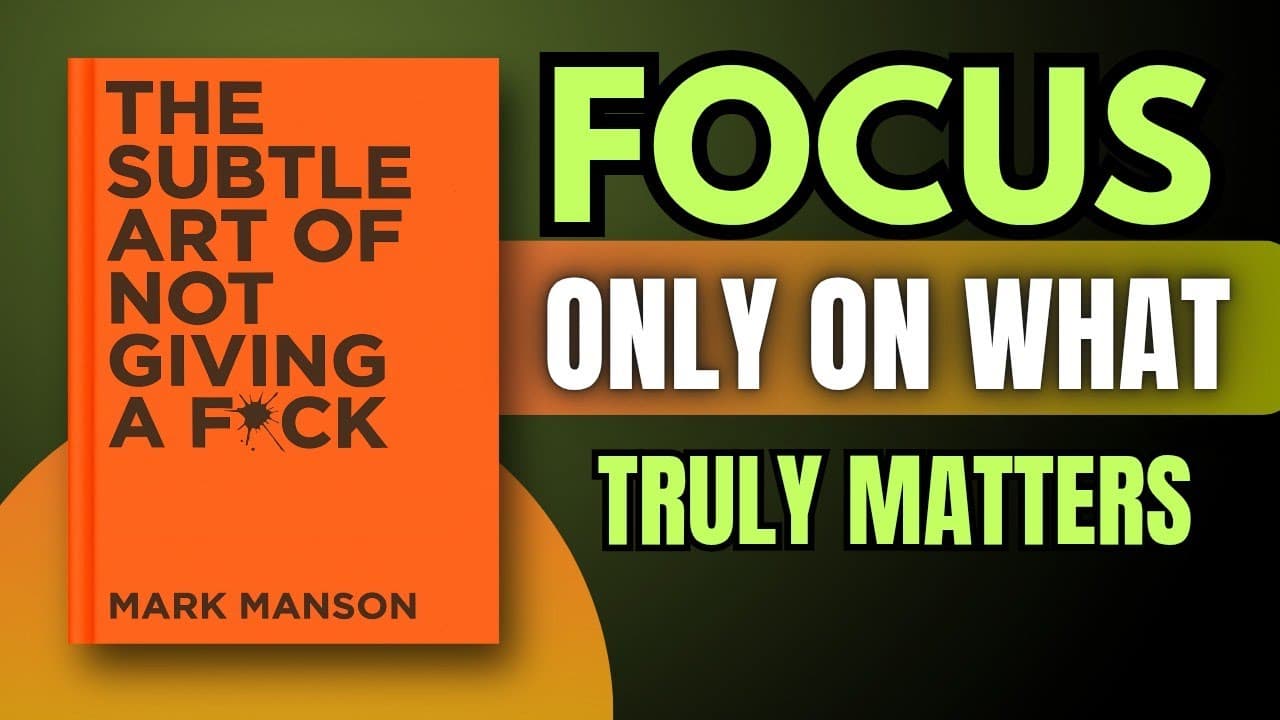
- Related book: The Subtle Art of Not Giving a F*ck
- Export your Kindle highlights to Glasp: How to Download Highlights and Notes from Kindle
- More videos about this book:
- More videos with Mark Manson:
Install to Summarize YouTube Videos and Get Transcripts
Explore YouTube Video Summarizer or Get YouTube Transcript Extractor
Questions & Answers
Q: How can I stop caring about unimportant things?
Treat attention, focus, time, and emotional strength as limited resources. Before reacting to criticism, comparison, inconvenience, or a new opportunity, ask whether it is truly worth your energy. Caring less does not require neglecting everything. It means reserving serious concern for health, growth, relationships, purpose, and other priorities that give life meaning.
Q: Why does solving problems create happiness?
A meaningful life is not free from problems, because avoiding every difficulty can create anxiety, boredom, or emptiness. Satisfaction often follows the completion of demanding work, the repair of a relationship, or progress toward a hard goal. The important choice is not whether to experience pain, but whether the difficulty solves a worthwhile problem and supports growth.
Q: What is the feedback loop from hell?
The feedback loop from hell occurs when a difficult feeling creates a second layer of distress. A person may feel anxious and then become anxious about being anxious, or make a small mistake and turn it into fears about judgment, failure, and losing a job. The growing cycle of overthinking eventually becomes more harmful than the original problem.
Q: How can acceptance reduce overthinking and anxiety?
Acceptance reduces overthinking by ending the struggle to feel perfect, confident, or happy at all times. Sadness, nervousness, insecurity, and mistakes are normal parts of being human. Allowing these experiences without treating them as proof of weakness prevents additional distress and makes it easier to correct problems, regain perspective, and move forward peacefully.
Q: Which values create a more meaningful life?
Values such as honesty, kindness, self-respect, growth, and meaningful relationships create stability because they can guide choices regardless of money or status. Values based mainly on attractiveness, wealth, popularity, or universal approval remain vulnerable to comparison and criticism. The quality of life therefore depends heavily on choosing principles that can be practiced through personal decisions.
Q: What is the difference between responsibility and blame?
Blame focuses on who caused an unfair event, while responsibility focuses on what you can choose next. Betrayal, job loss, family circumstances, or mistreatment may not be your fault. You still retain responsibility for decisions such as setting boundaries, forgiving, moving on, developing skills, applying elsewhere, or changing direction. That distinction restores personal control without requiring self-blame.
Q: Why is accepting that you are ordinary freeing?
Accepting ordinariness removes the demand to prove that your life has value through extraordinary achievement. Constant comparison with millionaires, geniuses, celebrities, or polished social media stories can produce anxiety and insecurity. Meaning can instead come from honest living, good relationships, gradual growth, small contributions, and being present with loved ones, without meeting impossible standards.
Q: Why can the pursuit of certainty prevent growth?
The pursuit of certainty can delay decisions, discourage risks, and close the mind to unfamiliar ideas because absolute assurance is unavailable. Waiting for the perfect plan or complete confidence may let life pass without meaningful movement. Growth requires questioning yourself, entering uncertain situations, accepting that you might be wrong, and choosing action despite the absence of guaranteed outcomes.
Summary & Key Takeaways
-
Time, attention, focus, and emotional strength are limited resources, so they should not be spent indiscriminately. Caring less means ignoring trivial criticism, approval seeking, minor inconveniences, and distracting opportunities while caring deeply about health, personal growth, meaningful relationships, and purpose. Asking whether something deserves your energy supports more conscious choices.
-
Happiness does not require eliminating every problem. It grows through confronting worthwhile difficulties and solving problems that improve life, such as exercising for better health or learning a skill to escape stagnation. Accepting sadness, anxiety, mistakes, and imperfection also prevents ordinary emotions from becoming larger cycles of overthinking and unnecessary suffering.
-
Durable values such as honesty, kindness, self-respect, growth, and meaningful connection provide greater stability than money, status, appearance, or universal approval. Personal power comes from accepting responsibility for responses without assuming fault for every event. Embracing ordinariness and uncertainty reduces pressure, encourages action, and creates room for authentic progress and fulfillment.
Read in Other Languages (beta)
Share This Summary 📚
Summarize YouTube Videos and Get Video Transcripts with 1-Click
Try YouTube Summary with ChatGPT & Claude or YouTube Transcript Generator