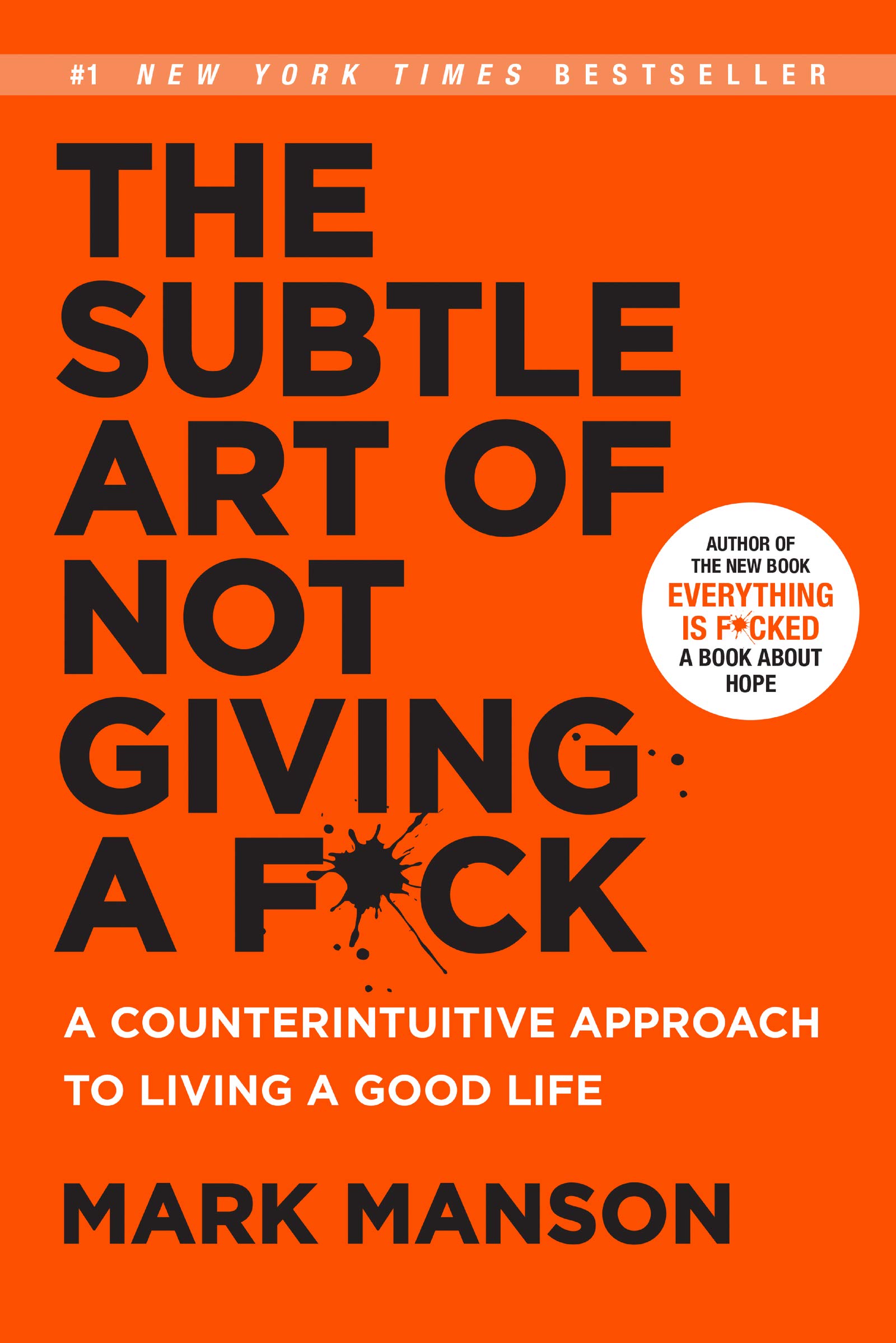
The Subtle Art of Not Giving a F*ck: A Counterintuitive Approach to Living a Good Life (Mark Manson Collection Book 1)
by Mark Manson
About This Book
Mark Manson’s core argument is that a good life does not come from maximizing comfort, positivity, or status. It comes from choosing what actually deserves your care, accepting the pain that comes with it, and taking responsibility for how you interpret and respond to life. The most highlighted idea in the book captures this reversal: chasing positive feelings tends to deepen dissatisfaction, while accepting negative experience often becomes the start of relief, growth, and meaning.
Across the book, Manson dismantles common self-help assumptions. Happiness is not an equation to solve or a permanent state to achieve. Problems never disappear; they are exchanged for new ones. So the real question is not what pleasure you want, but what struggles you are willing to endure. Your identity is shaped less by your desires than by the pain you can willingly sustain.
A second major theme is values. If you want to change your problems, you must change what you measure as success and failure. Good values are immediate, reality-based, and within your control; shallow values like constant pleasure, being right, or external validation create fragile lives. Readers repeatedly highlighted Manson’s insistence that negative emotions are signals to act, not proof that something has gone wrong.
The book also emphasizes responsibility without blame. You may not control what happens, but you do control your response. This extends into relationships: healthy bonds require boundaries, rejection, conflict, and each person solving their own problems rather than rescuing the other.
Finally, Manson argues for humility, uncertainty, and mortality awareness. Growth means becoming slightly less wrong, not perfectly right. Accepting death strips away superficial concerns and clarifies what matters. In that sense, “not giving a f*ck” is not indifference; it is disciplined, values-based attention.
Key Takeaways
- 1.Acceptance over avoidance: trying to escape pain often creates more suffering, while facing negative experience can open the door to growth.
- 2.Happiness comes from solving problems: the goal is not a problem-free life, but better problems worth engaging with.
- 3.Values shape reality: changing what you measure as success and failure changes how your struggles feel and what your life becomes.
- 4.Responsibility creates power: you may not control events, but you always influence your interpretation and response.
- 5.Uncertainty is necessary for growth: becoming less certain and more willing to be wrong makes learning possible.
- 6.Boundaries strengthen relationships: trust grows when people handle their own problems and can both say and hear no.
- 7.Mortality clarifies meaning: remembering death helps strip away shallow concerns and focus on what truly matters.
Top Highlights
The desire for more positive experience is itself a negative experience. And, paradoxically, the acceptance of one’s negative experience is itself a positive experience.
Highlighted by 13 people
Action isn’t just the effect of motivation; it’s also the cause of it.
Highlighted by 11 people
Everything worthwhile in life is won through surmounting the associated negative experience.
Highlighted by 10 people
you want to change how you see your problems, you have to change what you value and/or how you measure failure/success.
Highlighted by 10 people
Not giving a fuck does not mean being indifferent; it means being comfortable with being different.
Highlighted by 9 people
Subtlety #2: To not give a fuck about adversity, you must first give a fuck about something more important than adversity.
Highlighted by 9 people
Subtlety #3: Whether you realize it or not, you are always choosing what to give a fuck about.
Highlighted by 8 people
is the mark of an educated mind to be able to entertain a thought without accepting it.”
Highlighted by 8 people
And, paradoxically, the acceptance of one’s negative experience is itself a positive experience.
Highlighted by 7 people
fuck about less, giving a fuck about only what is true and immediate and important.
Highlighted by 7 people
AI Review
Glasp's AI analysis of 49 reader highlights suggests a strong consensus that this book is highly resonant and quotable. The highlight pattern points to lasting value around responsibility, values, suffering, and meaning, though the abrasive style may limit its appeal for some readers.
Pros
- +Memorable, highly highlightable core ideas
- +Clear challenge to toxic positivity
- +Strong emphasis on personal responsibility
- +Useful framework for choosing values and metrics
- +Practical insights on struggle, boundaries, and relationships
- +Resonant passages on mortality, uncertainty, and meaning
Cons
- −Deliberately abrasive tone will not work for everyone
- −Some ideas are repeated in multiple formulations
- −Shock-value humor can distract from the substance
- −Arguments can feel broad rather than deeply nuanced
Glasp AI analysis based on highlights from 49 readers.
Who Should Read This
This book is best for readers tired of polished positivity and motivational clichés. It especially fits people feeling stuck, overwhelmed by social comparison, trapped in people-pleasing, or unsure what deserves their energy.
It will resonate with:
- young professionals navigating ambition, anxiety, and social media pressure
- readers interested in practical philosophy and psychology rather than soft encouragement
- people reevaluating relationships, boundaries, and personal responsibility
- anyone who needs help choosing meaningful priorities instead of chasing endless validation
No specialist knowledge is required, but the tone is blunt and intentionally provocative, so it suits readers who can tolerate profanity and directness.
Frequently Asked Questions
What is the book about?
Who is it for?
What are the key lessons?
Is it worth reading?
What does not giving a f*ck actually mean in the book?
How does the book define happiness?
What does the book say about relationships?
How to Apply What You Read
- 1.List the three things in your life that truly deserve your energy, and identify what you will stop caring so much about.
- 2.Audit your values by asking how you currently measure success, failure, worth, and approval.
- 3.Choose one meaningful struggle you are willing to sustain instead of chasing an easier but emptier goal.
- 4.Own one unresolved problem by writing what is your responsibility in it, even if the fault is not yours.
- 5.Practice one boundary this week by saying no clearly or allowing someone else to manage their own issue.
Discussion Questions
- Q1.Which highlighted idea feels most true in your own life: accepting pain, choosing values, or taking responsibility?
- Q2.What kinds of problems do you currently have, and are they problems you actually want to keep solving?
- Q3.How much of modern unhappiness comes from social comparison and the expectation of being exceptional?
- Q4.What is the difference between being responsible for your response and blaming yourself for everything?
- Q5.How do healthy boundaries change the way we think about love, trust, and support?
- Q6.Does accepting mortality make life feel freer, darker, or more meaningful to you?
- Q7.Where in your life are you chasing rewards while avoiding the struggle required to earn them?
What People Are Saying
“[Mark Manson] is an awesome writer.”
More Books in Psychology

Revisit Your Highlights, Deepen Your Understanding
Import your Kindle highlights to review, organize, and share the ideas that matter most to you.
Get the free browser extension