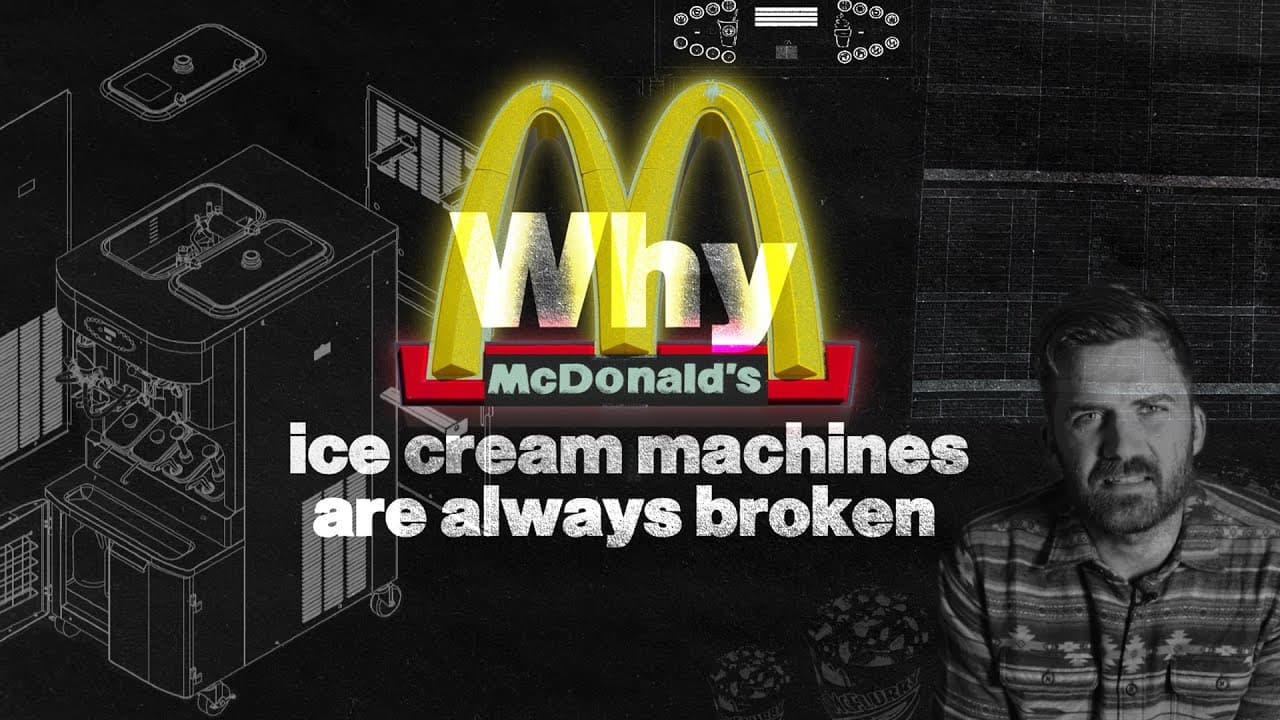
Why Are McDonald's Ice Cream Machines Always Broken?
TL;DR
McDonald's ice cream machines often fail due to complicated cleaning cycles and unclear error messages, which drive franchise owners to rely on costly repairs from the manufacturer, Taylor. This situation is exacerbated by contractual obligations that prevent franchisees from seeking alternatives, and McDonald's attempts to block innovative solutions that could reduce downtime. Legal battles are unfolding as Kytch, a company offering a useful diagnostic tool, sues McDonald's over these practices.
Transcript
have you heard the conspiracy about mcdonald's about their ice cream okay so i've been investigating something for a long time probably deeper than i've gone on any other video for a while at least something i never thought i would be investigating but i am i'm investigating mcdonald's ice cream machines who ... Read More
Key Insights
- McDonald's ice cream machines are frequently reported as broken due to a complex cleaning cycle and confusing error codes.
- The machines are made by Taylor, a long-time partner of McDonald's, and are specifically designed for McDonald's franchises.
- Taylor's revenue heavily relies on repair services, incentivizing them to maintain the status quo of machine issues.
- Franchise owners are contractually obligated to use Taylor machines, limiting their options for more reliable alternatives.
- A new device by Kytch offered a solution to the machine issue, but McDonald's discouraged its use, citing safety concerns.
- McDonald's and Taylor have a potential conflict of interest as they work on a competing connectivity solution.
- The issue highlights how long-standing business relationships can hinder innovation and problem-solving.
- The situation is under legal scrutiny as Kytch sues McDonald's, alleging anti-competitive behavior.
Install to Summarize YouTube Videos and Get Transcripts
Explore YouTube Video Summarizer or Get YouTube Transcript Extractor
Questions & Answers
Q: Why are McDonald's ice cream machines often reported as broken?
The machines undergo a complex four-hour cleaning cycle that often fails due to minor issues like temperature deviations. The resulting error codes are cryptic, leaving employees and managers without the information needed to resolve the problem, leading them to report the machines as broken.
Q: What role does Taylor play in the ice cream machine issue?
Taylor manufactures the ice cream machines and has a significant financial interest in maintaining the status quo, as 25% of their revenue comes from repair services. Their machines are designed with complex software and error codes that require frequent service calls, benefiting their repair business.
Q: How are franchise owners affected by the ice cream machine problems?
Franchise owners are contractually bound to use Taylor machines, limiting their ability to switch to more reliable alternatives. They bear the financial burden of frequent repairs and lost sales due to machine downtime, while McDonald's corporate does not directly incur these costs.
Q: What solution did Kytch offer for the ice cream machine issue?
Kytch developed a device that connects to the ice cream machines and provides detailed diagnostic information, helping employees understand and prevent issues that cause the machines to report errors. This solution aimed to reduce downtime and repair costs for franchise owners.
Q: How did McDonald's respond to Kytch's solution?
McDonald's advised franchise owners against using Kytch's device, citing potential safety risks and threatening to void warranties. This move discouraged many franchise owners from adopting the solution, despite its potential to address the persistent machine issues.
Q: What is the relationship between McDonald's and Taylor?
McDonald's and Taylor have a long-standing business partnership, with Taylor being the exclusive supplier of ice cream machines for McDonald's franchises. This relationship has resulted in a lack of competition and innovation in addressing the machine's frequent breakdowns.
Q: What legal actions are being taken regarding the ice cream machine issue?
Kytch has filed a lawsuit against McDonald's, alleging anti-competitive behavior and the suppression of their innovative product. The legal proceedings may uncover more details about the business practices and relationships involved in the ongoing machine issues.
Q: How does the ice cream machine issue reflect broader business dynamics?
The situation illustrates how entrenched business relationships can stifle innovation and problem-solving, as companies prioritize maintaining control over their market share and revenue streams, even at the expense of customer satisfaction and operational efficiency.
Summary & Key Takeaways
-
McDonald's ice cream machines frequently break due to a complex cleaning cycle and obscure error codes, resulting in frequent service calls to Taylor, the manufacturer. This benefits Taylor financially, as a significant portion of their revenue comes from repairs.
-
Franchise owners cannot choose alternative machines due to contractual obligations with McDonald's. A new product by Kytch aimed to solve the issue by providing better diagnostic tools, but McDonald's discouraged its use, citing safety concerns.
-
McDonald's is developing its own solution with a company related to Taylor, raising concerns about anti-competitive practices. Kytch is suing McDonald's, and the outcome may reveal more about the business dynamics at play.
Read in Other Languages (beta)
Share This Summary 📚
Summarize YouTube Videos and Get Video Transcripts with 1-Click
Try YouTube Summary with ChatGPT & Claude or YouTube Transcript Generator
Explore More Summaries from Johnny Harris 📚





Summarize YouTube Videos and Get Video Transcripts with 1-Click
Try YouTube Summary with ChatGPT & Claude or YouTube Transcript Generator