How Can Private Markets Govern AI Regulation Effectively?
TL;DR
The proposal for private market-based AI regulation, outlined in California's SB 813, suggests separating democratic goals from technical enforcement. This allows private certifiers to create AI safety standards, offering liability protection to compliant companies. The approach aims to foster a competitive market that encourages high safety standards while addressing current regulatory shortcomings.
Transcript
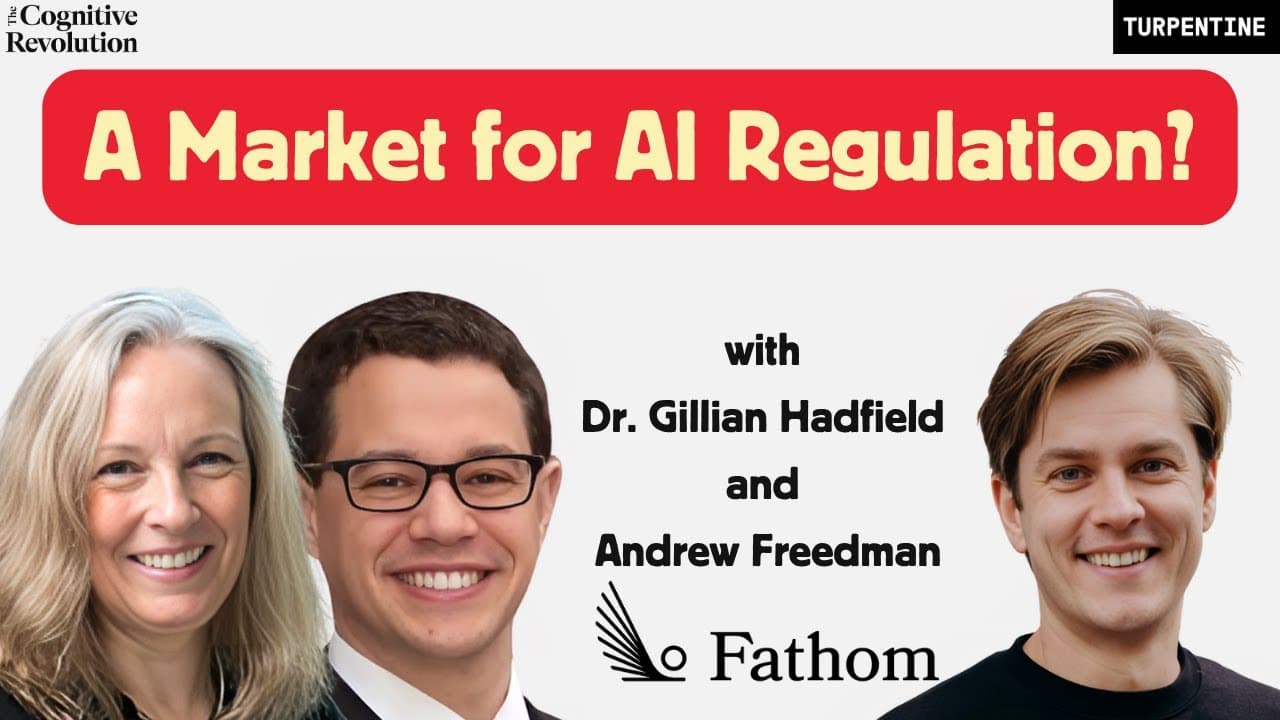
Hello and welcome back to the cognitive revolution. Today we're kicking off a short series on creative AI governance proposals and I'm speaking with Dr. Jillian Hadfield, Bloomberg distinguished professor of AI alignment and governance at Johns Hopkins University and Andrew Freriedman, co-founder and chief strategy officer at Fathom about their pro... Read More
Key Insights
- The proposal suggests separating democratic goal-setting from technical rule-making in AI governance to create a more agile system.
- Private certifiers would develop and enforce AI safety standards, offering companies liability protection for compliance.
- The approach aims to foster a 'race to the top' in AI safety standards, encouraging innovation while maintaining safety.
- Challenges include preventing a race to the bottom among certifiers and ensuring effective oversight by government bodies.
- Current AI governance systems are seen as inadequate due to their slow and complex nature, unable to keep pace with technological advancements.
- The proposal emphasizes the need for a robust market of independent regulatory services to ensure effective oversight.
- Financial incentives and market dynamics are crucial to attract investment and talent into the regulatory services sector.
- The system would require strong government oversight to ensure private regulators maintain high standards and avoid capture.
Install to Summarize YouTube Videos and Get Transcripts
Explore YouTube Video Summarizer or Get YouTube Transcript Extractor
Questions & Answers
Q: What is the core idea of the AI governance proposal discussed?
The core idea is to create a market-based AI governance system where democratic goal-setting is separated from technical rule-making. Government bodies would set safety outcomes, while private certifiers develop and enforce detailed standards. Companies that comply with these standards receive liability protection, creating a dynamic and responsive regulatory environment.
Q: How does the proposal aim to prevent a race to the bottom among certifiers?
The proposal emphasizes strong government oversight of private certifiers to ensure they maintain high standards. By creating a competitive market for regulatory services, certifiers are incentivized to develop effective and efficient methods to meet government-set safety outcomes, fostering a 'race to the top' rather than a race to the bottom.
Q: What are the main challenges discussed in implementing the proposal?
Key challenges include preventing a race to the bottom among certifiers, ensuring effective government oversight, and integrating the system with existing liability laws. Additionally, identifying qualified organizations to serve as effective private regulators is crucial to the success of the proposal.
Q: How does the proposal address the inadequacies of current AI governance systems?
The proposal seeks to address the slow and complex nature of current AI governance systems by fostering a market-based approach. By attracting investment and talent into the regulatory services sector, the system aims to create a more agile and responsive regulatory environment that can keep pace with rapid technological advancements.
Q: What role do financial incentives play in the proposed governance model?
Financial incentives are crucial in attracting investment and talent into the regulatory services sector. By creating a competitive market for regulatory services, the system encourages innovation and the development of effective methods to meet government-set safety outcomes, ensuring a dynamic and responsive regulatory environment.
Q: How does the proposal ensure visibility into AI systems for effective regulation?
The proposal aims to increase visibility by leveraging private certifiers who have contractual access to detailed information from AI developers. These certifiers are tasked with ensuring compliance with safety standards, and their findings are reported back to the government, enhancing oversight and transparency.
Q: What is the significance of liability protection in the proposed model?
Liability protection serves as an incentive for companies to comply with the safety standards set by private certifiers. By demonstrating compliance, companies can reduce their legal risks, encouraging broader participation in the regulatory system and promoting higher safety standards across the industry.
Q: How does the proposal accommodate different scales of AI developers, such as startups versus large companies?
The proposal is designed to be flexible, allowing for differentiation in regulatory requirements based on the scale and risk profile of AI developers. This flexibility ensures that both startups and large companies can participate in the system, fostering innovation while maintaining safety standards.
Summary & Key Takeaways
-
Dr. Gillian Hadfield and Andrew Freedman propose a novel AI governance model using private regulatory markets, introduced as California's SB 813. The system separates democratic goal-setting from technical rule-making, with private certifiers developing safety standards. Companies complying with these standards receive liability protection.
-
The conversation explores the potential for this market-based approach to create a 'race to the top' in AI safety standards, ensuring responsiveness to rapid technological changes. Challenges include preventing a race to the bottom among certifiers and ensuring effective oversight by government bodies.
-
The proposal seeks to address the inadequacies of current AI governance systems, which are seen as too slow and complex. By fostering a competitive market for regulatory services, the system aims to attract investment and talent, ensuring effective oversight and maintaining high safety standards.
Read in Other Languages (beta)
Share This Summary 📚
Summarize YouTube Videos and Get Video Transcripts with 1-Click
Try YouTube Summary with ChatGPT & Claude or YouTube Transcript Generator
Explore More Summaries from Cognitive Revolution "How AI Changes Everything" 📚






Summarize YouTube Videos and Get Video Transcripts with 1-Click
Try YouTube Summary with ChatGPT & Claude or YouTube Transcript Generator