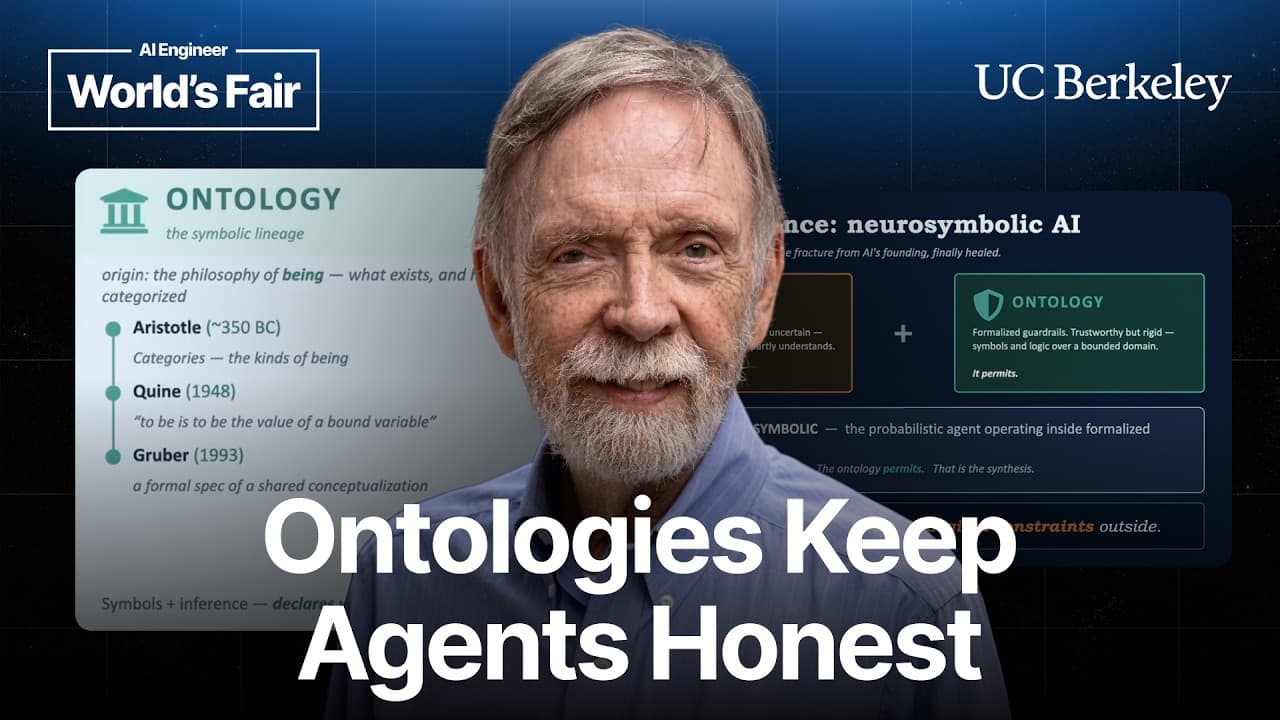
Why Do Agentic Systems Need Ontologies?, Frank Coyle, UC Berkeley
TL;DR
Agentic systems need ontologies to give probabilistic agents a formal model of domain entities, properties, and relationships that can keep their actions within logical guardrails. Frank Coyle explains how ontologies combine with LLMs in neuro-symbolic AI and outlines top-down and bottom-up approaches to building them. Read on to understand why flexible graph structures can support more reliable agent reasoning.
Transcript
[music] >> Um, okay, we're going to launch here. So, my name is Frank Coyle. Um, I'm I'm an educator and teaching at Berkeley now. I've been doing this computer science stuff for oh, 30, 35 years. And um >> [snorts] >> I'm intro and right now it's kind of a critical time for uh poor computer science students. Used to be the used to be the only game... Read More
Key Insights
- Agents are entities that perceive, decide, and act, originating from early AI concepts.
- Ontologies are formal specifications of shared conceptualizations, crucial for knowledge representation.
- Neuro-symbolic AI combines neural networks with symbolic AI to maintain logical constraints.
- Graph databases allow flexible data representation, unlike restrictive relational databases.
- Building ontologies can be approached top-down by experts or bottom-up through user data.
- Existing taxonomies like schema.org and DBpedia can be leveraged to avoid reinventing the wheel.
- RDFS and OWL provide tools for inference and constraints within ontologies.
- Pydantic and ontologies can validate AI actions, ensuring logical consistency and reducing errors.
Install to Summarize YouTube Videos and Get Transcripts
Explore YouTube Video Summarizer or Get YouTube Transcript Extractor
Questions & Answers
Q: Why do agentic systems require ontologies?
Ontologies give agents a formal specification of a shared conceptualization of a domain. By defining entities, properties, and relationships, they provide logical guardrails for probabilistic LLM-based agents and help connect neural networks with symbolic AI.
Q: What is an agent in artificial intelligence?
An agent is something that perceives, decides, and then acts. Frank Coyle traces this concept to the early days of AI and thinkers including John McCarthy, Selfridge, and Marvin Minsky.
Q: What is an ontology in the context of agentic AI?
An ontology is a formal representation of a domain’s entities, their properties, and their relationships to other entities. Coyle cites Gruber’s 1993 description of an ontology as a formal specification of a shared conceptualization.
Q: How does neuro-symbolic AI help keep LLM agents within guardrails?
Neuro-symbolic AI connects neural networks with symbolic AI, including rule-based systems and knowledge graphs. The symbolic representation supplies formal structure that can guide an LLM whose outputs are inherently probabilistic.
Q: Why are graph databases useful for ontologies?
Graph databases allow developers to attach new items, properties, and relationships without redoing the entire data structure. In contrast, adding something to a relational database may require a new column and changes to the existing table structure.
Q: How can an organization build an ontology from the top down?
A top-down approach brings domain experts together to identify and structure the domain’s entities. For example, they might define purchase orders, customers, and customer representatives, then specify their properties and relationships.
Q: What is the bottom-up approach to building an ontology?
Coyle identifies bottom-up development as the alternative to a top-down, expert-led approach. The excerpt establishes that both approaches are available, although it explains the top-down method in greater detail.
Q: Why did earlier expert systems fail to scale?
Expert systems followed a symbolic, top-down approach to AI, and companies spent millions of dollars pursuing them. Coyle says they could not scale, contributing to an AI winter; he also notes that neural networks proposed in the 1960s faced their own scaling limitations.
Summary & Key Takeaways
-
Ontologies help agentic systems by providing a structured framework that defines entities, relationships, and constraints, allowing AI to operate within logical boundaries. This reduces errors and enhances reasoning by integrating symbolic and probabilistic AI.
-
Graph databases and existing taxonomies like schema.org and DBpedia facilitate flexible data representation, essential for building effective ontologies. They allow for easy modification and expansion without the constraints of traditional relational databases.
-
RDFS and OWL are crucial tools for applying inference and constraints in ontologies, ensuring that AI systems maintain logical consistency. Pydantic can be used to validate types, further enhancing the reliability of agentic systems.
Read in Other Languages (beta)
Share This Summary 📚
Summarize YouTube Videos and Get Video Transcripts with 1-Click
Try YouTube Summary with ChatGPT & Claude or YouTube Transcript Generator
Explore More Summaries from AI Engineer 📚





Summarize YouTube Videos and Get Video Transcripts with 1-Click
Try YouTube Summary with ChatGPT & Claude or YouTube Transcript Generator