How to use if else in Python for conditions
TL;DR
The video explains the if else structure in Python, showing how the if block runs when the condition is true and the else block runs when it is false. It also covers shorthand if else for single-statement branches and provides a voting example to illustrate both forms clearly. The result is flexible, readable code that handles two possible outcomes.
Transcript
in this presentation we will understand the concept of if else statement so without any further delay let's get started the first topic of this presentation is Introduction to the if else statement the second topic is the shorthand if else let's get started with the first topic that is Introduction to the if else stat m in the last presentation we ... Read More
Key Insights
- The if statement executes a block when its condition is true, forming the basis of conditional logic in Python.
- The else statement runs when the if condition is false, providing an alternative code path without extra conditions.
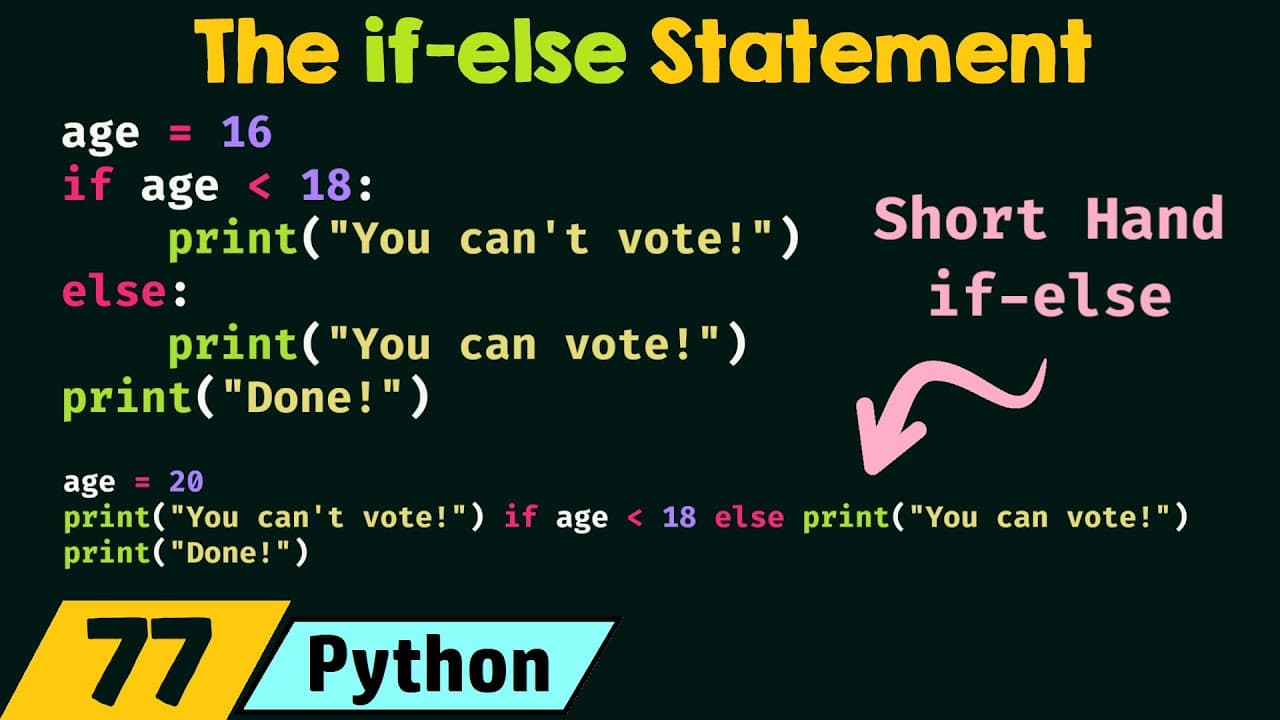
- A simple example uses age and voting eligibility to demonstrate the flow of if and else blocks.
- Shorthand if else is applicable when both the if and else blocks contain exactly one statement each, reducing code length.
- Indentation and syntax order are crucial for correct interpretation of if, else, and the accompanying blocks.
- The example shows that messages can be printed outside the conditional blocks to indicate completion or additional context.
- The else block is not optional; it complements the if by specifying what happens when the condition is not met.
- The same voting logic can be written in both standard and shorthand forms without changing the outcome.
Install to Summarize YouTube Videos and Get Transcripts
Explore YouTube Video Summarizer or Get YouTube Transcript Extractor
Questions & Answers
Q: How does the if else structure decide which block to execute?
The if statement checks the specified condition, and if it evaluates to true, the code inside the if block runs. If the condition is false, the code inside the else block executes instead. This creates two mutually exclusive paths depending on the truth value of the condition.
Q: What is the purpose of the else clause in an if statement?
The else clause provides an alternative block of code to run when the if condition is not satisfied. It ensures that there is a defined outcome for both possible states of the condition, enabling robust control flow in programs.
Q: When is shorthand if else appropriate in Python?
Shorthand if else is appropriate when there is exactly one statement to execute in the if part and exactly one statement in the else part. It reduces multiple lines into a compact single line, improving readability for simple conditional expressions.
Q: Can you give a practical example of using if else for input validation?
A practical example is checking if a user age is less than 18. If true, print a message indicating they cannot vote; otherwise, print a message indicating eligibility. This demonstrates a clear two-path decision based on the input condition.
Q: What happens to statements outside the if and else blocks in the example?
Statements outside the if and else blocks will be executed regardless of the condition, acting as a finalizing or closing message. They are not dependent on whether the condition is true or false.
Q: How does the voting example illustrate the logic of if else?
The voting example uses age to determine eligibility. If age is less than 18, it prints a cannot vote message; otherwise, it prints a can vote message. This clearly shows two distinct outcomes based on one condition.
Q: What role does indentation play in Python if else statements?
Indentation defines the blocks that belong to the if and else statements. Correct indentation ensures the interpreter associates the correct lines with each block, which is essential for the conditional logic to work as intended.
Q: Is it possible to rewrite the full if else logic using only one print statement?
Yes, using the shorthand form, the structure can be condensed into a single line where the print statement for the if block appears before the condition and the print statement for the else block follows after the else keyword, preserving the same behavior.
Summary & Key Takeaways
-
This summary explains the base concept of if-else and its role in executing code blocks based on a condition, along with the standard and shorthand forms. It highlights how the else block complements the if block and clarifies when to use shorthand syntax to reduce lines of code.
-
The video uses a voting example to demonstrate the practical effect of conditions, showing messages printed depending on whether age is under 18 or not and how a final statement prints regardless of the condition.
-
The content also clarifies syntax structure, emphasizes the importance of proper indentation, and reinforces how to decide between a full if-else block and the shorthand version for simple, single-statement cases.
Read in Other Languages (beta)
Share This Summary 📚
Summarize YouTube Videos and Get Video Transcripts with 1-Click
Try YouTube Summary with ChatGPT & Claude or YouTube Transcript Generator
Explore More Summaries from Neso Academy 📚


Summarize YouTube Videos and Get Video Transcripts with 1-Click
Try YouTube Summary with ChatGPT & Claude or YouTube Transcript Generator